Engagement Quality Scoring for LinkedIn Creator Post Comments
LinkedIn's comment quality reveals which creators reach actual buyers, not just engaged scrollers.

B2B marketers have started treating LinkedIn creators the way they once treated paid media, with real budget and real expectations attached. Most of them are still judging those creators by metrics that actively point in the wrong direction. Comment quality, read correctly, is the most reliable signal available for whether a creator's audience is made up of real buyers or just people scrolling past.
LinkedIn Comment Sections as a Pre-Buy Signal in B2B
Creator partnerships on LinkedIn stopped being a side bet a while ago. Marketing teams now put real dollars behind specific creators, expecting those partnerships to influence pipeline, not just rack up impressions. That shift changes what's at stake in picking the wrong one. A bad guess used to cost a few free posts and some awkward outreach to a prospect. Now it costs a line item that a finance team will ask about in the next budget review.
LinkedIn's own ranking system has moved in a direction that happens to line up with what careful marketers should want anyway. The platform no longer just counts whether someone tapped a reaction button. It grades how deeply people engage: how long they sit with a post, how substantial the comments are, whether people save or privately share it. That evaluation runs in stages. A post gets sorted for quality within minutes of going up. Early reactions in the first hour or two tell the algorithm whether to keep pushing it. Then, over the following day or two, the depth of engagement it keeps collecting either widens its reach or shrinks it.
A creator whose posts keep pulling in substantive, professional replies is getting rewarded by LinkedIn itself. That reward compounds, because the platform keeps showing that creator's work to more of exactly the kind of audience a B2B brand is trying to reach.
LinkedIn also hands marketers something no other platform offers: a comment section where the professional identity of every commenter sits right there in plain view. Job title, company, years in the field, all visible with one click. That turns the comment thread into a window onto who's actually listening. A comment from a VP of Engineering at a mid-market SaaS company tells a brand two things at once: that the right kind of person is in the room, and that this specific creator's content is landing with the kind of buyer the brand is trying to reach.
Why raw engagement metrics actively mislead B2B buyer-fit evaluation
Follower count and overall engagement rate feel like an easy, fast way to size up a creator, which is exactly the problem. Both numbers average together audiences that have wildly different value to a B2B brand, so a huge, generic following scores better on paper than a small, tightly focused one made up of actual decision-makers.
The data on B2B creators backs this up directly. Niche and micro experts in B2B average close to 6% engagement, a rate that runs opposite to what follower-count logic would predict, and that's not a fluke. It happens because a small, specific audience chose to follow someone for a narrow reason, so the people left in that audience are far more likely to respond when the content speaks to their actual job.
Engagement pods make the problem worse. A string of "great post" replies and fire emojis from other creators trying to boost their own visibility appears in the data exactly the same way a genuine comment from a real buyer does. No dashboard tells the two apart. A platform-reported engagement number cannot separate a comment from a VP of Finance who's genuinely interested from a comment left by someone gaming the algorithm for their own reach. Spotting the difference takes actually reading the comments, not running a report.
Single posts lie too. One viral hit can make a creator's overall numbers look much stronger than their typical output ever does, and that spike says little about how they usually perform. What a B2B partnership needs isn't the one peak a creator managed to hit once. It needs the baseline level of substantive, professional engagement they produce reliably, post after post. Chasing whatever happened to go viral pulls evaluation toward content built to perform well in the feed for a day, not toward the sustained credibility a brand is actually paying for.
No single number fixes this. Follower count misleads. Aggregate engagement rate misleads. Even a strong individual post misleads, if it's judged in isolation. Getting an honest read requires looking past all three and into the comments themselves.
Comment quality as a signal of a creator's relationship with their audience
A genuinely good comment in a B2B context reads like actual professional conversation. It pushes back on the creator's point, adds a real example from the commenter's own job, or asks a specific, technical question about how something would actually work. And it comes from someone whose profile shows they belong in the buyer's seat a brand is trying to reach, not just anyone with an opinion.
The real question to ask about any comment section is who's actually in it. Are the names behind these comments VPs, directors, founders, senior individual contributors in the exact buyer category the brand cares about? Or are they other creators trading comments back and forth to boost each other's reach? LinkedIn makes this easy to check in a way few platforms do, since every comment comes stamped with the commenter's actual professional identity by default.
How a thread develops matters almost as much as who's in it. A creator whose posts spark back-and-forth between commenters, where buyers respond to each other and not just to the original post, has built something closer to a working professional community than a simple audience. Jess Ramos's community engagement around Microsoft shows what this looks like in practice: real practitioners replying to each other, building on each other's points, treating the comment section as a place to actually talk shop.
A tight, consistent core of a few hundred genuinely relevant followers often does more for a brand than a much bigger audience that only shows up when something goes viral. The consistent core is the buyer pool a brand is actually trying to reach, and it's the one most likely to show up again on the next post, and the one after that.
Saves and shares add a useful secondary check. They tell you someone found a post worth coming back to or worth passing along, but they lag behind the real signal. The comment thread shows quality as it happens. A post that racks up plenty of saves and shares but draws almost no real conversation in the comments is probably useful content, written by someone the audience doesn't yet see as a genuine authority on the topic.
A practical scoring framework for evaluating LinkedIn creator comments before committing budget
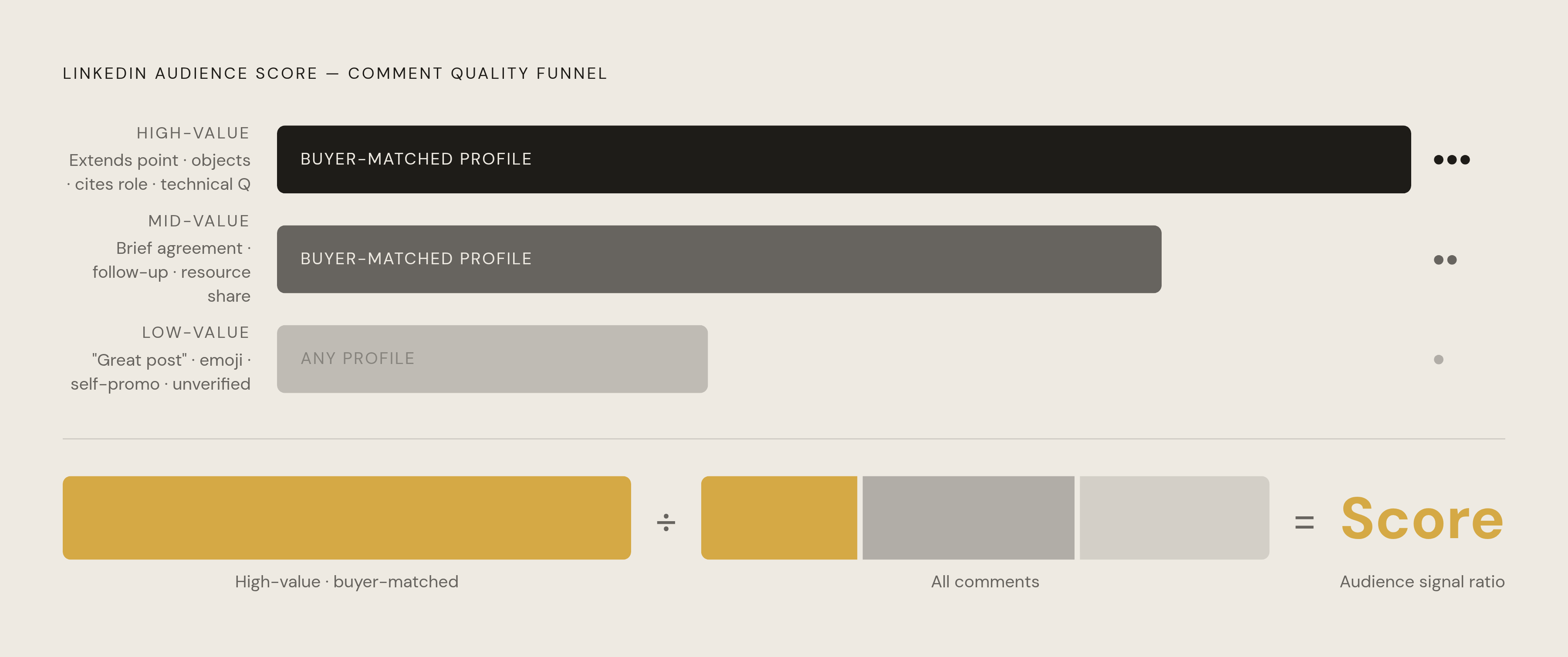
Turning this into something a marketer can actually run takes two layers of review: who is commenting, and what they're saying. Both need to happen before a single dollar goes out the door.
The first layer is a composition check. Pull a sample of recent posts, click into the people commenting, and note their job title, seniority, company type, and company size. A creator whose comment sections regularly include VP-level and director-level people at companies that match the buyer profile has proven real audience fit, and that's the main thing to look for. If the commenters are mostly other creators, career coaches, or job titles that have nothing to do with the target buyer, the fit isn't there, no matter how high the engagement rate reads. Audience composition beats audience size every time: a smaller following packed with the right kind of buyer will outperform a much bigger following made up of the wrong people.
The second layer is a substance check, reading the actual comment threads and sorting what shows up into three rough tiers. A high-value comment extends the creator's point, raises a real objection from someone who's done the work, brings up a specific situation from their own job, or asks a pointed question about how something actually works. A mid-value comment is shorter but still genuine, maybe agreement on a specific point, a relevant follow-up question, or a resource recommendation, coming from someone whose profile checks out as relevant. A low-value comment is the generic stuff: "great post," "so true," emoji with nothing attached, self-promotion with no connection to the topic, or a reply from a profile with no verifiable professional background.
From there, assign rough point values to each tier so different creators can be compared side by side. High-value comments from people who match the buyer profile should carry the most weight, since they're the actual signal the whole evaluation is trying to capture. Mid-value comments from matched profiles carry real but smaller weight, solid evidence without being the strongest kind. Low-value comments, and even high-value comments from people outside the target buyer profile, carry almost no weight, because neither one moves the buyer-fit argument forward. None of this needs to be precise science. The point values exist to make comparison possible, not to produce a number worth defending to three decimal places.
Once the tiers are counted up, the single most useful figure to come out of the whole exercise is the ratio of high-value, buyer-matched comments to total comments. That ratio adjusts for how many posts got reviewed and how big the creator's following is, so a smaller creator with a tight, engaged audience can be compared fairly against a much bigger one.
One condition has to hold before any of this scoring means anything: the creator needs a track record of posting consistently over several months, including through slow news cycles and algorithm changes. A creator who posted hard for six weeks and then went quiet for four months doesn't have a usable sample. Recent activity skews the read in either direction, and there's no way to tell whether the data reflects the real pattern or a short burst that won't repeat.
Comment Quality Score, Rate Negotiation, and Creator Selection
Once a comment quality score exists, it changes how the rate conversation goes. A creator with a strong ratio of high-value, buyer-matched comments can justify a rate that raw follower count alone would never support. The flip side holds just as firmly: a creator charging a premium rate but showing weak comment quality is overpriced, no matter how large the follower number looks on the proposal.
Before any agreement gets signed, ask the creator for their own LinkedIn analytics. The platform shows job titles and seniority levels across a creator's full follower base, which gives a brand a platform-verified check against the manual comment audit done by hand. If the two line up, a brand can move forward with real confidence. If they don't, ask the creator about it directly before committing spend.
A smaller following made up of the right people will often beat a much bigger one made up of the wrong people, and the analytics usually confirm whatever the comment audit already suggested. Engagement rate, impression counts, video watch time, and save counts are worth a look too, but none of them substitute for actually checking who's commenting and what they're saying.
Whether a creator already talks about a brand's category, or a closely related problem, without being paid to, is worth paying attention to. A creator who's mentioned a brand's product or an adjacent problem on their own, before any deal existed, comes across as genuinely credible on that topic. Their comment section will usually reflect it, since their audience already associates them with the subject.
None of this replaces negotiation. It gives the marketer a specific, defensible basis for the conversation they were already going to have about rate, drawn from actual evidence about who's in the room.
Attributing Pipeline Back to a Creator After the Comment-Quality Bar Is Cleared
Clearing the comment quality bar at the selection stage is the start of the job, not the end of it. A creator whose audience is full of real buyers still needs to be tied to pipeline the partnership actually influences, because comment quality is a leading indicator that the audience is right. It's not proof, on its own, that revenue followed.
Standard last-click attribution badly undercounts what a creator is actually worth in B2B. Creator content mostly works at the top of the funnel: someone sees a post, remembers the name months later, and eventually books a demo. A short attribution window built around the last click before conversion will miss that connection almost every time, even when the creator's content was the thing that first put the brand on the buyer's radar.
The more honest approach treats a creator partnership as ongoing credibility infrastructure, not a campaign with a start and end date, and measures it with the tools built for that job: influenced pipeline, lead quality over time, and lift measured across matched markets, rather than counting on any single post to produce a traceable, immediate conversion.