What Follower Count Actually Tells You About a B2B Creator
Follower count masks audience quality, the metric that actually drives B2B sales.

Follower count tells you almost nothing about whether a B2B creator can reach your actual buyers. It's the number marketers reach for because it's visible and easy to compare, but it measures the wrong thing entirely.
B2B creator marketing borrowed its playbook from B2C influencer marketing, where reach really is the currency that matters. If a skincare brand pays a creator with two million followers, the odds that a decent chunk of those two million buy skincare products are pretty solid. That logic isn't wrong for consumer goods. It just doesn't hold up in B2B, where the buying committee for, say, a mid-market ERP tool might be six people at a handful of companies, moving through a decision cycle that stretches for months. The right question was never "how many people saw this." It's "did the right six people see this."
Part of why follower count stuck around so long is that the alternative, actually knowing who's in a creator's audience, used to require data nobody had easy access to, a gap that platforms like Naano, a B2B LinkedIn creator marketplace, were built around closing. That's changed. Tools like LinkedIn's Creator Marketplace, Favikon, and Modash now pull audience composition, job titles, seniority, company size, straight from the platform. The excuse of "follower count is all we've got" doesn't hold anymore. So the question worth asking is: what does follower count actually tell you, and what is it hiding?
What follower count genuinely signals — and what it doesn't
Follower count isn't meaningless. It tells you a creator has built something over time, that LinkedIn's algorithm has rewarded them with enough visibility to keep growing, and that they've stuck around a topic long enough to accumulate an audience instead of burning out after a few posts. It's a rough floor on how many impressions a post might get if it lands well.
But here's what it can't tell you. It doesn't say who's actually following: what job title, what seniority, what industry, what size company. It doesn't say whether those followers are still paying attention or whether they're leftovers from a post that went viral two years ago. It doesn't confirm the creator's current content is even relevant to the audience that built the account in the first place.
There's a structural issue baked into this. As a page grows, more of its followers become passive. People follow after one viral moment, or because their employer nudged them to, not because they track the topic closely. Those followers inflate the number without adding anything useful. Practitioners in this space have called follower count the weakest signal available on LinkedIn, and the reasoning holds up: a creator with a large following in a general business niche carries the same number as a creator whose entire audience sits inside your buying committee. Same metric. Wildly different value.
How engagement rate inverts as follower count grows on LinkedIn
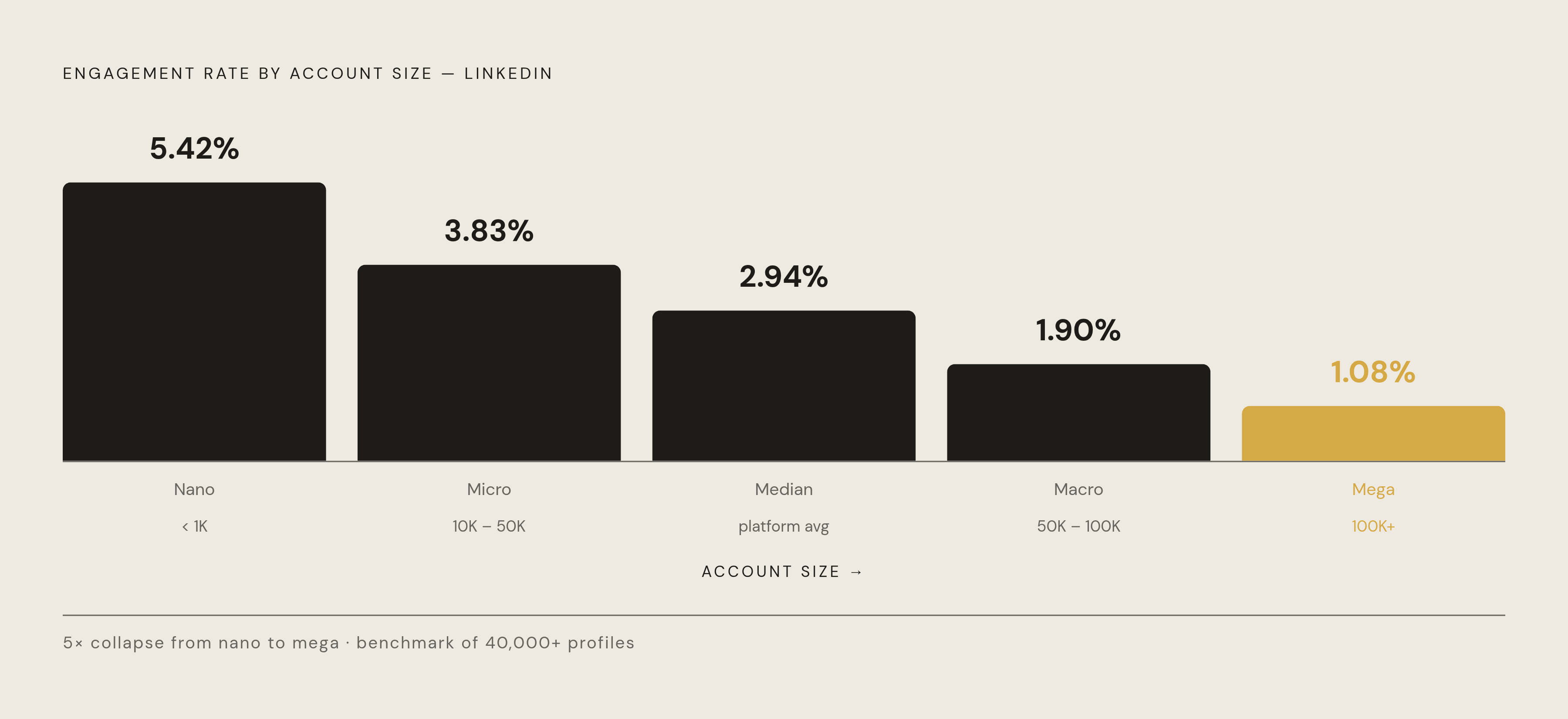
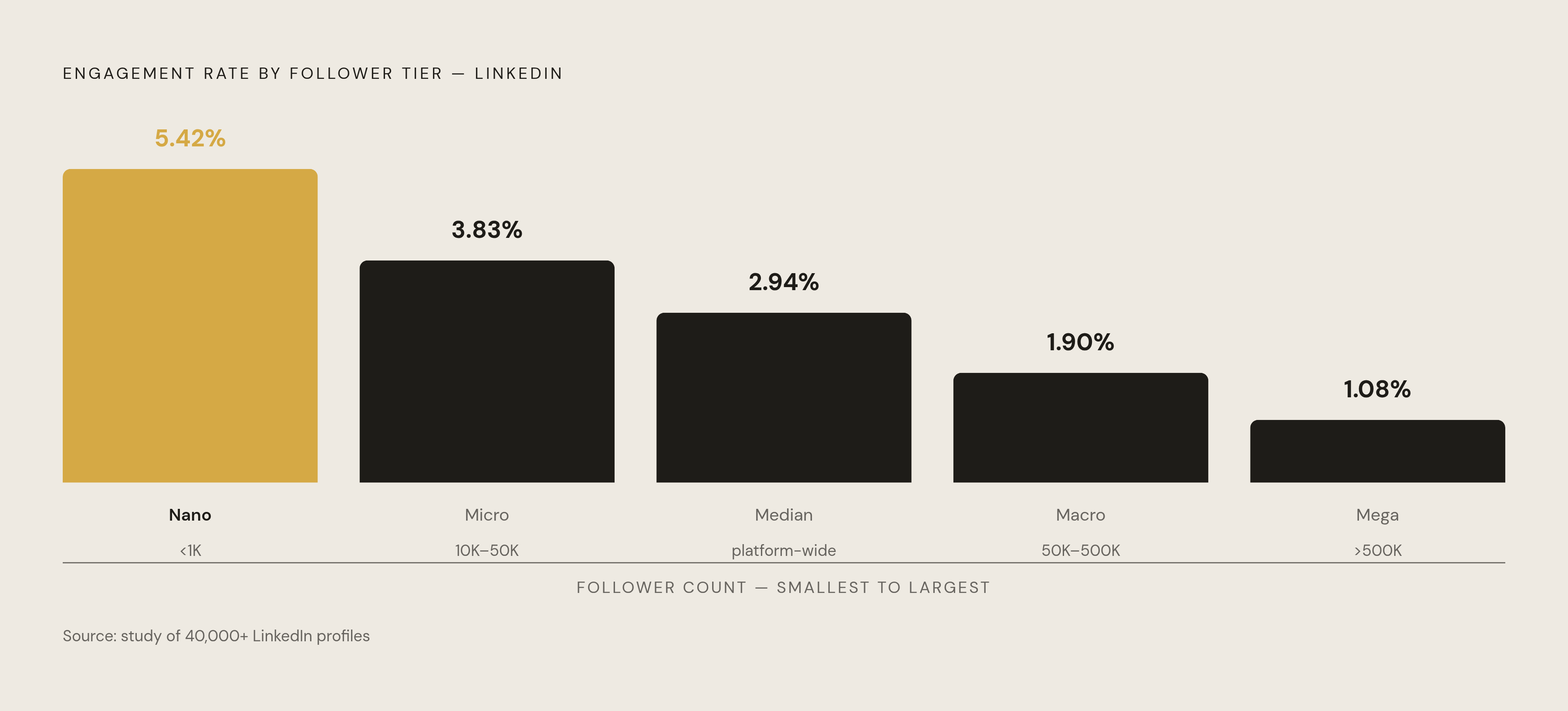
Here's where it gets counterintuitive. On LinkedIn, engagement rate runs backwards from what B2C intuition would predict: the smaller the account, the better it tends to perform.
A benchmark study covering more than 40,000 LinkedIn profiles found nano-level accounts, the smallest tier, average 5.42% engagement. Mega accounts average 1.08%. That gap isn't noise; it's structural. Separate research tracking B2B programs found micro and niche experts averaging around 6% engagement against roughly 1.9% for macro creators. The same 40,000-profile study also found micro-level creators, those in the 10,000 to 50,000 connection range, land at a median engagement rate of 3.83%, well above LinkedIn's platform-wide median of 2.94%.
The mechanism isn't mysterious. Small, expert-run accounts get built one deliberate follow at a time, by people who sought out that specific voice because it said something useful. Large accounts pick up passive followers along the way: algorithm spillover, one viral post that pulled in a crowd that never came back, connections added because someone's employer told them to follow the company's spokesperson. The denominator grows faster than genuine interest does, so the rate falls. It's just math.
For B2B buyers, engagement rate is a much better proxy for "active audience" than follower count ever was. But it's still not the finish line. Even a high engagement rate doesn't confirm the people reacting are the people you're trying to sell to. The real question isn't how many people react anymore; it's which people are reacting.
The pricing trap hidden inside follower-count brackets
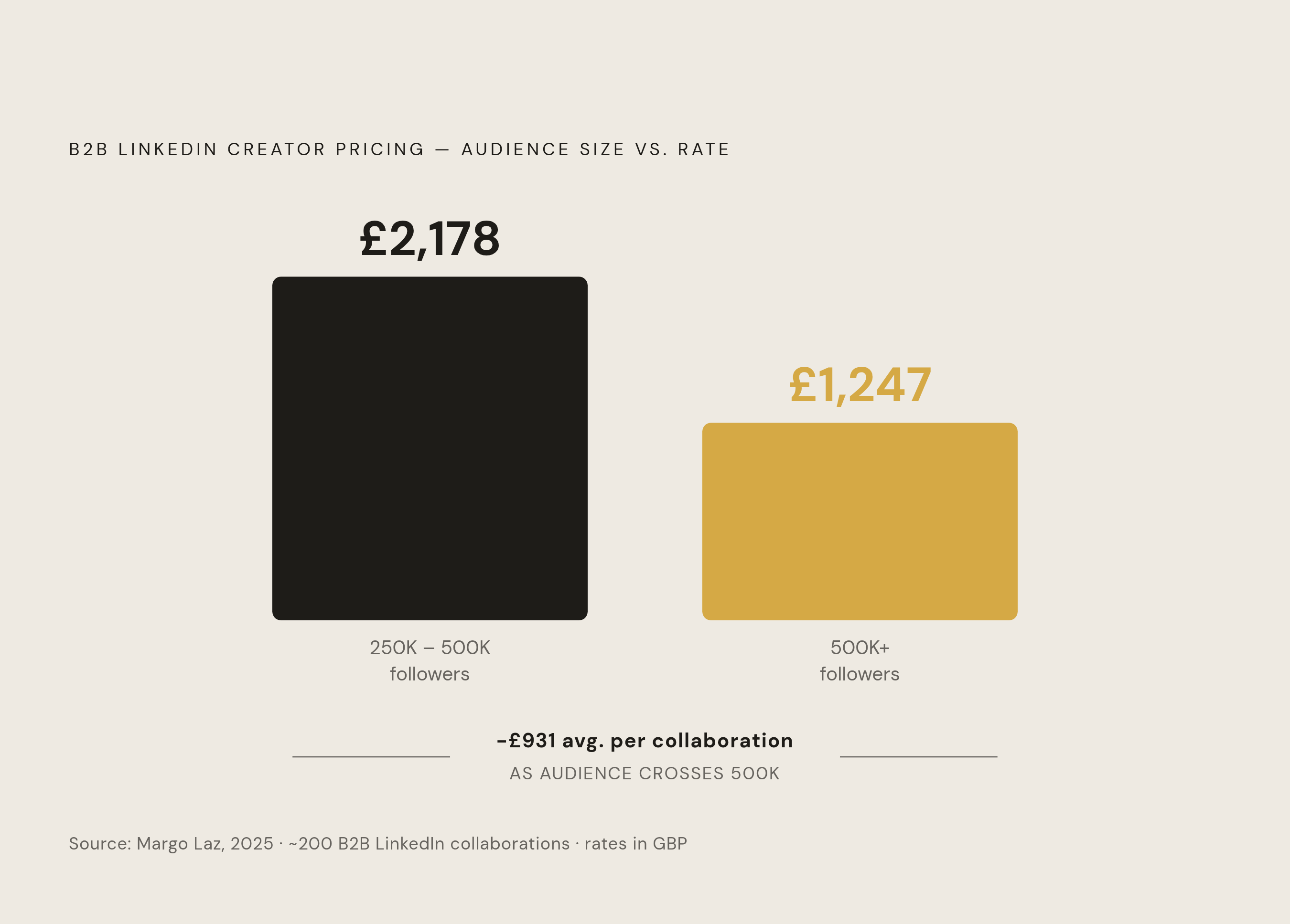
Margo Laz's 2025 analysis of roughly 200 B2B LinkedIn collaborations, published through Kudos Narratives, turned up something odd: the most expensive tier wasn't the biggest one. Creators with 250,000 to 500,000 followers commanded an average of £2,178 per collaboration. Creators above 500,000 followers averaged only £1,247. Rates dropped as the audience got bigger.
That's the market pricing in exactly what the engagement data already showed. Past a certain scale, the audience mix gets too diluted, too generic, to command a premium from buyers who care about precision. Mid-tier creators with strong engagement tend to command meaningful rate premiums relative to their audience size, while category-leading voices with a track record of moving pipeline can command significantly more — but that premium is earned through proven influence, not raw follower count.
This creates a real trap for brands. Spending the whole budget on one or two big-name creators is a common early mistake, and deal-log pricing data consistently shows that three or four micro-tier creators with dense ICP overlap outperform a single macro-tier voice on pipeline-relevant metrics, frequently for less combined cost. LinkedIn's B2B-skewed audience means a misjudged buy here isn't a rounding error. It's an expensive one.
The signals that actually predict whether a creator reaches your buyers
The single most important variable is simple to state and hard to measure without the right tools: what percentage of a creator's audience holds titles and works at companies that match your ideal customer profile.
Picture two creators. One has a small but focused following, and the majority of them hold VP or C-suite titles at mid-market SaaS companies. The other has a following ten times larger, mostly junior or impossible to verify. The first creator is categorically more valuable to a B2B brand, and it isn't close. Ten times the followers means nothing if none of them sit anywhere near your buying committee.
A few signals matter more than the rest, roughly in this order. Audience role composition comes first: what share of followers are director-level and above, and do their functions match who actually sits in your buying process. Industry and company-size distribution comes next. Engagement rate matters too, but read it against the account's size tier rather than in isolation. Content topic consistency deserves scrutiny: has the creator stayed in the lane that built their audience, or have they drifted into unrelated territory chasing broader reach. And the creator's own professional background counts for something real; credibility with practitioners usually comes from having actually done the job, not just talked about it.
LinkedIn's own Creator Analytics, along with third-party tools like Favikon and Modash, surface most of this. None of it shows up in a follower count.
The trust math backs this up. Expert endorsements are 1.7 times more likely than a company's own written content to tip a buyer toward one vendor over a competitor. Being named the top solution by analysts or industry experts was ranked the single most influential trust signal by 37.9% of B2B buyers, ahead of both video and written customer testimonials. And as of 2025, B2B buyers are 70% more likely to trust a peer recommendation than a message coming straight from a brand. None of that trust premium comes from audience size. It comes from the creator's standing inside the specific community your buyer actually belongs to. Which is also why over-scripting a creator kills the whole advantage: the second their own voice gets replaced with brand-approved language, the trust that made them worth hiring in the first place disappears.
Why the hidden buyer problem makes audience fit more urgent than reach
The 2025 Edelman-LinkedIn B2B Thought Leadership Impact Report found that 71% of hidden buyers have little or no interaction with sales, while 95% said strong thought leadership makes them more receptive to sales and marketing outreach later on.
Hidden buyers are the ones researching, shortlisting, and quietly steering the final decision without ever filling out a form or booking a demo. Outbound sequences can't touch them. Retargeting can't touch them. But they're following creators, reading posts, forming opinions inside their own professional feed, long before anyone on a sales team knows they exist.
A high-follower creator with a scattered, generic audience will probably reach a few of these hidden buyers by sheer volume. But the signal gets buried in noise, attribution becomes impossible, and efficiency tanks. A creator whose audience is dense with the exact titles sitting on your buying committee reaches those same hidden buyers with precision, at the exact moment they're consuming content they trust. The 2025 Edelman x LinkedIn Thought Leadership Impact Report found 55% of decision-makers use thought leadership as part of their vetting process, meaning they're forming impressions before a CRM ever logs their name.
That's the argument for fit over reach at its most direct. If a buyer is invisible through every conventional channel, the only way to reach them is to already be inside the content they trust, and that means picking creators for audience overlap, not audience scale. LinkedIn's 2026 research puts a number on the payoff: 82% of B2B marketers say creators increase credibility with decision-makers. Credibility doesn't scale with follower count. It scales with fit.
How to use LinkedIn's creator tools to evaluate fit before you commit budget
LinkedIn's Creator Marketplace is the sensible starting point. It's a searchable database of vetted creators, filterable by industry, job title, and the seniority of a creator's followers, built around relevance rather than raw reach.
BrandLink adds a paid layer on top: brands can co-sponsor a creator's content and target it by job title, seniority, company size, or specific account lists. That last part matters operationally. It means creative brief development and ABM targeting need to happen at the same time, not one after the other as an afterthought.
A workable evaluation sequence looks something like this. Filter by industry and audience seniority first, and treat follower count as a tiebreaker at best, not a primary filter. Pull audience composition data from Creator Analytics or a third-party tool like Favikon or Modash before any rate negotiation starts. Cross-check the creator's recent posts against what your ICP is actually talking about right now, since relevance fades fast if a creator has drifted topics. And ask for engagement numbers on posts specifically in your subject area, not the account's blended average.
Format matters too. Document and carousel posts have outperformed video for lead capture in early B2B data: multi-image carousels are running around 6.60% average engagement and documents around 5.85% on LinkedIn in 2025. A creator's format mix belongs in the fit evaluation, not just their subject matter. Newsletter sponsorships deserve a mention on their own; LinkedIn newsletters see open rates of 30% to 50%, compared to 20% to 25% for typical email platforms. Narrower audience, but far higher engagement per reader, which makes newsletters the right call when depth matters more than breadth.
None of this is as fast as glancing at a follower count. But the tools to do it properly now exist at scale. The bottleneck isn't data anymore. It's whether marketers bother to build the workflow around it.
What ROI data from mature B2B creator programs reveals about fit vs. reach
Mature, always-on B2B creator programs have returned 420% ROI at the 12-month mark. When the creator genuinely fits the ideal customer profile, that number climbs as high as 20 to 1, and the gap between those two outcomes comes down to fit, not follower count or volume of content.
That spread matters. Programs that optimize for fit at the creator-selection stage land at the high end. Programs that optimize for reach land closer to the average. Per the LinkedIn-Ipsos 2025 B2B Marketing Benchmark, brands running influencer programs on LinkedIn beat non-users by up to 39% on customer engagement and brand awareness, and by 30% on revenue growth and lead generation.
Timing matters as much as targeting. Awareness and engagement metrics tend to spike within the first 30 days. Pipeline-positive ROI usually needs a six-month runway, because B2B leads move slowly no matter which channel is pushing them along. That's exactly why always-on programs beat one-off campaigns: trust compounds, it doesn't spike and fade.
That measurement discipline — tracking ROI through MQLs, SQLs, and share of voice — is what lets a program actually learn and improve instead of guessing. The market's already voting with its budget on this: sophisticated buyers are moving toward smaller, sharper audiences, not bigger ones.
Follower count is a record of how many people once found a creator interesting. ICP-matched audience composition tells you whether the buyers you actually care about will find that creator credible today, and whether that credibility turns into pipeline. Those are two very different numbers, and only one of them predicts the outcome that matters.