Why B2B Brands Get Better ROI From Micro Influencers on LinkedIn
Audience fit, not follower count, determines which creators drive real B2B pipeline.
LinkedIn is widely recognized as the dominant platform for B2B social leads, and posts from individual creators consistently outperform company page posts on engagement. Most marketers credit personality and luck for that gap, but the numbers point somewhere else. The real driver is audience fit: how densely a creator's following matches the exact buyer a brand needs to reach. A tightly matched audience of a few thousand beats a loosely matched audience of hundreds of thousands, and most marketers still buy the opposite way, chasing follower count because it's the number sitting right there on the profile. That's the wrong number to chase, and the data below explains why.
What the engagement rate data actually shows, and what it leaves unexplained
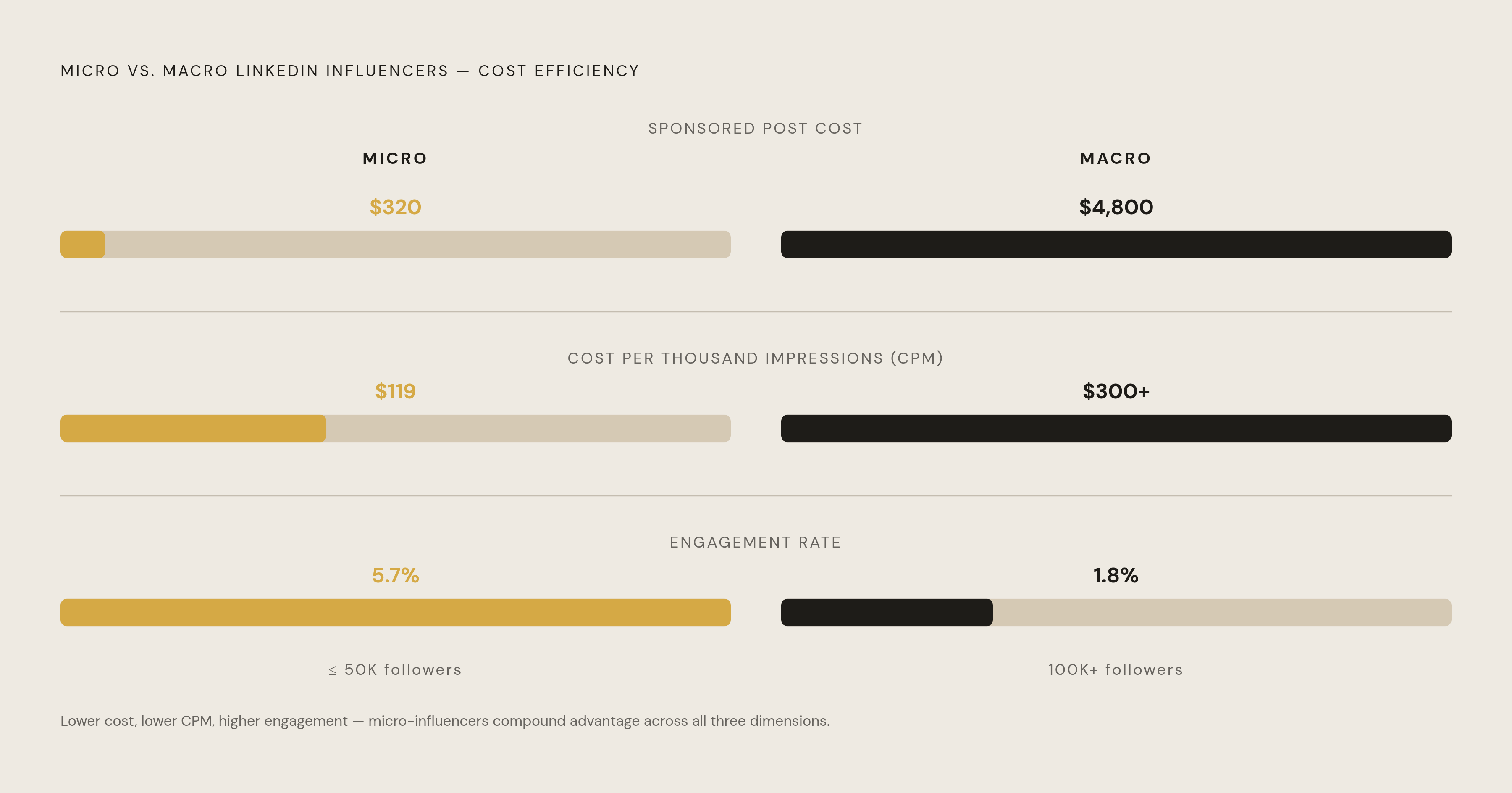
Start with the number everyone quotes. Micro-influencers, the 10,000 to 50,000 follower range, average 5.7% engagement on LinkedIn. Macro-influencers north of 500,000 followers average 1.8%. LinkedIn's own platform data lines up with that: pages with 1,000 to 5,000 followers land in the 4% to 8% range, while pages over 50,000 settle around 1% to 3%.
The usual explanation says small audiences feel more personal. That doesn't explain why a VP of Engineering clicks through and fills out a demo form. Warmth alone doesn't drive a purchase decision, and treating it like one is where most creator budgets go to die.
Here's what the engagement number can't tell you: who's actually doing the engaging. A like from a peer creator, a fan, or someone with zero purchase authority counts the same in the math as a like from your real buyer. A 5.7% engagement rate from 5,000 people who are largely your ideal customer profile is a completely different number from 5.7% out of a much larger audience where your ICP makes up only a small fraction of the crowd. One of those audiences is full of buyers. The other is mostly noise wearing a good percentage.
Engagement rate is a symptom, with audience fit as the mechanism underneath it, and that mechanism builds up early in a creator's growth before falling apart the bigger the account gets.
How audience fit concentrates in smaller LinkedIn followings, and dilutes as creators scale
Most LinkedIn creators build their first audience inside one specific world: a SaaS sales niche, a founder community, one industry vertical. That early wave stays tight and coherent, because word travels inside a professional circle before it ever leaks outside one.
Growth past that point works against the creator, not for them. To keep climbing, they pull in people outside that original core: adjacent industries, adjacent job functions, curious scrollers the algorithm hands them, people who followed because one post got shared into their feed once. None of that hurts the creator's own numbers. It hurts anyone trying to reach a specific buyer through that account, because the share of followers matching any single ICP shrinks even as the total count climbs. This is the part most media kits bury.
A workable target for audience fit: strong pages keep 70% to 85% of followers matched to a target demographic. For a B2B software company, the right creator partner has a clear majority of followers sitting in relevant roles like tech, finance, or consulting. That's a number tied to a specific buyer, worth more than a mixed bag that looks big on a media kit.
Run the math on reach instead of staring at follower count. A creator with 5,000 followers at 80% ICP density delivers thousands of addressable buyers. A creator with 500,000 followers at 3% ICP density delivers somewhat more, technically, but at a fraction of the engagement rate and a much higher price per relevant impression. The assumption that bigger reaches more falls apart the second you run the arithmetic. Fit should decide the pick over scale.
The cost structure that turns audience fit into ROI
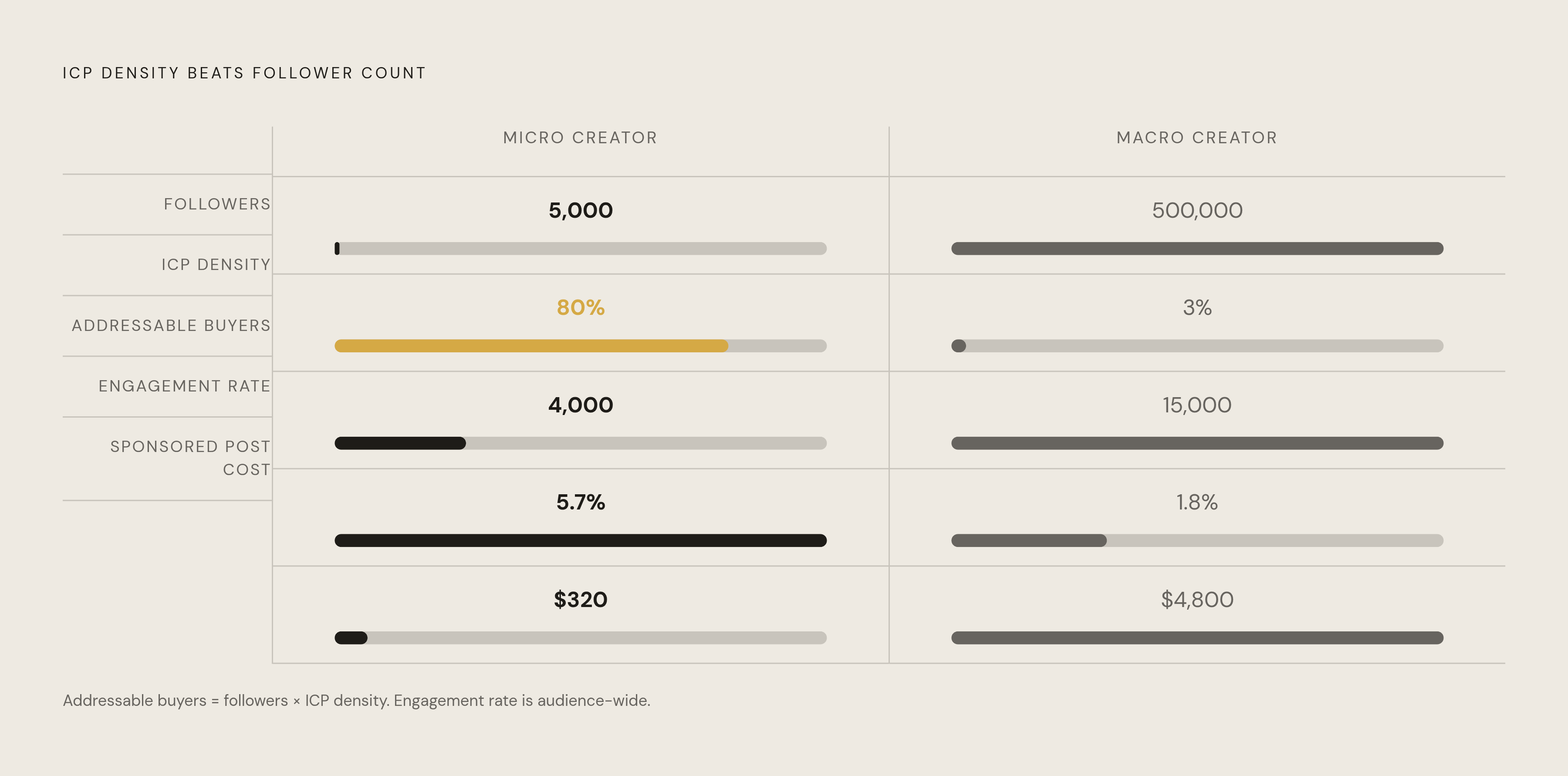
Cost is where audience fit stops being a nice idea and turns into a line item that either works or doesn't. Sponsored posts from micro-influencers average $320. Macro-influencer posts average $4,800. That gap makes the engagement advantage multiply rather than add: a higher engagement rate at a fraction of the spend, well beyond a slightly better rate at a slightly lower price.
CPM tells the same story from another angle. Micro-influencer CPM runs around $119; macro CPM runs $300 or more. Brands have caught on: 61% report higher ROI from micro-influencers than macro, and 73% now favor micro and mid-tier creators specifically because the engagement-to-cost ratio holds up.
B2B conversion backs this up too. Email sign-up campaigns run through B2B influencers convert at 4.1%, against 2.3% in B2C. That gap says something real: B2B audiences act on what they read, going well beyond a tap on the like button, which is the whole point of running these campaigns in the first place.
A portfolio beats a single big name, and it isn't close. Three or four micro creators, each with high ICP density in their own lane, beat a single macro creator on pipeline-relevant metrics, and cost less combined than the one splashy signature. Spreading budget across concentrated niches costs less per relevant buyer reached, and that's the only number pipeline actually cares about.
Why trust travels differently on LinkedIn than reach does
Trust is the thing that turns any of this into revenue. B2B buyers routinely factor credibility and visibility into their decisions, and a brand's presence through trusted voices shapes how seriously it gets considered. Credibility functions as a purchasing input here, plain and simple.
Sponsored influencer content consistently beats brand content on conversions, a pattern that holds across B2B creator programs. Same message, different messenger, different outcome. That gap is most of the argument for creator partnerships over corporate posting.
The mechanism is simple. A micro creator working a specific niche has spent real time building a reputation among the exact peers reading their posts. When they post, the trust moving through that post travels peer to peer: someone the audience already listens to, talking in their own voice.
That relationship snaps at macro scale. Once a creator's audience gets big and mixed enough, the creator stops being a peer and turns into a media property. The post might read the same on the page, but it lands like an ad, because at that scale, functionally, it is one.
Comment sections give this away fast. The strongest B2B creators aren't the ones posting the most. They're the ones whose first 30 comments show real depth: specific questions, pushback, insight from someone who's actually done the work. That's a signal no engagement-rate dashboard picks up, and it's worth more than the like count sitting above it.
Audience relevance is widely recognized as the top creator selection criterion, ahead of factors like trustworthiness and subject matter expertise. Follower count doesn't crack the list. Trust is what converts, and fit is what makes trust scalable in the first place.
How Thought Leader Ads extend micro creator reach without sacrificing audience fit
The obvious objection: a creator with 5,000 followers reaches 5,000 people. How does that turn into real pipeline volume without giving up the fit that made it work in the first place?
LinkedIn's answer is Thought Leader Ads. A brand sponsors a creator's original organic post, the voice and credibility stay exactly as posted, and the post gets targeted to a precise B2B audience well past the creator's own follower list. The content stays fixed. Only the audience changes.
The numbers back the format up. Campaigns running Thought Leader Ads have consistently shown stronger click-through rates, lower cost per click, higher form completion rates, and lower cost per lead compared to standard single-image ads.
Sequencing is what makes this work. Test organically first, and only pay to amplify a post once it's already earned strong engagement and real comment depth on its own. Budget should follow proof, not a hunch, and any team skipping that step is paying to amplify a guess.
That's the compounding part: a post that already performed well with a dense ICP audience organically becomes a verified creative asset the moment it's amplified. The algorithm and the audience already confirmed it works before a single paid dollar goes out. That beats spray-and-pray influencer spending everywhere else.
How to evaluate audience fit before committing budget to a creator
Before signing off on a creator, ask for the audience breakdown: job title, seniority, industry, company size. Look for 70% to 85% overlap with the target ICP. Below that, the audience is probably too diluted to justify the spend, no matter how good the engagement rate looks on paper.
Comment quality beats like count every time. Pull the last 10 to 15 posts and look at who shows up in the comments. Practitioners in the target function asking sharp questions or pushing back with counterarguments signal real buyer attention. Other creators trading compliments signal a closed loop that never touches your pipeline.
Use engagement rate as a filter, not a scoreboard. It screens out dead or inactive audiences well enough. Ranking two creators against each other is where it falls apart, because two accounts sitting at 4% engagement can carry completely different audiences underneath that number.
Watch pricing too. Past a certain follower threshold, LinkedIn rates stop climbing in a straight line, because the market has already priced in the dilution. A mid-tier creator with the right ICP density beats a bigger name on results while costing less, every time the comparison gets run honestly.
Split the budget across three or four micro creators dominant in different niches rather than betting it all on one big name. That structure covers the buying committee: the economic buyer, the technical evaluator, the internal champion, while keeping fit tight everywhere. Before any check gets cut, one question settles it: what percentage of this audience could actually buy from us? That number, not the follower count on the profile, should decide the spend.
Measuring whether the audience fit thesis held, attribution from post to pipeline
Most B2B teams still measure creator programs on impressions and engagement rate. That only proves content got seen; it says little about whether the right person saw it and did anything after seeing it.
A measurement setup built around audience fit tracks something else entirely: clicks to landing pages with UTM parameters tied to the specific creator and post, lead form completions checked against ICP firmographics, and, where CRM integration allows it, pipeline sourced or influenced by those creator-driven leads.
CPL is the fastest gut check available. If a $320 micro-creator post produces ICP-qualified leads, the CPL math shows it fast. A high CPL, even when the engagement numbers looked strong on the surface, shows just as fast that the audience fit was never real. Numbers don't lie here, even when a vanity metric wants them to.
The competitive floor is rising. More than half of B2B marketers already run influencer or creator marketing on LinkedIn, and a large share of the rest plan to start within the year. Most competitors will have a creator program soon enough; what separates winners will be who's tracking pipeline and who's still stuck admiring impressions.
The upside is real for teams that get the measurement right. Brands running LinkedIn influencer programs outperform those that don't on engagement, brand awareness, revenue growth, and lead generation, by a wide margin. That gap only means something once it's verified after the fact, though. Audience fit is the thesis; attribution from post to pipeline is the proof. Without it, there's no telling whether the mechanism worked, or whether the budget just landed somewhere that felt right.