Which Attribution Model Actually Works for LinkedIn Creator Campaigns
Most attribution models systematically undercount creator influence on B2B pipeline.
No single attribution model can tell you what a LinkedIn creator campaign actually did. The tools aren't at fault so much as mismatched: they were built for a different picture of how B2B buying happens than the one that actually plays out. Get the mismatch right, and you can build a stack that ties creator spend to pipeline. Get it wrong, and you'll spend a budget cycle defending a channel with numbers that were never going to show its work.
How badly standard models miscount creator influence
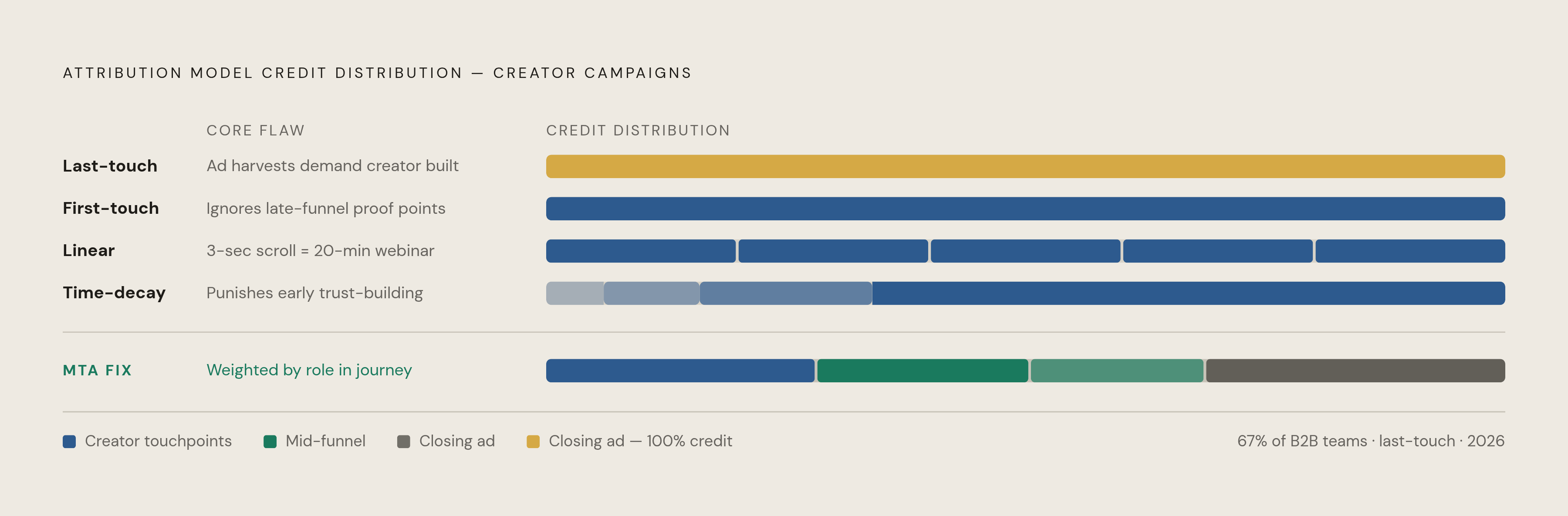
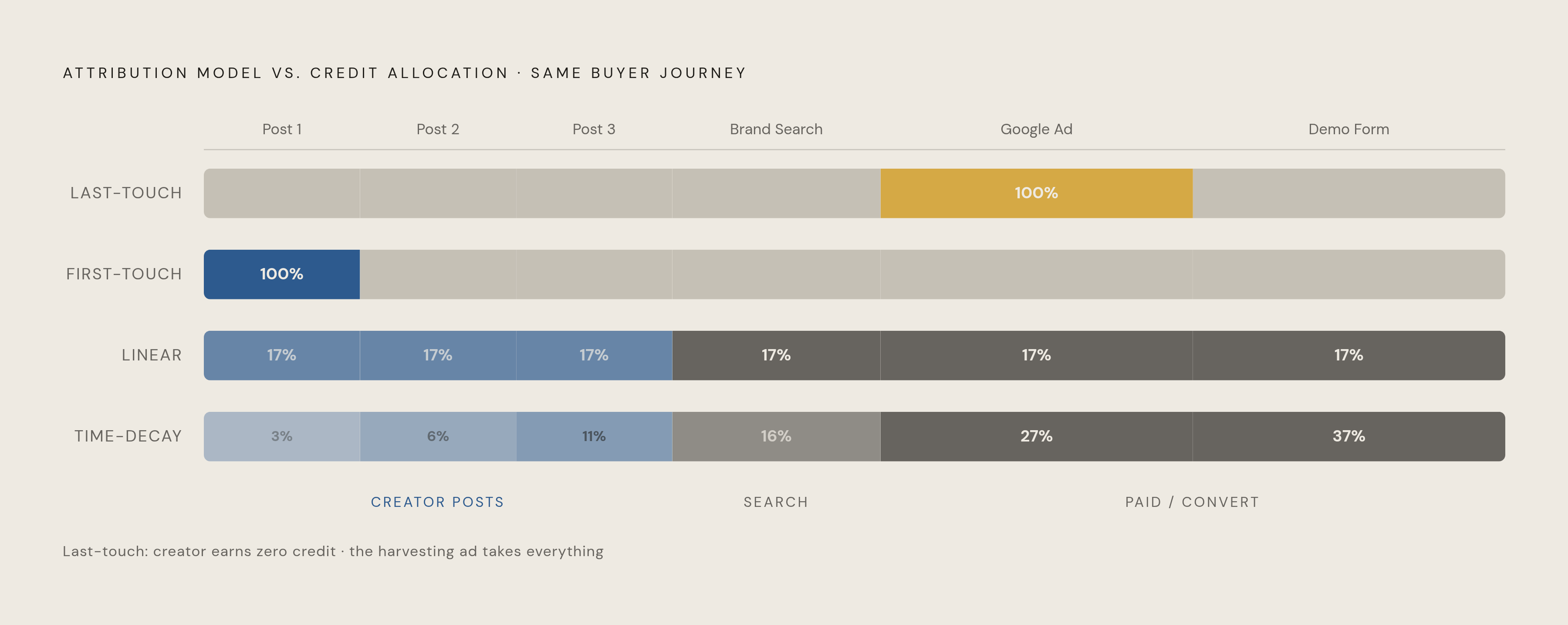
Most attribution setups still run on last-touch. As of 2026, 67% of B2B marketing teams default to it, according to Visionary Marketing's 2026 analysis, even though the average buyer now hits 27 or more touchpoints across a cycle that runs six to twelve months. Last-touch was built for a simpler sequence: one click, one form, one answer. A VP who reads three posts from a creator over two months, quietly forms an opinion, then searches the brand name and clicks a Google ad on the way to filling out a form doesn't fit that sequence at all.
In that sequence, the ad gets full credit. The creator spend that actually built the trust gets zero. So the team scales the ad and cuts the creator budget, not realizing the ad was just harvesting demand the creator had already created.
First-touch flips the error but doesn't fix it. It'll correctly flag that early creator post as the start of the journey, but it overvalues that one moment and ignores every late-funnel proof point that closed the deal. Linear models split the difference by spreading credit evenly across every touch, which sounds fairer until you realize it treats a three-second glance at a sponsored post the same as a 20-minute webinar with that same creator. Time-decay tries to correct for that by weighting recent touches more heavily, but that punishes exactly the kind of early trust-building a creator program is supposed to deliver.
None of this is abstract. Only 21% of B2B marketers say they can measure marketing ROI with confidence, per a 2025 Demand Gen Report survey, and model choice is a big part of why. It gets worse underneath the model layer, too: 64% of B2B organizations don't have a formal UTM policy, according to Gartner's 2025 data. So even before a model starts weighting touchpoints, the click-path data feeding it is already full of holes.
The dark funnel share of creator impact that no click-path model sees
Here's the part that standard tracking simply can't reach. A creator pushes a post, and branded search spikes two days later, but Search Console logs that as organic, not creator-driven. Someone reads a thread mention and goes straight to the demo page as direct traffic. A prospect tells a rep on a discovery call, "I heard about you from [creator name]," and that sentence disappears unless someone happens to type it into a CRM field.
This is the dark funnel, and it's not a rounding error. Self-reported attribution work consistently finds that 30% to 50% of pipeline comes from channels that digital attribution can't see at all, per ORM's 2026 B2B SaaS attribution analysis. For creator-heavy programs specifically, that invisible share is probably higher, since LinkedIn organic content just doesn't throw off UTM-tagged clicks the way paid ads do.
Gartner's research puts a finer point on why: B2B buyers spend only 17% of their buying journey actually meeting with potential suppliers. The other 83% is self-directed, research, reading, peer conversations, and creator content consumed alone, with no salesperson and no tracking pixel in the room.
So picture a buying-group member who follows a creator for six months, never clicks a tagged link, then books a demo. Every click-path model hands that conversion to whatever last-touch exists, usually direct traffic or branded search. The creator's actual role, the thing that made the demo happen, just vanishes from the data. Better tracking alone can't close that gap. Doing so means adding a layer that isn't click-based at all.
Multi-touch attribution as the non-negotiable foundation
Multi-touch attribution (MTA) spreads credit across the touchpoints in a journey instead of handing it all to one. In a creator campaign, that might mean a creator post gets credit as first touch, a Thought Leader Ad gets credit mid-funnel, a webinar registration gets credit further along, and the demo request closes it out, each one earning a fractional share. That's a far more honest picture of how a buying committee actually moves than any single-touch model offers.
This matters most as a defense of creator budget specifically. First-touch and last-touch models both systematically undercount creator investment, since creator content tends to live in the middle of the journey, doing the quiet work of warming someone up before they convert somewhere else entirely. MTA is the first model that even has a slot for that role.
But MTA is only as good as the tagging underneath it. Every creator-linked URL needs UTM parameters so the touchpoint can flow into the CRM as a real record, not a guess. And here's where most teams get tripped up: UTM data captured on a form often shows up once, on the contact record, and then never updates again as the deal moves forward. The opportunity record downstream often shows nothing at all. Combine that with the 64% of B2B orgs running without a formal UTM policy, and you've got MTA models running on data that's already missing pieces before the model does anything.
The fix isn't glamorous. Build the UTM taxonomy and the CRM field mapping before a single creator brief goes out the door. Retrofitting it mid-campaign means the historical data is just gone, and you can't get it back. MTA sets the floor rather than the ceiling. It's necessary, but it still won't catch a dollar of dark-funnel influence, which is exactly why the stack needs more layers on top of it.
When algorithmic attribution earns its place — and when it doesn't
Algorithmic, or data-driven, attribution uses machine learning to assign credit based on patterns in actual closed-deal data, rather than a fixed rule like "first touch gets a large share, last touch gets a large share, the middle splits the remainder." It can surface something a rule-based model never would, like a specific creator's post at day 30 of the cycle carrying outsized weight toward conversion, even though it's neither the first nor the last thing the buyer saw.
The catch is volume. These models need a real number of closed deals to learn from before the patterns mean anything. Most small-to-mid-market B2B teams don't hit that threshold quickly, and running an algorithmic model on thin deal volume just produces confident-sounding output built on noise. The chart will look clean. Whether it's true is a separate question.
There's also a practical wrinkle worth knowing about going in: tools like Marketo Measure 2.0 integrate with Salesforce for ML-based multi-touch attribution, but expect something like a 15% to 25% discrepancy between what the two systems report, purely from differences in how they match records. That gap needs to be flagged to leadership ahead of time, or it turns into a credibility problem the first time someone compares two dashboards side by side.
For most creator programs in their first year, rule-based MTA, W-shaped or full-path, is the more trustworthy choice. Algorithmic models earn their keep later, as a validation layer once deal volume and CRM hygiene can support them. And even then, remember what they can't do: an algorithmic model optimizes the touchpoints that generate trackable events. Creator influence mostly doesn't.
Self-reported attribution as the direct line to dark-funnel influence
If click-path data can't see the dark funnel, ask people directly. Hybrid attribution pairs the software models above with self-reported attribution, meaning a required field on a demo request form, a sign-up flow, or a post-conversion survey that simply asks how someone heard about you. It's about as low-tech as marketing measurement gets, and for creator programs, it's one of the highest-signal tools available.
The reason it works so well here is almost obvious once you say it out loud: a buyer who followed a creator for months before converting remembers that creator's name. They don't remember which banner ad they scrolled past in March. When a creator genuinely fits your audience, that name shows up in the responses at a rate no click-path model could ever produce.
A few operational details make or break this. The field has to be required, not optional; optional fields collect responses from a small, self-selecting slice of people and tell you almost nothing. Route every creator mention into a CRM field that can actually be queried by name later. Train SDRs to ask the same question on every discovery call and log the answer, since verbal mentions catch influence that even a form field misses. And treat a creator mention as a pipeline influence signal, not a conversion event; the goal is visibility into what's shaping deals, not a hard attribution claim you'd defend in an audit.
Self-reported data has its own blind spot, worth naming plainly: people tend to credit the most memorable touchpoint, not necessarily the most influential one. That's exactly why it sits alongside MTA instead of replacing it.
Branded search and traffic lift as an indirect signal for creator impact
Some signals won't prove causation, but they'll build a pattern solid enough to act on. Watch what happens in the 48 to 72 hours after a creator publishes a sponsored post: branded search volume in Search Console, direct traffic to demo or pricing pages, new follower activity on the brand's own LinkedIn page. None of these confirm the creator caused the lift. But when the same pattern shows up campaign after campaign, the correlation becomes hard to argue with. Measure a 30-day baseline before each activation and compare it to the post-publish window; the delta is the number worth tracking.
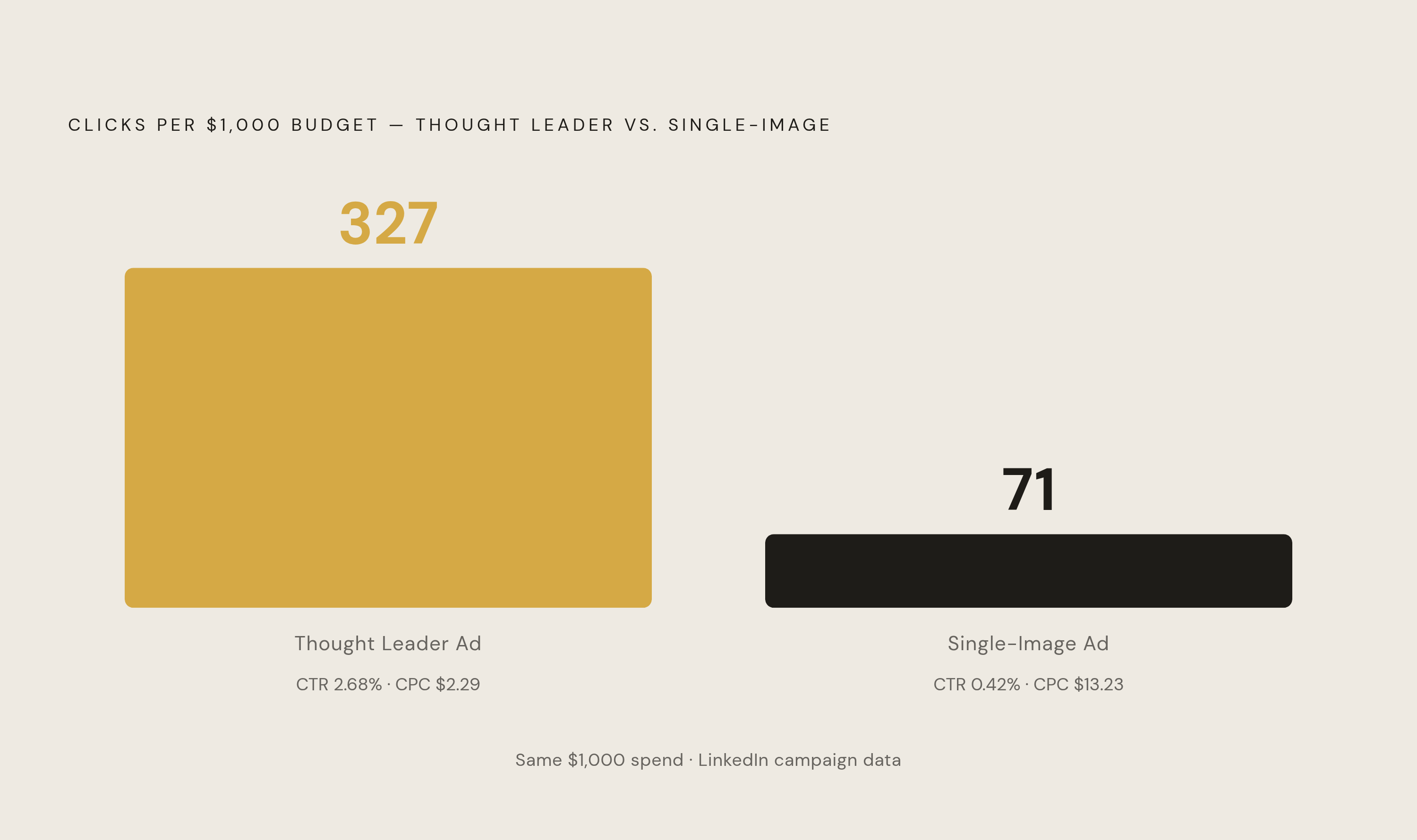
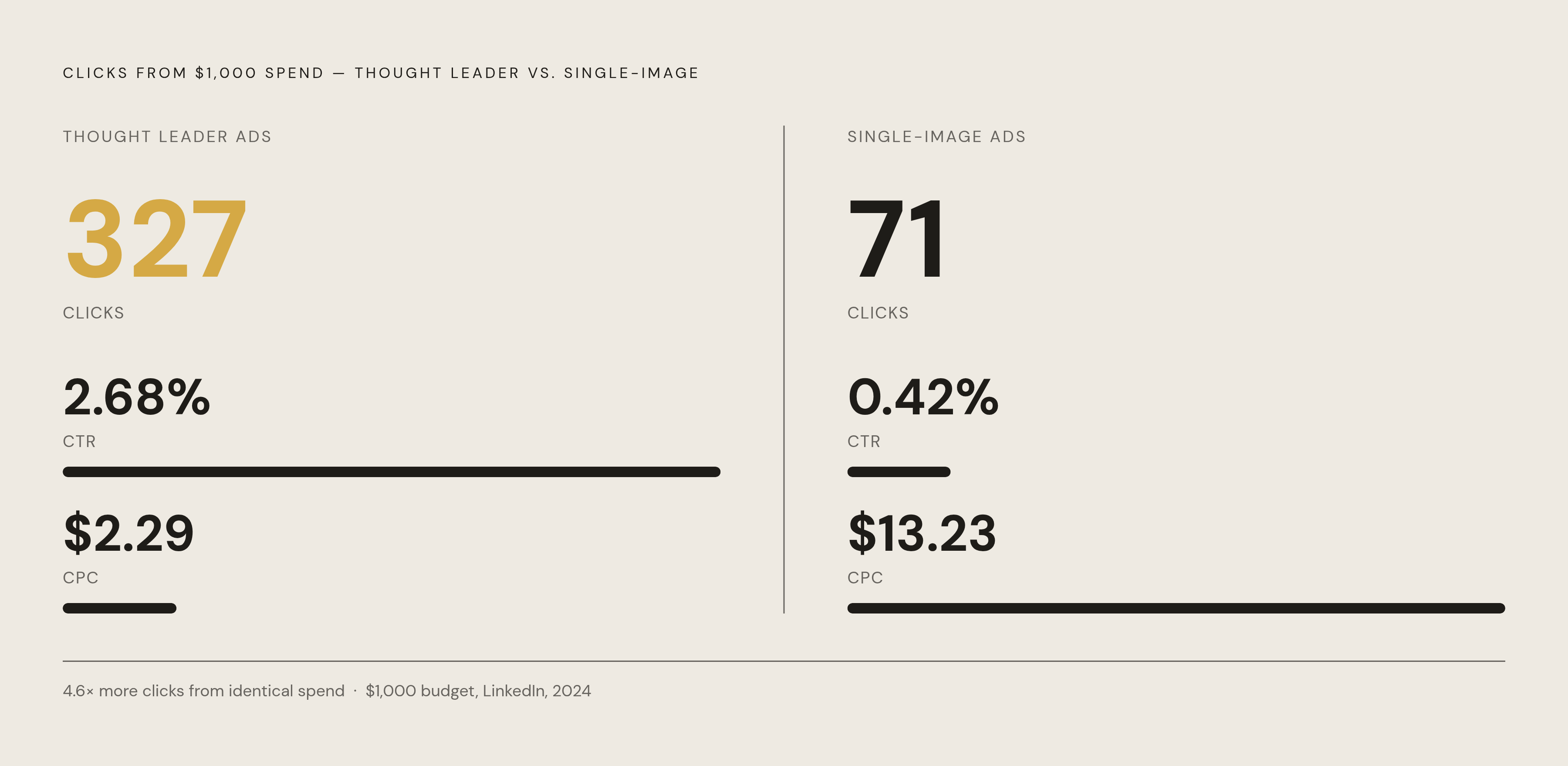
Thought Leader Ads add a layer that's actually trackable in the normal sense. TLAs run from a named person's own profile and read like organic content, and the performance gap versus standard formats is not subtle: a median 2.68% click-through rate and $2.29 cost-per-click, against 0.42% CTR and $13.23 CPC for single-image ads. Put $1,000 into TLAs and you're looking at roughly 327 clicks, versus roughly 71 clicks from the same budget on single-image ads. TLAs generate real UTM data, which makes them the one place where creator-style content and click-path attribution actually meet.
That overlap is useful for more than just performance reporting. If a creator's organic post triggers a branded search spike but barely any tagged clicks, and the TLA version of similar content then converts at a high rate, that's a strong clue the organic post built the intent that the paid version simply cashed in. It's the closest thing to a paper trail that dark-funnel influence leaves behind.
Engagement quality as a leading indicator before pipeline data exists
Raw engagement numbers, impressions, likes, total comment count, aren't attribution and shouldn't be treated as such. But engagement filtered by who's actually engaging is a different animal, and it's a legitimate early signal. Two hundred comments from founders, marketing heads, and RevOps directors at companies inside your ICP means something completely different from two hundred comments from a general audience of professionals who happened to scroll past. The difference is fit, not volume, which is exactly why picking creators by audience composition matters more than picking them by follower count.
Worth actually tracking here: comment author job titles and company types, cross-referenced manually or through LinkedIn Sales Navigator; saves and reposts from ICP-matching accounts, since a save signals someone intends to come back to it later, not just a passive scroll; and profile visits or connection requests to the brand's own team in the days right after a post goes up.
There's a credibility layer behind all of this worth remembering. LinkedIn's 2026 Global B2B Marketing Outlook, a YouGov study of 1,299 B2B marketers, found 82% agree creators increase credibility with decision-makers. Watching decision-makers actually engage with a specific creator's content is the early, on-the-ground evidence that this credibility transfer is happening in a specific campaign, not just in the abstract.
Used well, engagement quality data drives creator continuation and replacement decisions before pipeline attribution has had time to catch up. Strong ICP engagement in weeks two and three tends to predict pipeline influence by month three, not with certainty, but reliably enough to act on. The mistake worth avoiding is treating engagement quality as the finish line. Treat it instead as the signal you watch while you wait for the pipeline data to tell you whether you were right.