Red Flags in LinkedIn Creator Audience Quality Audits
Most B2B marketers can't verify whether a creator's followers match their actual buying committee.

LinkedIn has more than a billion registered members. Only 37.9% of them log in each month. That gap matters before anyone looks at a single creator's follower count, because the platform's headline numbers and its real numbers have never been the same thing.
Personal profiles on LinkedIn generate substantially more engagement than company pages. That gap is why B2B brands have gone all in on creator partnerships. But that same gap raises the incentive to inflate personal-profile metrics, since a bigger following now turns directly into brand budget. Spend on LinkedIn creator marketing grew 171% year over year, and 61% of B2B marketing leaders say they'll spend even more in 2026. Budgets are moving faster than the vetting built to protect them, and that mismatch is the whole problem this piece is about.
Sam Corrao Clanon, LinkedIn's Director of Product, has said the platform's goal is to surface subject matter experts and practitioners for their expertise. Most brands buy against reach anyway, and that's the wrong call. A creator's follower count is the first number LinkedIn shows you. It's also the number least connected to whether your actual buyers sit anywhere inside that audience.
What audience quality means in a B2B context
Audience quality in B2B comes down to one thing: ICP density. How concentrated is a following with the job titles, seniority levels, company sizes, and verticals that map to your buying committee? A consumer brand on Instagram or TikTok is chasing one person reaching for a wallet. A LinkedIn buyer almost never acts alone, so a creator's audience has to reflect the whole committee.
Kate Fleming, Director of Influencer Strategy at PartnerCentric, frames the real question sharply: not "are these the right consumers," but "are these the right buyers, champions, and internal influencers inside target accounts?" Job title and seniority spread, company size, vertical concentration, and geographic fit with the ICP: that's where the audit starts, and most brands skip straight past it to the follower count.
AJ Eckstein, Founder and CEO of Creator Match, makes the point from a different angle. One VP of Engineering leaving a real comment on a post tells you more than a 6% engagement rate ever will. Comment quality from named professionals in relevant roles predicts B2B outcomes far better than an aggregate engagement number, because engagement rate doesn't care who's doing the engaging.
Influencer Marketing Hub data points to a sweet spot: the most effective B2B creators tend to have between 5,000 and 100,000 followers, with engagement rates above 5%. Small by consumer standards, but those audiences often carry real purchasing authority, and that's the trade worth making. Yet only 35% of B2B marketers say they can reliably match a LinkedIn creator's audience to their actual buying committee. That's most of the market operating on guesswork, and guesswork is expensive at these budgets.
The vetting question isn't complicated, even if the answer takes work to find. Who is the creator, really? Who's actually listening? And does either of those produce a commercial outcome, or just a vanity number on a slide?
Follower growth spikes that have no content event behind them
Pull up the creator's follower growth curve and lay it against their posting history. A sudden jump with no viral post, no press mention, no platform feature behind it is a spike with no explanation. Ask about it directly, before the contract, not after.
LinkedIn has gotten more aggressive than most platforms about pulling down fake accounts. But follow-for-follow behavior inside creator cohorts leaves audiences that look clean on paper holding zero purchase authority all the same. In March 2026, LinkedIn rolled out an update targeting inauthentic activity that removed engagement pods and hid automated comments from the "Most Relevant" tab. That cleaned up a lot of feed noise. It did nothing to undo follower counts already padded by years of reciprocal following.
The practical move: pull the growth chart, available through third-party tools like Shield, and lay it against post dates. Any sustained jump without a traceable cause is a flag, not a verdict. It just means someone needs to ask the creator to walk through their growth history before money changes hands.
LinkedIn View Counts and Their Limited Value for B2B Vetting
LinkedIn has counted "views" on an impression basis, autoplay video included, for a long time now. A view fires the moment a post enters someone's screen. It says nothing about whether that person read a single word of it, and treating it like a quality signal is the mistake most buyers still make.
Tobias Hoss, Senior Advisor at TopFan, put it bluntly: autoplay turns view counts into noise, inflating a number that carries no signal of intent or relevance. LinkedIn's 2026 Feed SR ranking model still trains on dwell time (logged internally as "Long Dwell") alongside likes, comments, and shares, the same signals its prior model used. LinkedIn has never published how those signals get weighted against each other, so when a creator points to a big view count, there's no way to know how much of it was genuine attention and how much was scroll-past.
Ask instead for post-level analytics on saves, shares, and profile visits. Those require someone to take a deliberate action, which makes them far harder to fake than a view. Engagement rate alone doesn't fix this either: a viral post that reaches the wrong audience is worse than no post at all, because it teaches the algorithm to keep feeding that creator's content to people who were never going to buy anything.
Generic comments and engagement pod residue in the comment section
The March 2026 update killed off formal engagement pods and hid automated comments from view. Residue from before that date still sits on older posts, and informal reciprocal-commenting habits between creators haven't gone anywhere.
Run a manual check on the last five posts. Read every comment. How many are substantive responses from professionals in roles that actually matter to your buying process, versus generic noise, "Great post 🔥," "So true!," the kind of comment left by another creator angling for their own visibility rather than engaging with anything said.
Comment quality over comment volume is the real B2B filter, because reach lies and comments don't, as Hoss puts it. Eckstein offers a similarly clean test: strip away the follower count entirely and read only the last ten comments. Would that still be someone worth working with?
Count the comments from named professionals inside your target accounts across those five posts. That number predicts campaign impact better than any engagement percentage on the page. Then cross-reference who comments on the creator's posts against whose posts the creator comments on. A tight, closed loop between the same names is a pod signal even after the pods themselves have been dismantled.
Audience seniority that looks professional but misses the buying committee
A creator can build a completely legitimate, genuinely engaged audience made almost entirely of mid-level individual contributors who hold no budget authority whatsoever. No fake accounts anywhere in sight. Still the wrong fit for an enterprise software campaign, and this is the failure mode that slips past most audits because nothing about it looks fake.
Across LinkedIn overall, senior leadership roles make up a meaningful but contested share of active users, with some estimates placing C-Suite and owner-level professionals at roughly 30%. A creator whose audience skews toward entry-level professionals or students is serving a different crowd than that platform-wide seniority mix suggests, and no amount of raw engagement changes that math.
Ask for the LinkedIn analytics export showing seniority and job function breakdowns of the follower base. Legitimate creators with strong B2B audiences can usually produce this without friction. Reluctance to share it says something on its own. Fleming's checklist applies here too: job title and seniority spread, company size, vertical concentration, geo alignment against the ICP, ideally backed by LinkedIn analytics, a tool like Shield, or a direct audience export.
The mismatch rarely appears in a pitch deck. A creator working the "SaaS" or "marketing" niche might have built a following on beginner-friendly career advice, which pulls in junior professionals rather than the CMOs, procurement leads, or security architects who actually sign off on budget. 87% of B2B buyers consult thought leaders during purchase decisions, and 82% say creator content directly shapes their thinking, according to LinkedIn's own research. That influence only becomes pipeline if the audience includes people with the authority to decide anything.
Oversized followings where audience quality has already diluted
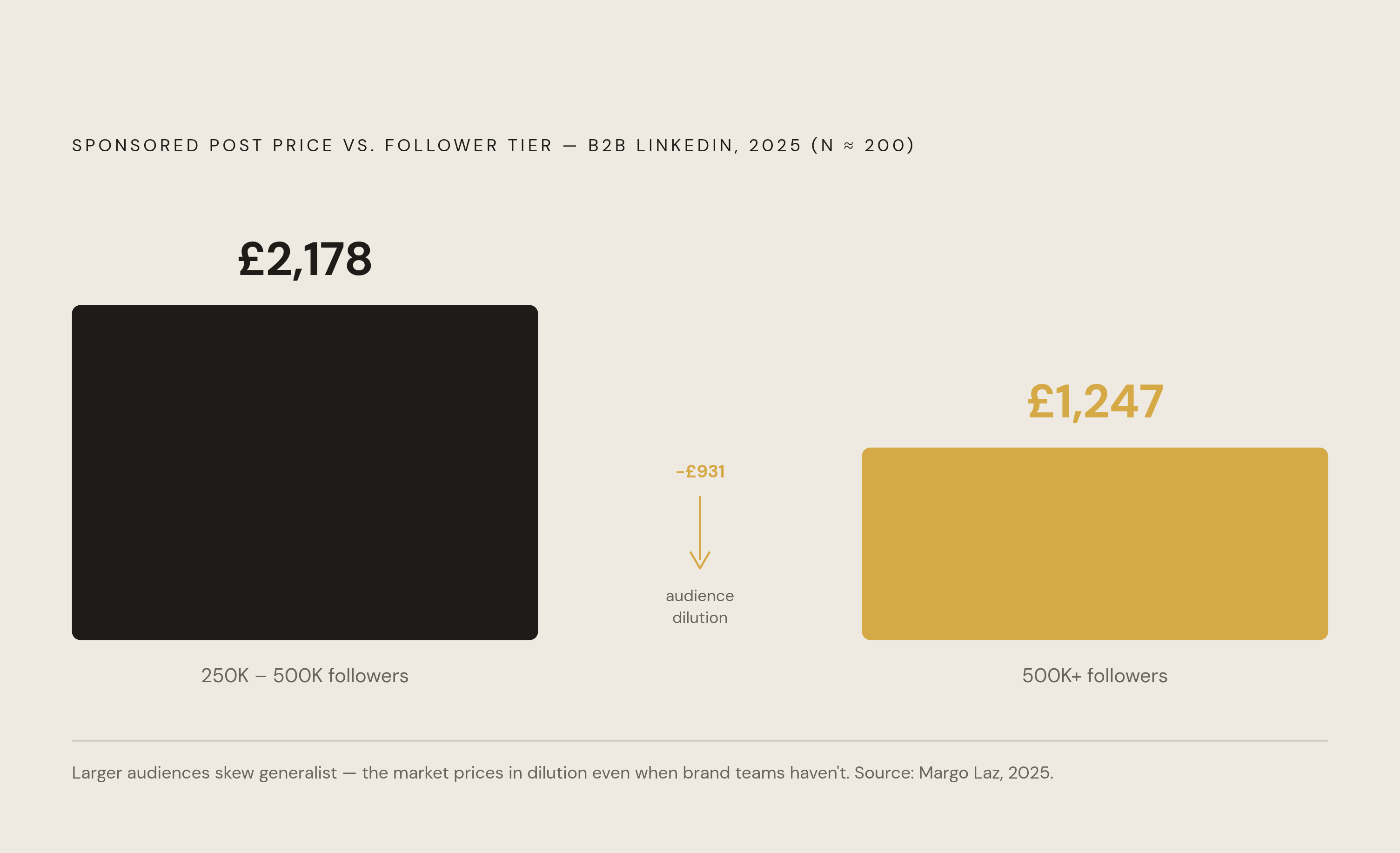
Margo Laz's analysis of roughly 200 B2B LinkedIn collaborations, published by Kudos Narratives in 2025, found creators in the 250K to 500K follower range commanded an average of £2,178 per sponsored post. Creators above 500K followers averaged only £1,247. Price fell as audience size climbed past a certain point, and that's a market telling on itself: the people paying for these placements have already priced in the dilution.
Growth past a certain scale on LinkedIn usually comes from broadening content to appeal to a general professional crowd, and the tight, ICP-dense niche that made a creator valuable at 30,000 followers becomes a shrinking slice of a 600,000-person following. Bigger is not better here. Bigger is often worse, and the rate cards already reflect that even when brand teams haven't caught up.
For a niche B2B product where trust drives the sale, not raw reach, a creator with 8,000 highly engaged enterprise cybersecurity followers will consistently outperform one with 80,000 general business followers. Check audience composition at whatever tier a creator sits in, and apply the same ICP-density test regardless of the headline number. The only question that matters is what share of followers match the buying committee. How big the total looks on a slide means nothing on its own.
Credential claims that LinkedIn's badge system does not verify
LinkedIn's Top Voice badges come out of the collaborative articles program. A creator can earn a badge in "Marketing" purely through editorial contributions, without ever building an audience through original thought leadership of their own. Treat the badge as decoration.
Check employment history instead. Does the profile show sustained tenure in the field they claim expertise in, or does it look like a consultant pattern, short stints scattered across many companies? Real subject matter authority tends to run deep in one domain rather than wide across several.
Scroll back 90 days through their content. Is the topical focus steady, or does the creator chase whatever news cycle is trending that week? Scattered content signals a confused audience, and a confused audience signals weak ICP alignment from the start.
Look outside LinkedIn too. Are they cited in trade press, quoted in industry reports, invited to speak where your buyers actually show up? Kaleigh Moore's advice is simple: search the creator's name in Google. Quoted in a trade publication, referenced in a newsletter, invited onto a podcast, any of that counts as off-platform credibility, and it's a strong proxy for the on-platform kind. It matters even more now that AI systems increasingly recognize entities the same way, so authority visible outside a creator's own feed tends to get picked up elsewhere too.
With AI-generated content now common on LinkedIn, verify that posts reflect real, first-person expertise. Ask directly for a content brief or a sample of DM engagement from a recent post. A genuine expert answers those questions differently than someone running a content-volume operation. The Edelman x LinkedIn Thought Leadership Impact Report found 55% of decision-makers use thought leadership to vet organizations they're considering. That trust doesn't transfer if the "expert" credited with the content is laundering AI output.
Selection processes that let internal opinion override the data
Plenty of creator picks come down to the highest-paid person in the room liking someone's feed. Call it what it is: personal familiarity, aesthetic preference, name recognition, none of which has anything to do with ICP density. That's how bad picks get made even inside sophisticated marketing teams.
Score every candidate against a written rubric before a single discovery call happens. That forces internal alignment on what "good" looks like, and it gives the data a structural edge over gut instinct when the final call gets made. The rubric should fold in everything already covered here: the follower growth curve, comment quality from ICP-matched professionals, seniority spread of the audience, topical consistency, and the credential checks outlined above.
Only 35% of B2B marketers say they can reliably match a creator's audience to their buying committee, and that gap isn't purely a data problem. A lot of it is process, subjective preference filling a space structured evaluation should occupy instead. Michelle Blaser, a LinkedIn consultant cited by Kaleigh Moore, points to a signal that's hard to fake: has the creator ever posted about the brand organically, without being paid to? That single behavior removes almost all doubt about whether an endorsement was paid for.
TopRank's research found identifying the right influencers is cited by 32% of marketers surveyed as a top priority for B2B influencer programs, and it stays a leading challenge even for teams running mature programs. Rubrics handle the repeatable part of that problem. Judgment still has to handle the rest, and no rubric replaces it.
Content briefs that turn creator voices into brand press releases
The most common failure here is briefing the right creator like a paid ad unit: brand voice guidelines, feature lists, a scripted call to action, as though the audience needs convincing rather than context. That approach might work for a display ad. It actively undermines creator content, and it wastes the exact thing the brand paid for.
LinkedIn's professional audience spots a sales pitch dressed up as a post from a mile away, and the engagement drop on over-scripted content occurs fast in the numbers. Part of that is mechanical: the 2026 Feed SR ranking model was built to suppress repetitive, low-substance posts and recycled thought leadership, so content that reads like a brand template gets throttled by the algorithm before it reaches anyone.
Eckstein's framing cuts to it directly. The best B2B creators are operators and practitioners who happen to create, and handing them a brief that overrides their practitioner voice with brand language destroys the exact thing that earned them their audience's trust in the first place.
What works instead is giving the creator the specific challenge to address, the evidence to work from, and the outcome the brand cares about, then getting out of the way on framing, tone, and structure. TopRank found that 99% of B2B teams running long-term creator partnerships rate those programs as effective. Rigid or unclear briefs tend to compound in one-off campaigns, where there's no time to calibrate. Retainer structures, typically running $3,000 to $25,000 a month over nine- to twelve-month engagements, give the brief room to evolve as the creator learns what actually lands with their own audience.
Building the audit into a repeatable pre-spend process
Sequence the checks by effort. Start with what's publicly visible, such as the follower growth curve, the five-post comment audit, and a Google search for outside citations. Save the requests that need creator cooperation, like analytics exports, for after a candidate has cleared the free checks.
The five-post comment audit deserves top billing in that sequence. It costs nothing, needs no tool access, and needs no cooperation from the creator at all, yet it surfaces more about audience quality than most paid vetting tools manage on their own. Run it first, every time, before a single dollar of budget gets discussed.