Creator Diversity Strategy Across LinkedIn Verticals for Enterprise GTM
Match every buying committee role to a LinkedIn vertical where they actually spend time.

Enterprise deals don't get decided by one person nodding along in a demo. A CFO signs off on budget, an IT lead clears security review, an ops director signs off on workflow changes, and somewhere in there a VP champions the thing internally. Each of those people reads different content, follows different voices, and lives in a different corner of LinkedIn. A creator program that only reaches the sales crowd is reaching maybe one node out of five.
What "vertical" means on LinkedIn and why the boundaries matter for GTM
A vertical on LinkedIn functions as a professional neighborhood, built around job function, industry, and the specific problems people in that role lose sleep over. It's closer to a professional neighborhood, built around job function, industry, and the specific problems people in that role lose sleep over.
Sales and revenue is one such neighborhood: AEs, RevOps managers, SDR leaders, CROs, all trading notes on pipeline math and quota pressure. SaaS and product is another, full of PMs and founders arguing about retention curves and what actually drives adoption. AI and data pulls in engineers and ML practitioners who care about tooling and automation more than buzzwords. Finance and procurement is its own world, CFOs and FP&A leads talking ROI models and vendor risk. Operations and IT centers on CIOs and implementation leads worried about integration and security posture. Marketing and GTM has its own crowd around attribution and pipeline metrics. And founder-executive content, the CEO and board-level tier, runs on strategy and category narrative.
Inside each of these, trust doesn't distribute evenly. Practitioners carry weight in some corners, analysts in others, executives in still others. A creator who's the loudest voice in the sales vertical can post daily for a year and barely register with a finance audience, because the two groups almost never cross paths at scale, even on the same platform. LinkedIn's user base runs into the billions, with tens of millions holding senior decision-maker titles and tens of millions more in senior influencer roles. Most B2B leads sourced from social platforms trace back to LinkedIn specifically. So the platform has the right people. The vertical map just tells you where inside it each type of buyer actually spends their scroll time.
How to map buying committee roles to creator verticals before recruiting a single creator
Start with the committee, not a spreadsheet of creator handles. Write out every role that touches a typical deal: economic buyer, technical evaluator, end-user champion, procurement, executive sponsor. For each one, ask three things. Which vertical do they live in? What problem are they actually trying to solve when they open LinkedIn? And whose voice would they trust on that problem?
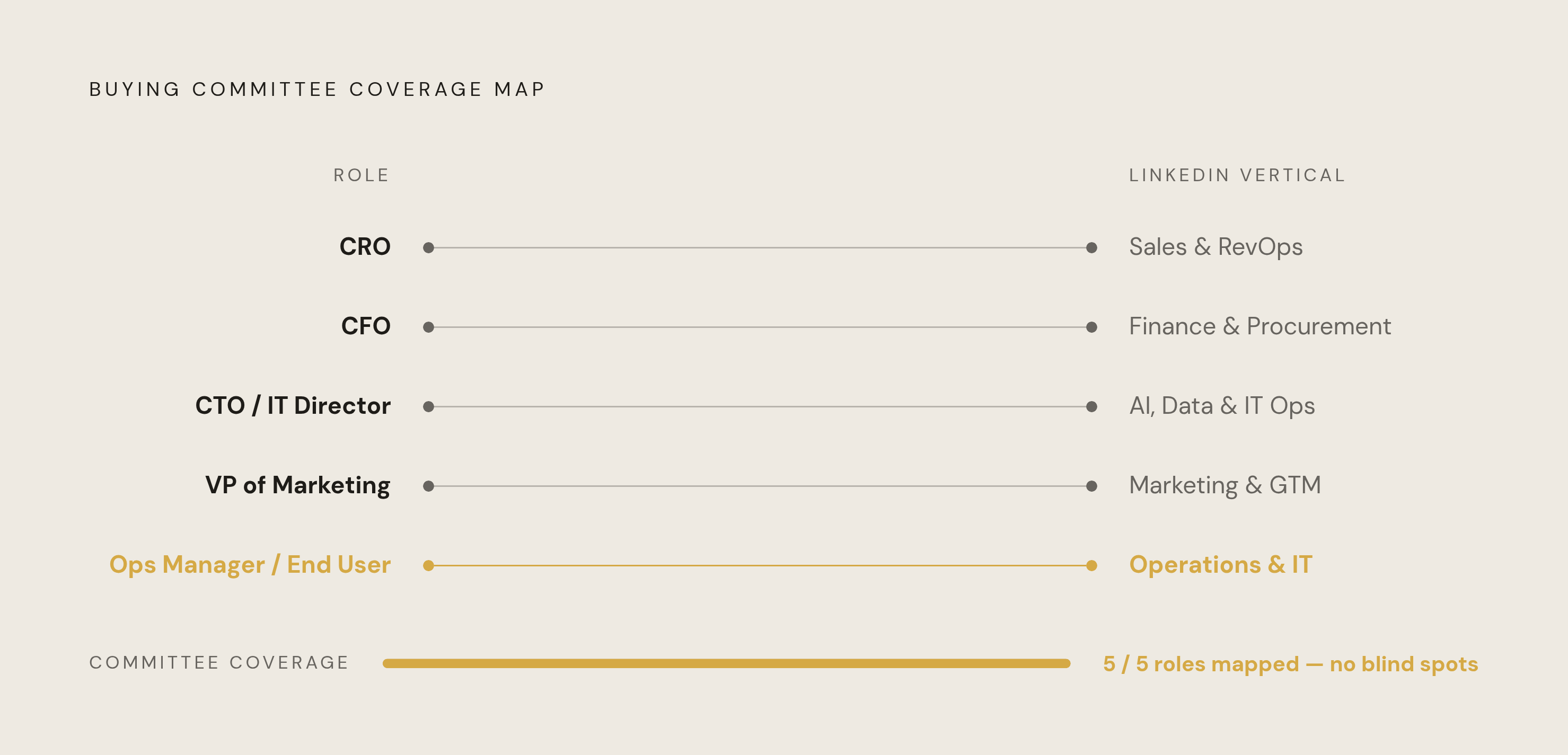
A rough version of this mapping might look like: the CRO sits in the sales and RevOps vertical and trusts a practitioner who's carried quota. The CFO sits in finance and procurement and trusts an operator who talks ROI and vendor risk in plain terms. The CTO or IT director sits somewhere between AI, data, and IT ops, and trusts a technical practitioner over a marketer any day. The VP of Marketing trusts a demand-gen operator with real numbers to show. The end-user or ops manager trusts whoever's written honestly about implementation headaches.
Any role missing a matching vertical is a hole in coverage, plain and simple. That gap is more than a nice-to-have, it counts as a blind spot in the deal. This exercise also sets the floor for how many verticals actually matter: not every company needs all seven, but every company needs at least one creator relationship for every role with real influence over the deal. Cross-check this against the account-based marketing target list too. If the contacts at target accounts cluster heavily in finance and IT, that's where budget should land first, not wherever the marketing team already has relationships.
Credibility and industry relevance are widely cited as core requirements when B2B marketers evaluate creators for partnership. Both of those are vertical-specific by definition. A creator can be credible in one room and a complete unknown in the next.
Creator selection principles that hold across every vertical
Follower count is a vanity number. Audience alignment is the number that matters. A creator with 8,000 tightly matched VPs of Finance in their audience will outperform someone with ten times the followers spread across five unrelated industries.
Smaller, focused B2B creator communities tend to run engagement rates well above what broad, general-audience creators pull in, and the pattern holds across verticals: the tighter the community, the stronger the resonance. Most credible voices in B2B, meanwhile, have never taken a sponsorship dollar in their life. That's not a weakness but an opportunity. The best-fit creators in most verticals are underpriced simply because nobody's approached them yet.
A consistent vetting approach across verticals should weigh a few things: how closely the creator's audience matches the target role and buyer stage, how much real authority they carry inside their specific community, how genuine the engagement in their comments looks, how well their voice and format fit a real partnership instead of a scripted ad, how reliable they are to work with, what they cost relative to the ICP reach they deliver, and whether their content actually moves people toward a demo or a piece of gated content.
Red flags stay the same no matter which vertical: generic motivational posts with no real substance behind them, a follower count that jumped overnight for no clear reason, a feed that reads like one long ad, or an audience that just doesn't match the buyer role being targeted. If a creator already has visible engagement from people at target accounts, that's live intent sitting in the comments section, and it outweighs almost every other signal. Prioritize that over reach every time.
Vertical-by-vertical creator strategy for enterprise GTM programs
Sales and RevOps is the category here, and the audience is AEs, SDRs, RevOps managers, CROs, the people actually running the revenue machine day to day. Credibility comes from having carried a number, not from having opinions about numbers. Content that lands covers objection handling, CRM workflows, quota attainment, the operational nuts and bolts. This vertical reaches the people closest to killing or saving a deal at the ground level. Watch for creators whose content is all hype and no substance. Engagement looks great, but that trust doesn't transfer to a vendor message.
SaaS and product covers PMs, growth operators, founders. The creators who earn trust here have actually built or scaled something, or they map competitive landscapes with real precision. Growth loops, adoption frameworks, integration walkthroughs, this is where buyers figure out if a product fits their architecture and their growth model.
AI and data covers data engineers, ML practitioners, technical decision-makers who've grown tired of vendor talk. Deep practitioners and infrastructure consultants carry the weight here, especially ones willing to talk honestly about where a tool falls short. This is one of the fastest-growing creator communities on LinkedIn, and also the one most allergic to polish. A proof-of-concept lives or dies on whether the technical evaluator trusts the voice vouching for it.
Finance and procurement covers CFOs, FP&A leads, procurement managers, financial controllers. Most creator programs skip this vertical entirely, which is a mistake, because a CFO's signature is often the actual bottleneck on a deal. ROI math, total cost of ownership, vendor risk, cost-of-inaction framing, that's the content that moves this room. It's also the least competitive vertical for creator partnerships right now, simply because so few brands are showing up here.
Operations and IT covers IT directors, CIOs, security stakeholders, implementation leads. Integration architecture, change management, security posture, the stuff that stalls a deal in review if nobody addresses it up front. Implementation practitioners and security-focused operators carry the authority here that a generalist marketer never will.
Marketing and GTM covers CMOs, demand-gen leads, growth marketers. When the product itself serves marketing teams, this vertical does double duty: it's part of the ICP and it's where internal champions get built. Attribution, pipeline metrics, channel strategy, campaign breakdowns with actual numbers attached.
Founder and executive covers CEOs, founders, board operators. This is where category narratives get set before anyone starts evaluating vendors. Founder-operators with real exits or scaled companies behind them, or executives with genuine standing, carry this room. Research into B2B buyer behavior consistently points to credible industry figures as more trustworthy than company-authored content, and this vertical is the clearest expression of that preference in action.
How a diversified vertical mix compounds influence across the buyer journey
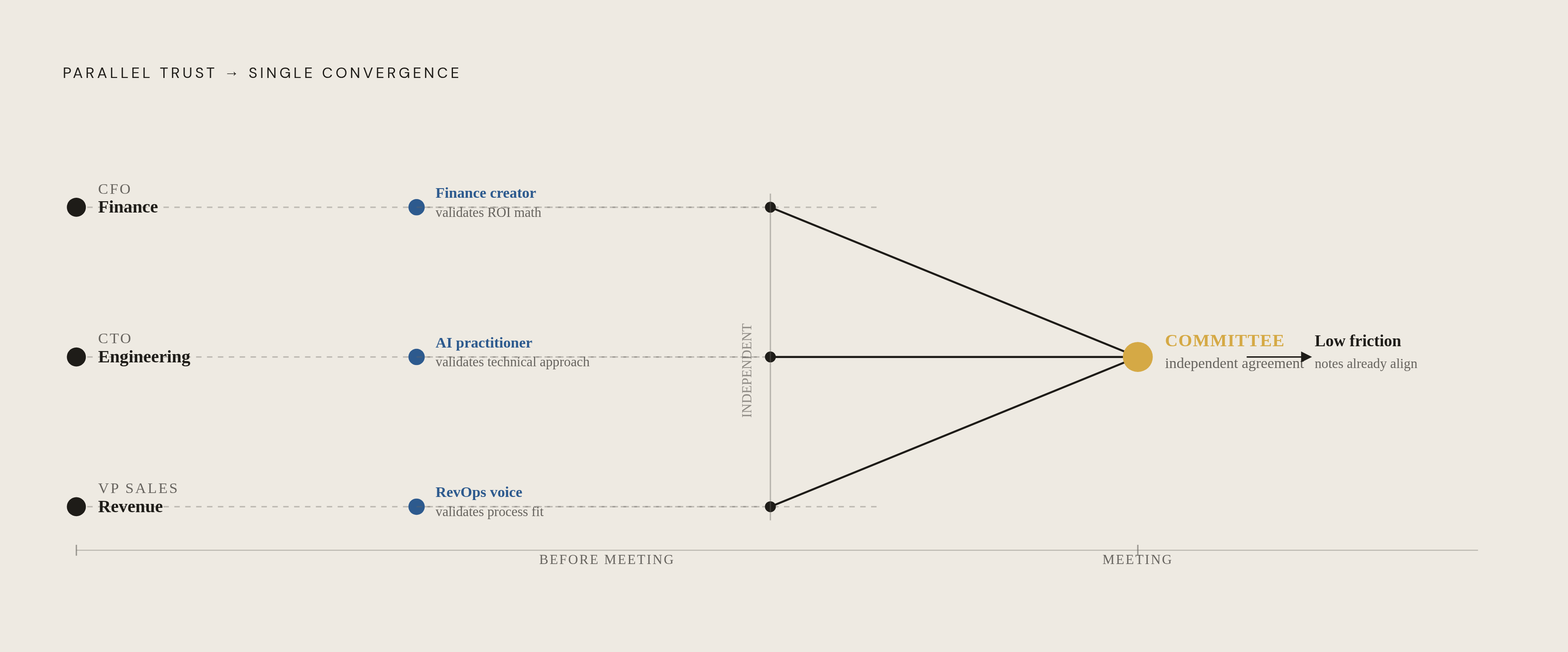
Picture the mechanism in motion. A CFO sees a finance creator validate the ROI math. Separately, a CTO sees an AI practitioner validate the technical approach. Separately again, the VP of Sales sees a RevOps voice validate the process fit. None of them talked to each other yet, and all three walked away with a positive read on the same vendor.
Research on B2B buying behavior has found that a majority of buyers consume more creator content on LinkedIn than on any other platform, and most say that content directly shapes their decisions. Across a full buying committee, that influence is happening at the same time in five different places, not one after another. Expert endorsement research has also found that third-party validation gives a brand a real edge over company-authored content, and that edge multiplies once it's happening across multiple verticals at once rather than in a single lane.
The flywheel works like this: someone in finance discovers the brand through a voice they already trust, someone in IT discovers it through a different voice, and neither exposure feels like an ad because neither creator is selling anything directly. Repeated exposure across verticals reinforces the brand without repeating the same message twice. Over time the brand gets tied to the specific problem each function cares about, not just the problem the one internal champion happens to care about. And when the committee finally compares notes in a meeting, they find they've each independently arrived at trust in the same vendor, which cuts down on internal friction almost automatically.
A lot of this compounding never appears in an attribution report. It happens in a Slack thread, in a hallway conversation, in a forwarded LinkedIn post nobody logs anywhere. The buyer journey now runs close to nine months on average, based on research drawing on millions of tracked B2B customer journeys, and that's a long enough window for cross-vertical trust to build quietly in the background. Programs with mature, well-established creator partnerships on LinkedIn have shown meaningfully stronger results on engagement, brand awareness, revenue growth, and lead generation compared to brands running no creator program at all, and that gap is meaningful across both engagement and revenue metrics.
Budgeting and sequencing a multi-vertical creator mix without spreading investment too thin
Spreading a fixed budget evenly across seven verticals on day one is close to the worst move available. The result is thin, forgettable presence everywhere and real traction nowhere.
Sequence by deal impact instead. Start with the two or three functions that most often stall or speed up deals in the current pipeline, sales and RevOps for most B2B companies, maybe finance if procurement reviews have been a recurring bottleneck. Put the first real budget there and give those relationships enough runway to actually build trust with the audience, not just post once and move on.
Once that foundation is producing signal, expand into the verticals covering roles nobody's reaching yet. Finance and IT tend to be among the most underserved verticals in B2B creator programs, which makes them high-leverage additions once the anchor verticals are working. Adding a vertical without first proving out the model in a narrower lane usually means diluting attention right when a program needs consistency most, so resist the urge to launch everywhere in the same quarter. A creator mix built one deliberate layer at a time, tied to the actual buying committee and not just the loudest room on the platform, is what turns a scattering of sponsored posts into something a CFO, a CTO, and a VP of Sales all happen to trust independently, before a single sales rep ever reaches out.