Niche Creator vs. Large-Audience Creator ROI in B2B Campaigns
Niche creators deliver better leads at lower cost by reaching the actual buying committee.
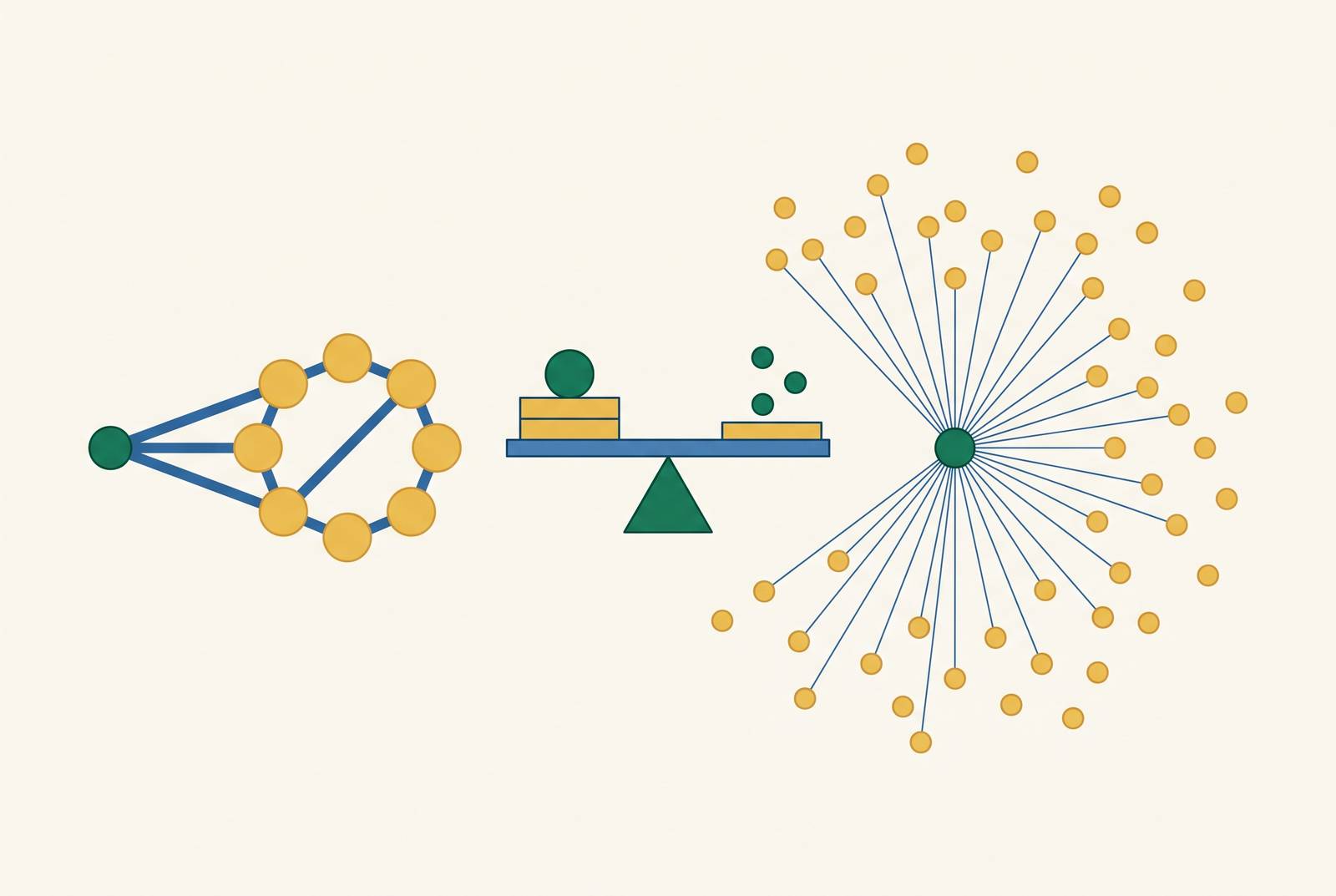
Most B2B marketers still buy creators like they're booking a concert headliner: whoever draws the biggest crowd wins the budget. That instinct is costing pipeline. Niche creators, the ones with a few thousand to a few tens of thousands of followers in a specific job function or industry, beat large-audience creators on leads, cost per lead, and pipeline contribution, because their followers are the actual buyers, not a broad crowd that happens to include a few.
Spending keeps climbing faster than anyone's ability to judge whether it's working. When teams can't measure value clearly, they fall back on the number that's easiest to see: follower count. Yet that number is a weak predictor of B2B outcomes. Here's what to look at instead.
What makes B2B buying different and why it breaks the reach-first model
Consumer buying runs on impulse. Show a sneaker to a million people, and some fixed share buys it, no committee required. A single B2B deal passes through a buyer, a budget holder, an end user, IT, procurement, and legal before anyone signs anything, and the cycle stretches for months while the stakes stay high enough that nobody wants to be the person who championed the wrong vendor.
Reach without role fit produces noise. What matters is the slice holding budget authority, sitting in the right job function, or influencing the purchase from inside the buying committee, regardless of the raw follower count on a creator's profile.
Expert endorsements move a B2B buyer more than a company's own content ever does. Being named the top solution by analysts or industry experts ranked as the single most influential trust signal among B2B buyers. So "influence" here means something specific: domain credibility, one practitioner talking to another practitioner who does the same job. A creator's value comes down to how closely their audience maps to the buying committee, with follower count carrying little weight in that calculation.
How niche creators' engagement numbers actually compare to large-audience creators
Start with the raw numbers. Micro and niche creators post engagement rates in the mid-single digits, well above the 1% to 2% typical of larger accounts. Even under more conservative measurement, micro influencers still edge out mid-tier creators. Niche wins even at the low end.
In consumer marketing, a high engagement rate still might not touch an actual buyer; someone can love a skincare video and never buy the product. In B2B, engagement from the right audience signals real professional interest, distinct from a bored scroll-and-tap. A VP of finance commenting on a niche accounting creator's post carries different weight than a stranger double-tapping a lifestyle photo.
Most brands now lean toward micro and mid-tier influencers because the engagement-to-cost ratio is stronger. Engagement rate alone won't tell you who's engaging, though, and that's the part the headline numbers hide: a thousand likes from students and job seekers means nothing to a pipeline. Who is engaging matters as much as how many, maybe more. Running several niche creators at once, each concentrated in a slightly different corner of the buying audience, beats betting everything on one large partnership almost every time. Distributed relevance beats diluted mass.
The audience composition test that actually predicts B2B campaign ROI
Picture two creators. One has a few thousand followers, with a large share holding senior titles at mid-market SaaS companies. The other has hundreds of thousands of followers, all lifestyle content, without a single person from any buying committee anywhere in that crowd. The first creator delivers more value at 6% of the follower count. Nobody needs a spreadsheet to see which one wins, and yet follower count is still what most media plans lead with.
That comparison is the whole argument. So before choosing a creator, run the composition test. Check the job function breakdown: what share of followers sit in the ICP's function, sales, finance, IT, HR, whatever the buyer role actually is. Check seniority distribution: how much of the audience holds director, VP, or C-suite titles. Check industry concentration: does the audience cluster in target verticals, or scatter across sectors that have nothing to do with the product. Check company size: do followers work at companies matching the buyer's revenue band or headcount.
Getting this data used to be a hassle. Now it's easier. Creator media kits often include LinkedIn Analytics screenshots, third-party audience intelligence tools can cross-check follower composition, and LinkedIn has expanded creator analytics access to outside tools, cutting a lot of the vetting friction that used to slow this down.
Watch for red flags: a big follower count spread thin across unrelated geographies, an audience heavy with students or job seekers, engagement that's all likes and no substantive comments from practitioners. Brands overpaying on LinkedIn are almost always the ones evaluating creators by follower count instead of audience role composition. Build an internal audience fit score, weighting ICP job function match, seniority fit, and industry overlap, before the conversation ever turns to rates.
What niche and large-audience creators actually cost on LinkedIn, and what that means for CPL
LinkedIn's native post pricing splits cleanly by tier. Micro creators, 5,000 to 30,000 followers, run $500 to $3,000 a post. Mid-tier creators, 30,000 to 150,000 followers, run $3,000 to $15,000. Newsletter mentions land between $1,000 and $8,000, podcast sponsorships between $1,500 and $10,000 an episode, and webinar co-hosting can run $5,000 to $25,000 or more.
The bulk of posts on the platform, across the full range of follower counts, still fall under a few thousand dollars. Niche is the accessible baseline here, though specificity carries a real premium: SaaS, finance, and HR creators command more than general professional content creators, because their audience is worth more per follower. Even with that premium stacked on, niche still comes in far below what a large macro account charges.
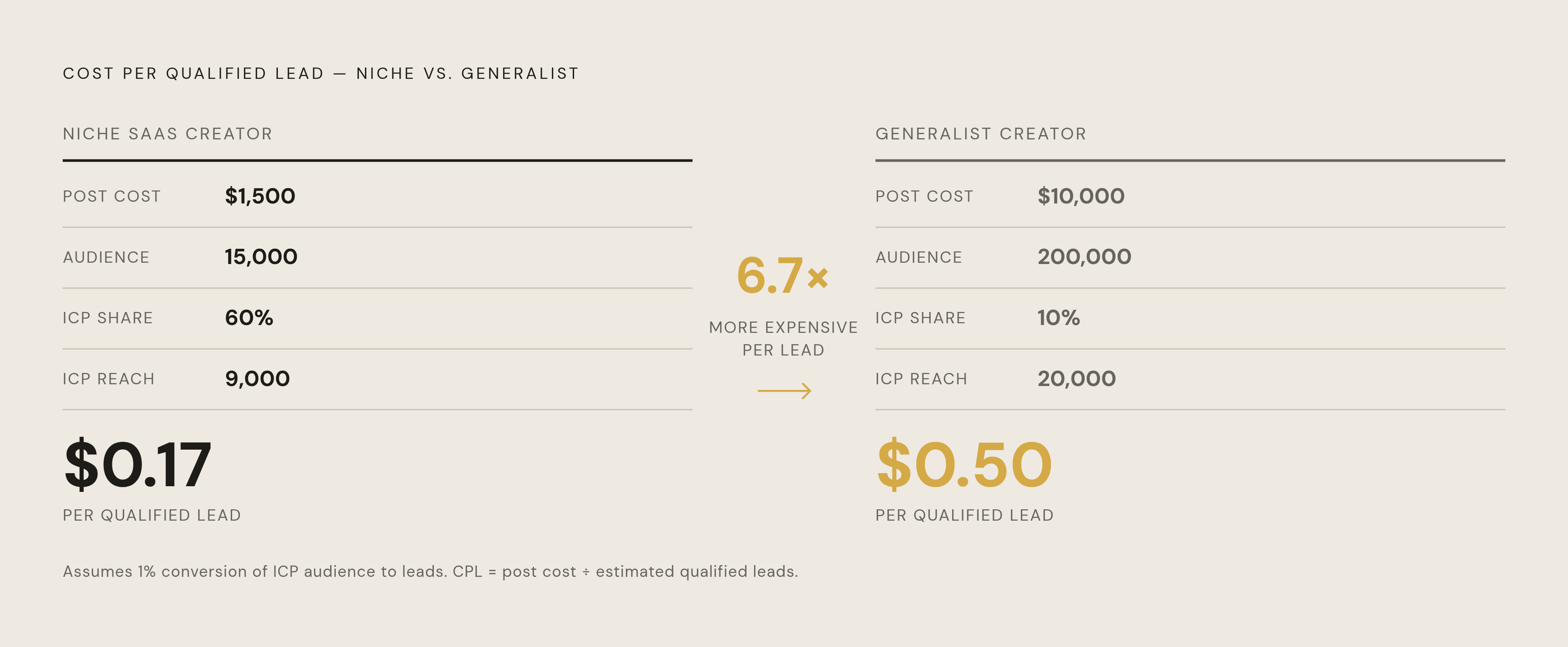
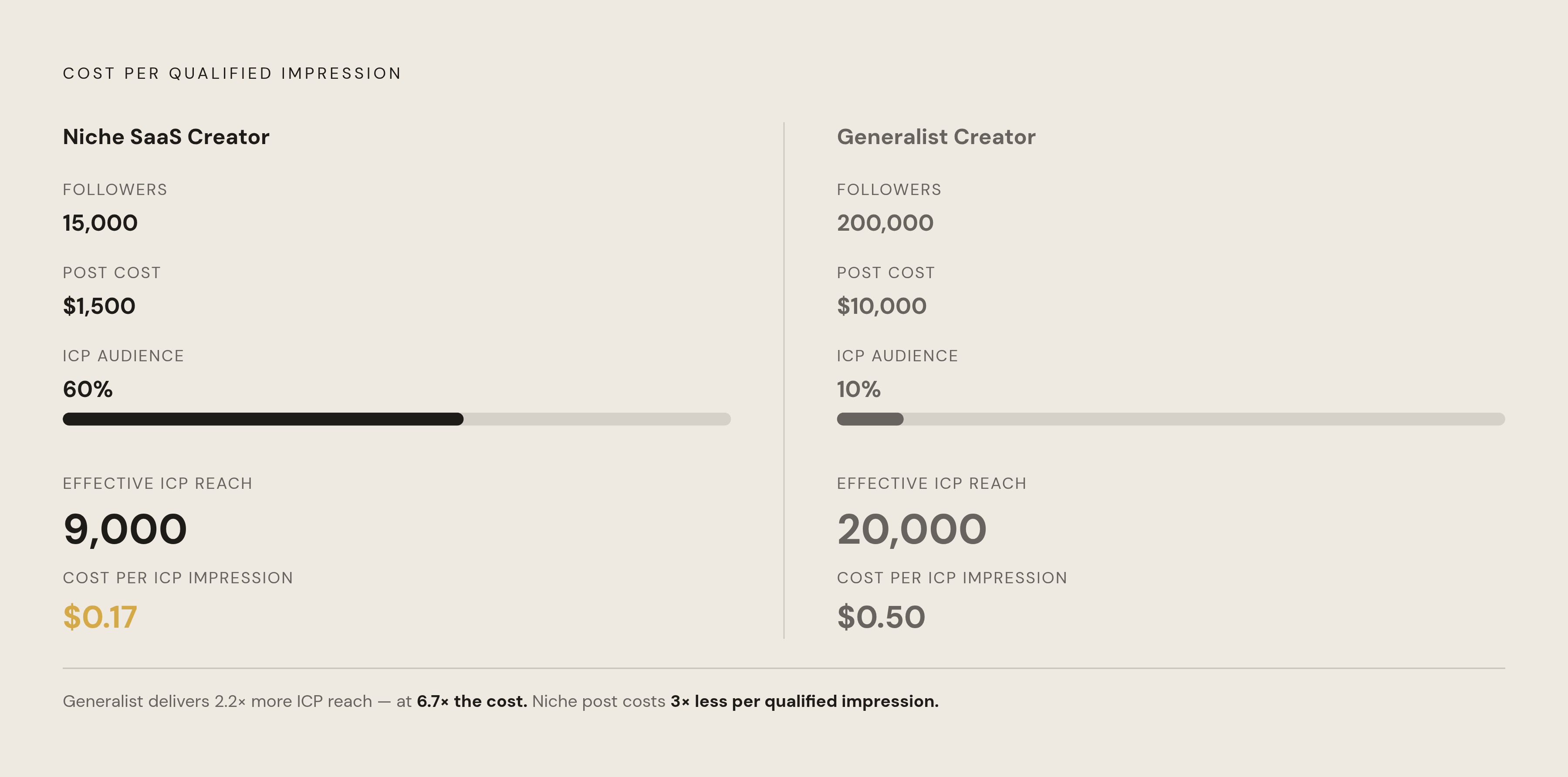
Run the CPL math and the case makes itself. A $1,500 post to a 15,000-follower SaaS operations creator whose audience is 60% ICP will almost always beat the CPL of a $10,000 post to a 200,000-follower generalist whose audience is 10% ICP. CPL is qualified leads divided by cost, and raw reach inflates the cost side without growing the lead side to match. So the math tilts against big audiences almost every time.
CPM tells the same story from a different angle. Niche and micro creators run cheaper per thousand impressions than macro-influencers, before anyone even accounts for the conversion quality gap on top of that. Format matters too: different content types carry different price points depending on production and engagement expectations. And if paid amplification enters the mix, layering Thought Leader Ads on top of a creator deal adds to the base rate, but Thought Leader Ad CPMs for tightly targeted ICPs can end up more cost-efficient at scale than the organic creator fee alone.
When a large-audience creator is actually the right choice
Big creators earn their budget in a few real cases, and only these. Category creation is one: if a product category doesn't exist yet in the buyer's mind, broad reach seeds awareness before any niche audience is even ready to self-select into caring. Brand legitimacy is another: a younger company entering a crowded market can borrow credibility from association with a recognizable industry voice. Large-scale account-based marketing is a third: if the ICP itself is broad, say every mid-market CFO in the US, a creator with a huge finance-heavy audience can approximate niche fit through sheer scale.
The question that decides it: is this campaign trying to generate qualified demand right now, or build brand recognition that pays off later? That answer picks the tier, not the follower count.
LinkedIn's own roadmap reflects this split. BrandLink pairs brand content with premium publisher networks. It's built for reach and credibility signaling more than direct-response CPL, and the pattern backs that framing: BrandLink campaigns show meaningfully higher average video completion rates than standard in-feed video, and members exposed to a BrandLink campaign show a lift in Lead Gen Form conversion afterward. Even reach-oriented placements, in other words, can tie to pipeline outcomes if the measurement is set up right. Large-audience creators for awareness lift and share-of-voice, niche creators for CPL and pipeline. Define the goal before picking the tier, not after.
LinkedIn's infrastructure for finding, vetting, and running creator campaigns in 2026
LinkedIn's Creator Marketplace is a self-serve discovery tool built into Campaign Manager, letting brands find, vet, and partner with creators directly. It's still limited in geography and language coverage, but the direction is clear. Fees get negotiated directly between brand and creator. That keeps the cost structure transparent, though it means the operational overhead, contracts, invoicing, tracking, sits entirely on the brand's side.
Thought Leader Ads inside the Marketplace let brands find organic content already mentioning their product and turn it into a paid placement, cutting out a lot of the brief-writing friction when a creator has already said something worth amplifying. For brands that want hands-on execution alongside self-serve discovery, LinkedIn also runs BrandWorks, an internal team offering strategy, creative, content, and event support, following the earlier Top Voices 360 program, which attracted major enterprise brands as clients.
That's an institutional creator economy taking shape in real time. Expanded API access gave third-party tools access to creator analytics data, lowering the friction of vetting audience composition before any budget gets committed. Most B2B marketers working today are Gen Z or millennial, and that generational shift is driving native demand for creator-led video right inside the feed. That generational shift is reshaping how creator-led content fits into the platform's broader direction.
Why operational complexity is the hidden reason most B2B teams default to large creators
Here's the part that doesn't show up on any pricing chart. Plenty of marketers already believe niche creators outperform, but they don't act on it, and the reason usually isn't disagreement. It's logistics, plain and simple.
Ten $1,500 niche creator campaigns means ten briefs, ten contracts, ten rounds of content review, ten separate payments, and ten sets of performance data that all need reconciling by hand. Most B2B marketing teams don't have the staff or the systems to run that many parallel relationships well, so they default to one or two large-creator deals instead. Rarely does the CPL math support that choice; it's simply easier to manage on a Tuesday afternoon with a small team and a full calendar.
Automation changes that math. Platforms that handle brief creation, contract templates, payouts, and reporting take the per-creator overhead out of the equation, turning a portfolio of ten niche creators into something no harder to run than one large deal.
Attribution is the second wall teams hit. Niche creator leads are hard to trace back to a specific post without UTM discipline, dedicated landing pages, or platform-level tracking built in from the start. Teams that can't point to which post drove which lead can't defend the spend in a budget review, no matter how good the underlying CPL actually is. Most marketers already agree sponsored influencer content out-converts brand organic posts; the gap is that most B2B teams still can't say which creator drove which lead, let alone tie it to pipeline value. That's the sophistication gap, and it's a bigger obstacle to niche creator programs than pricing ever was. B2B creator marketplaces built around end-to-end operations, audience-fit discovery, brief generation, contracting, payout, and post-level attribution, go straight at both problems at once.
A working framework for choosing creator tier based on campaign goal and audience fit score
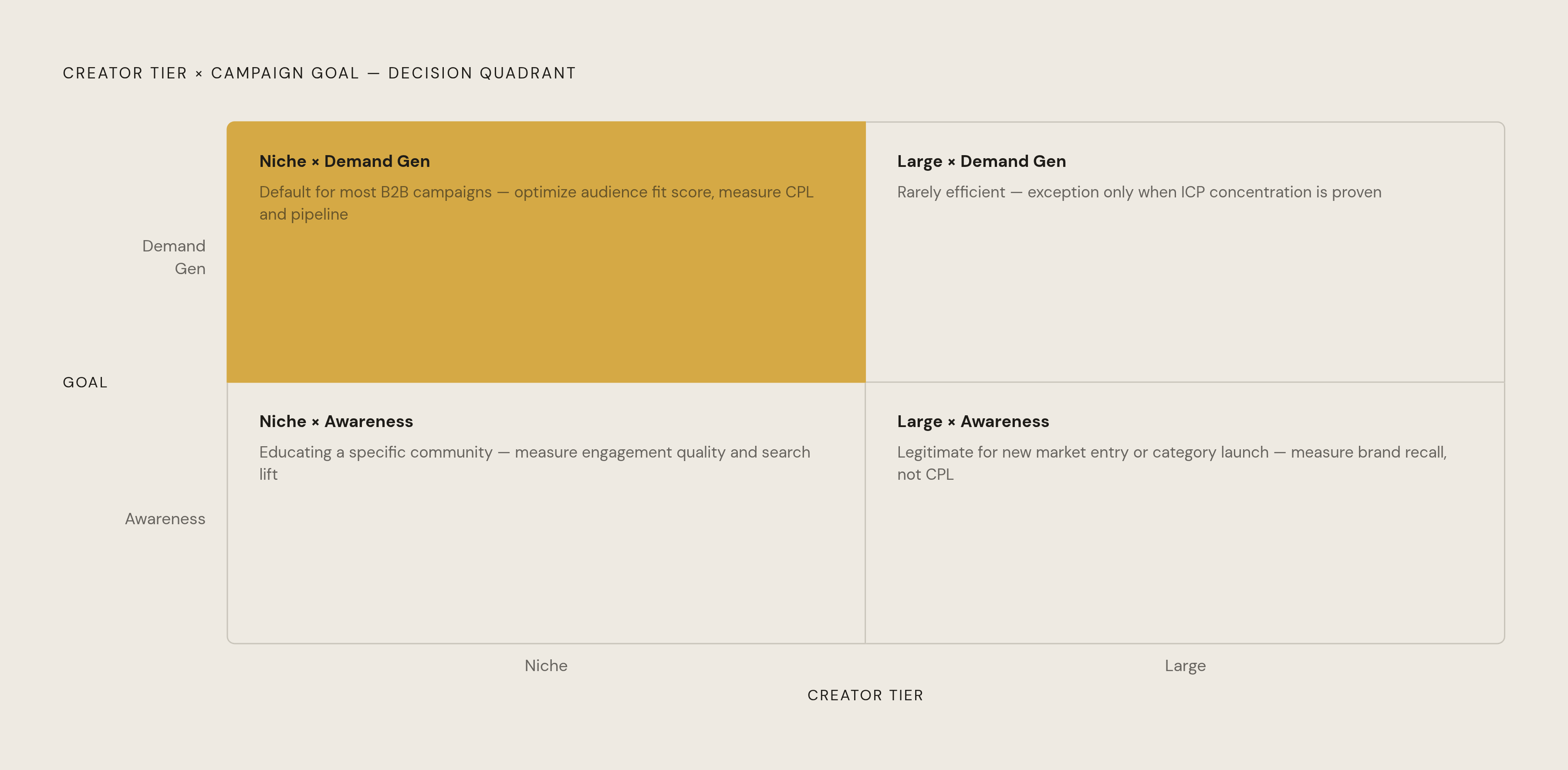
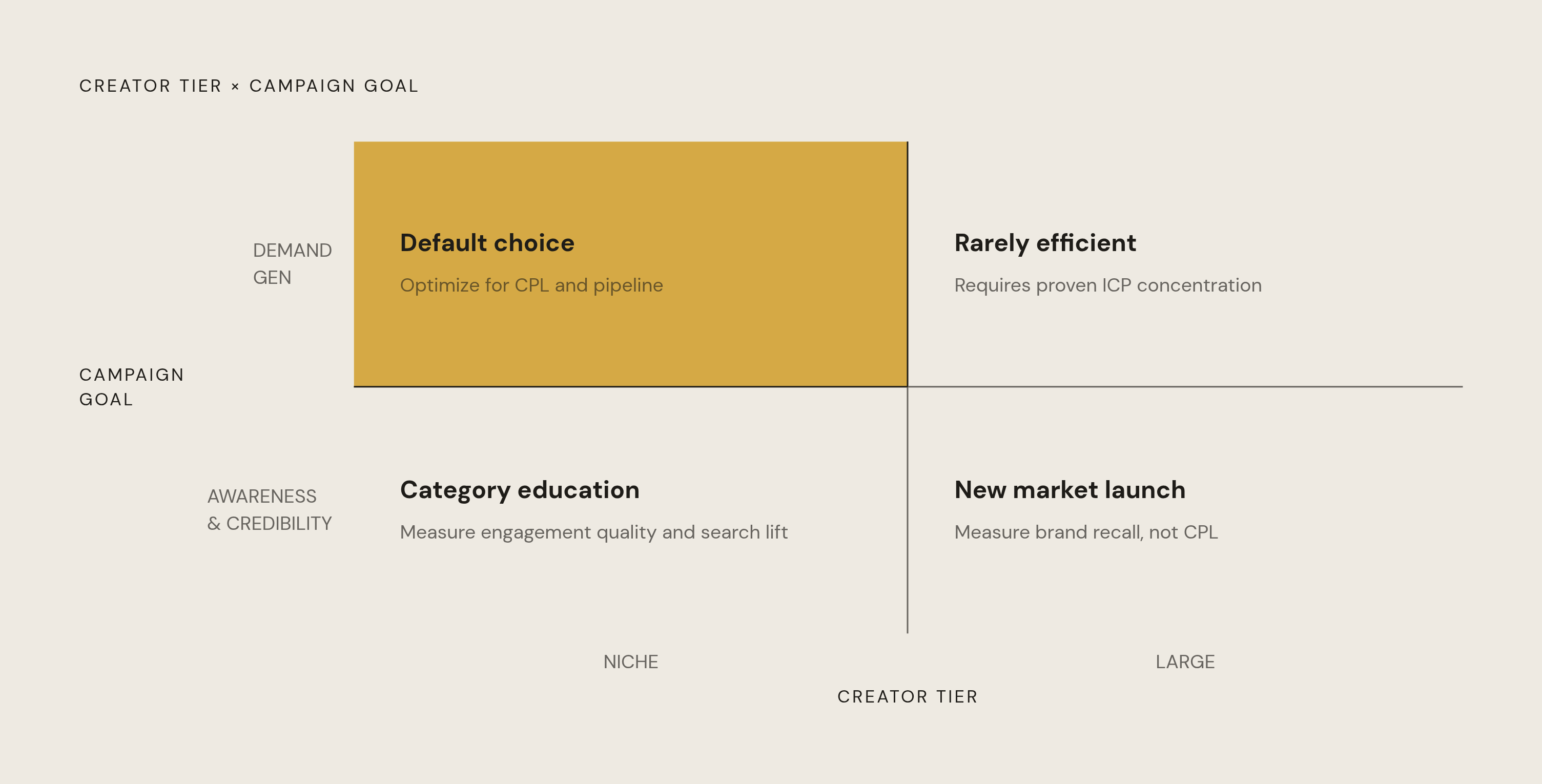
Put creator tier on one axis and campaign goal on the other, demand generation against awareness and credibility, and four clear quadrants fall out.
Niche creator paired with a demand-gen goal is the right call for most B2B campaigns. It should be the default, not one option among several. Optimize for audience fit score, run several creators in parallel, and measure CPL and pipeline contribution directly. Large creator paired with demand-gen is rarely efficient and should be treated as the exception, one that only earns its budget when the creator's audience genuinely concentrates ICP roles at real scale, and that needs proving with composition data before any money moves.
Niche creator paired with an awareness goal works well for educating a specific community about a new category; podcasts, newsletters, and carousel posts all fit here, measured through engagement quality and downstream search lift rather than CPL. Large creator paired with awareness is legitimate too, particularly when entering a new market or launching a category outright, as long as expectations are set around brand recall, not cost per lead.
Before signing any creator deal, the checklist is short. Define the goal first, demand or awareness. Run the audience composition test. Calculate CPL against the audience fit score rather than the rate card. Then decide whether the operational lift is worth managing in-house or better handled through a platform built for it, Naano, for instance, is a B2B LinkedIn creator marketplace that handles discovery, contracts, and post-level pipeline attribution in one place. Skip any one of those steps, and follower count ends up making the decision instead, which is the exact mistake this framework exists to correct.