Mapping LinkedIn Creator Categories to B2B Buyer Personas
Reach hidden buying committee members through creators they already trust.
Most B2B campaigns are built on a quiet assumption: write one message, aim it at one buyer, and the deal moves forward. That assumption breaks down the moment a real purchase decision gets made, because B2B purchases are not made by one person. LinkedIn's B2B audience persona framework names five distinct roles that shape a deal, each through a different channel and for a different reason: the Initiator, the Influencer, the End User, the Gatekeeper, and the Decision-Maker.
Each role does a different job inside the committee. The Initiator spots the problem first and builds the internal case for solving it. The Influencer is one of the five distinct buying roles that shapes a deal. The Gatekeeper decides what reaches the C-suite at all. The Decision-Maker signs off, but leans on everyone else in the room, because the Decision-Maker typically has the least direct exposure to the problem being solved.
A single message aimed at the Decision-Maker alone misses four other people whose judgment shapes whether that Decision-Maker ever says yes. LinkedIn and Edelman research identifies "hidden buyers": people in legal, procurement, or operations who rarely appear on a sales team's radar but carry real weight in building consensus, and who typically map onto the Influencer or Gatekeeper roles. A sales team can run a flawless outreach sequence aimed at the named economic buyer, but it can still lose the deal in a procurement review nobody saw coming.
This changes who content can reach, making it matter more for persona access than targeting does. LinkedIn and Edelman also found that strong thought leadership makes hidden decision-makers more open to vendor outreach, with 95% of hidden decision-makers saying so. The kind of content a buyer encounters shapes whether that buyer can be reached at all, beyond whether a brand's ad gets served to the right job title. The real question behind this piece is this: if the committee is five different people with five different information needs, what kind of content actually reaches each one.
Reaching buying committee members through creator content
LinkedIn creators are a way to reach specific people inside a buying committee who tune out direct brand messaging but pay close attention to someone they already trust, not a brand awareness tactic bolted onto a paid media plan. Buyers treat creator content the way they treat advice from a peer, not the way they treat an ad, and that distinction explains why creator content moves people brand content cannot.
The numbers back this up directly. LinkedIn's B2B Creator Research found that 82% of B2B buyers say creator content shapes their decisions, and an even larger share say they'd rather hear from a credible industry voice than read something written by the brand itself. The LinkedIn and Ipsos 2025 B2B Marketing Benchmark found something sharper still: an expert endorsement is nearly twice as likely to tip a buyer toward one vendor over a rival compared to the vendor's own written content, and getting named the top solution by analysts or industry experts was the single strongest trust signal buyers reported. Buyers don't just prefer third-party voices in the abstract. They act on them, and they rank them above the brand's own word on the subject.
That preference appears in LinkedIn's creator data, which traces buyers discovering new brands, comparing solutions, visiting vendor sites, and reaching out to sales teams, all as downstream behavior tied to creator content. A post from a trusted practitioner can start a chain that ends in a sales call, in a way a sponsored brand post rarely does.
None of this works the same way on a platform where the audience isn't making business decisions. LinkedIn Marketing Solutions data shows four out of five LinkedIn members drive business decisions at their own organizations, and the platform accounts for most B2B social leads overall. That's the structural reason creator selection deserves the same rigor as targeting a paid campaign: get the creator wrong, and the trust mechanism that makes LinkedIn work never activates.
The four LinkedIn creator categories
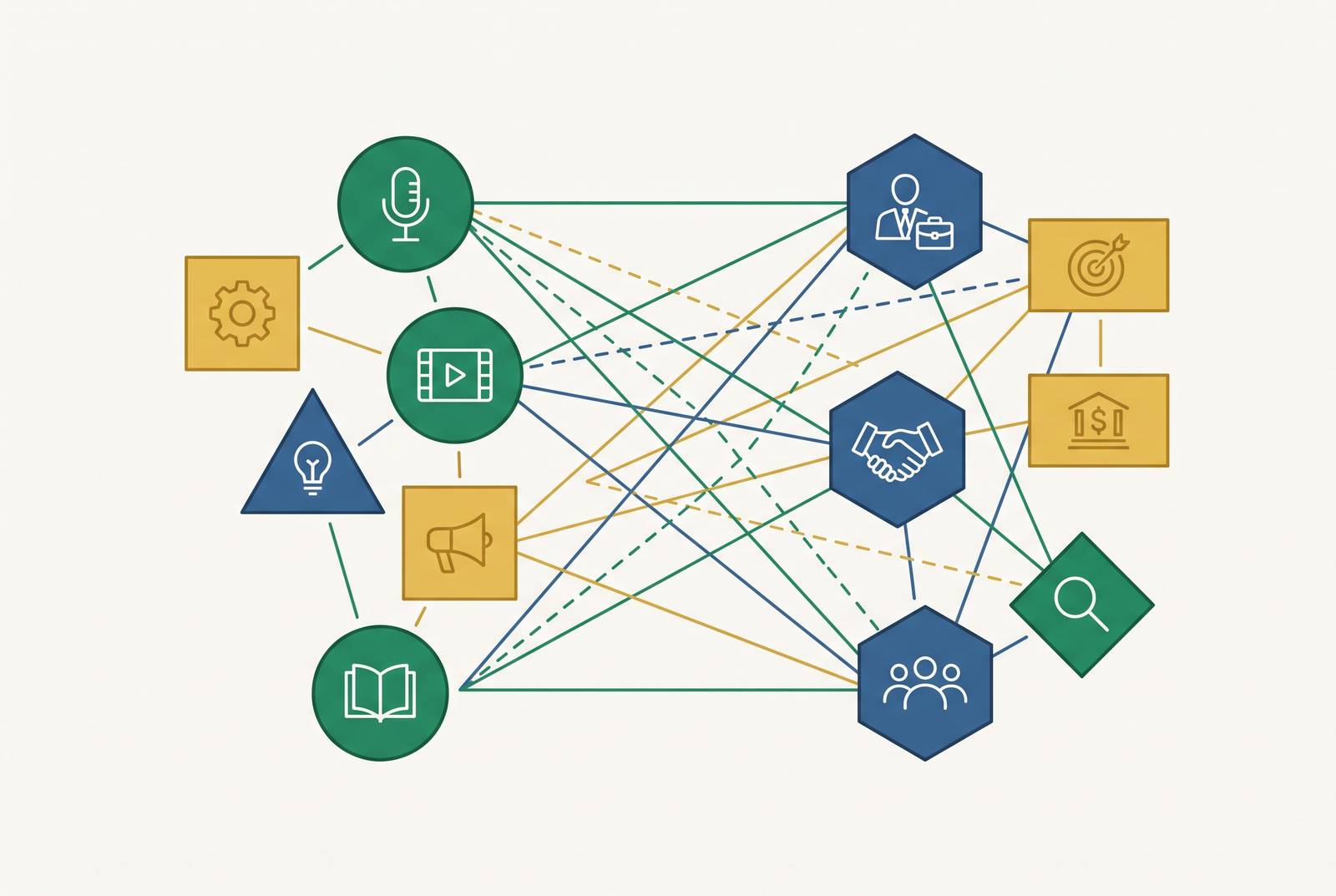
Not all LinkedIn creators earn trust the same way, and that difference is the whole reason creator selection is a discipline rather than a guess. Four functionally distinct categories exist on the platform, and each one builds credibility through a separate mechanism, which determines which buyer persona it can move.
Industry analysts and category experts sit at one end: Gartner analysts, Forrester researchers, and independent authorities who publish the frameworks that practitioners end up citing for years. Their credibility comes from distance. They're not selling anything, and the 2025 Influence Report rates this group the most effective influencer type on the platform. Their endorsement works because it's disinterested.
Customer influencers work from the opposite direction. These are existing buyers who built a LinkedIn following while documenting their own professional work, not paid spokespeople reciting talking points. Their advocacy lands because the audience knows they already bought the thing and have no reason to vouch for it beyond their own experience. The 2025 Influence Report rates them the second most effective type on the platform.
Independent practitioners, often called operator-creators, are the category most B2B marketers underrate. Contentgrip's LinkedIn influencer playbook identifies this as a sixth tier that standard five-tier influencer frameworks miss entirely: a working founder, VP, or senior individual contributor who documents their own professional thinking in public, with no brand behind them and no customer relationship driving the credibility. Their following is small compared to a consumer creator's, but it's packed with exactly the buyers a B2B brand is trying to reach, and that density is the whole value proposition.
Internal executives are founders and C-suite leaders whose LinkedIn presence functions as influencer content when activated and distributed. This category is often sitting in plain sight inside a company that's otherwise paying outside creators, since the executive's existing network and credibility just need direction rather than recruitment.
Matching creator category to buying committee role
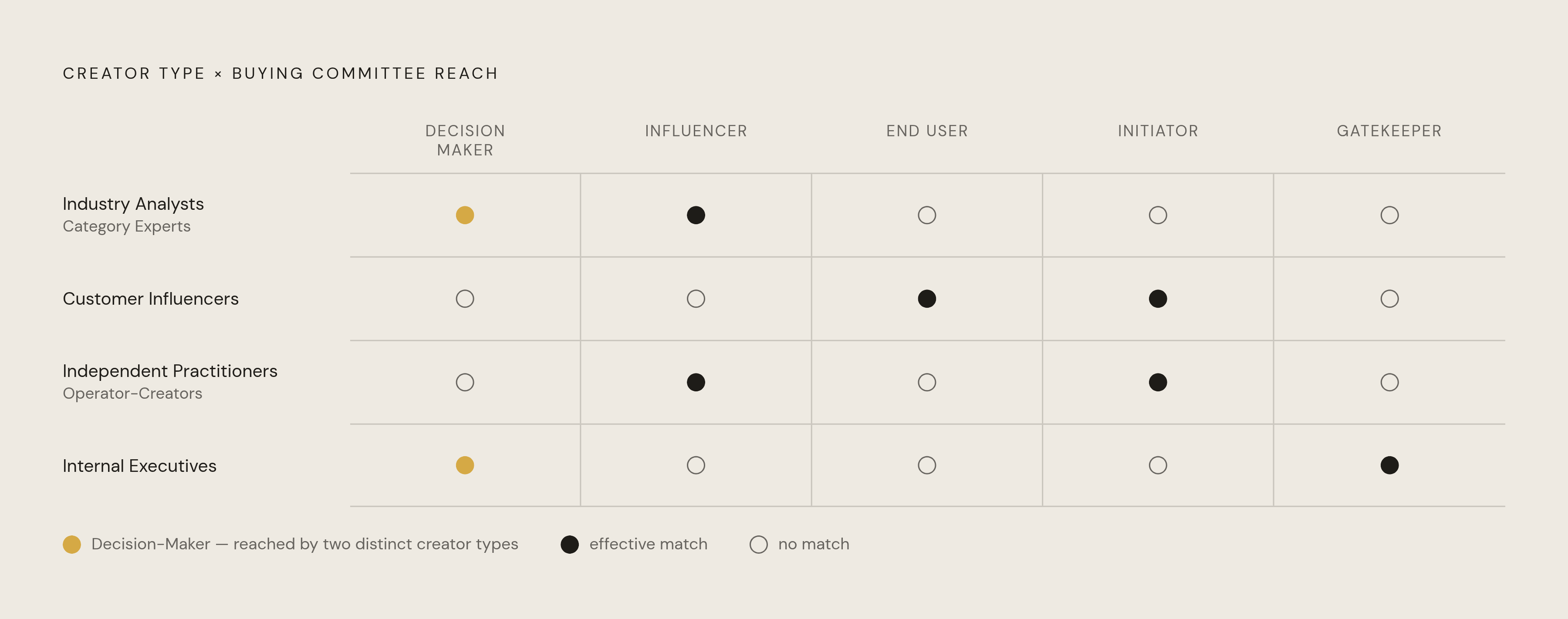
Reach alone doesn't make a creator the right choice for a given campaign. Fit does, and fit means matching the mechanism that makes a creator credible to the mechanism that persona already uses to make decisions.
Industry analysts and category experts map most cleanly onto the Decision-Maker and the Influencer. Decision-Makers have the least hands-on exposure to the problem, so they lean on outside frameworks to judge their options, and analyst-tier creators are built to supply exactly that kind of framework. Influencers, meanwhile, earn their sway by synthesizing outside signals into a recommendation they can defend internally, and an analyst's endorsement gives that recommendation cover. LinkedIn's own persona research notes that thought leadership content is particularly effective at reaching hidden buyers, who often sit in the Influencer or Gatekeeper roles, and that this kind of content makes them measurably more open to a vendor's outreach. Analyst-tier creators do their best work late in a deal, during final vendor evaluation, not at the top of the funnel where the committee is still forming an opinion.
Customer influencers map onto the End User and the Initiator. End Users are judging whether a solution will actually hold up in daily use, and a creator who's also a customer is speaking from that same vantage point, in the same register. Initiators need proof that change is both possible and worth fighting for internally, and a customer creator who documents a real transition hands them exactly that proof. The credibility here is structural rather than performed: because a customer influencer isn't a paid advocate for the category, their endorsement reads as peer testimony instead of marketing, which is the reason the 2025 Influence Report ranks them second overall. Activation tends to be lighter too, through co-marketing, advisory arrangements, or community programs, because anything heavier risks turning peer testimony back into an ad.
Independent practitioners map onto the Initiator and the Influencer. Initiators are often the most naturally curious people in the committee, and they read practitioner content because it hands them language and evidence to build a case internally before any vendor is involved. Influencers become trusted references for an operator-creator who publishes consistently useful thinking well before any vendor relationship exists. Lloyed Lobo of Boast.AI is a concrete version of this: he built a following past 200,000 through founder journey documentation and tactical content for B2B founders, and deals tied to his personal brand have opened with buyers referencing specific posts from months earlier, the Initiator-to-pipeline path playing out in real time. Devin Reed, known as The Reeder, built content engines at Gong and Clari before launching a media company that now runs entirely on inbound driven by LinkedIn content. That's what it looks like when operator-creator credibility compounds into a self-sustaining demand channel rather than a one-off campaign.
Internal executives map onto the Decision-Maker and the Gatekeeper. A Decision-Maker is far more likely to engage with a peer executive's post than with anything coming from a branded company page, because that's a horizontal trust relationship rather than a vendor pitch. Gatekeepers decide what gets in front of the C-suite, so they're more likely to let a proposal through once it arrives backed by recognizable peer endorsement, since executive-led content pre-warms the gate before the pitch ever lands. Cursor's growth illustrates the pattern: co-founder Michael Truell, team member Ben Lang, and former team member Rohan Varma (now at OpenAI) have all kept up meaningful LinkedIn and Twitter distribution, and together their reach compounds into buyer tiers a brand account alone could never touch. Dave Gerhardt built Drift's brand and demand engine through executive-led content and community well before personal branding became standard practice in B2B, an early proof that executive content can function as a demand generation channel with real Decision-Maker reach.
Reading a creator's content and audience composition as signals for persona fit
A creator's fit for a given persona is readable before a single dollar gets committed. Three signals do the work: content posture, professional identity, and audience composition.
Content posture is the fastest tell. Analysts and category experts write in frameworks: they define terms, compare approaches, and place vendors relative to each other in a category map. Content that a Decision-Maker or a senior Influencer would actually forward to their own leadership team as a reference document is a strong sign that a creator is operating at analyst-tier reach. Customer influencers write differently, in first-person implementation language: here's what we tried, here's what happened. Content packed with operational detail and honest outcome reporting speaks directly to End Users and Initiators building an internal business case. Operator-creators write in a peer advisory register, tactical and opinionated and tied to current professional practice, and that register draws Initiators and Influencers who are actively sharpening their own functional expertise. Executive creators write in strategic, directional language: what they're betting on and why it matters for the category. Decision-Makers and Gatekeepers respond to that register because it mirrors how they already process information at the leadership level.
Professional identity is the second signal, and it works almost like a proxy for a creator's whole audience. A creator's current and past roles tell you which professional community their followers self-selected into. A VP of Revenue Operations who posts regularly about GTM tooling draws an audience of other Revenue Operations practitioners, a following that maps directly onto Initiator and Influencer personas inside GTM-adjacent buying committees. Contentgrip's playbook quotes Dinda Anandita, Account Director at Content Collision, on what separates working LinkedIn influencer programs from wasted ones: find practitioners who already carry the trust of the exact buying committee a brand is trying to reach, then let them speak in their own voice instead of a scripted one. Over-scripting a creator erases the fit entirely, because the moment a practitioner starts sounding like a brand account, the audience that trusted them for being independent stops listening the same way.
Audience composition closes the loop, and it's the most direct evidence available. LinkedIn's native audience insight tools, along with the data creators sometimes publish in their own media kits, show follower job titles, seniority levels, industries, and company sizes. A creator whose followers skew toward C-suite and VP-level titles at enterprise companies is built for Decision-Maker reach. A creator whose audience concentrates in individual contributor and manager roles is built for End User and Initiator reach instead. Checking that composition before committing budget turns creator selection from a guess based on follower count into a decision grounded in exactly who sits in that audience, and exactly where they sit on the buying committee this entire framework was built to describe.