Creator Payment and Compliance Tools for B2B LinkedIn Campaigns
B2B influencer programs need systems to manage contracts, taxes, and payments at scale.
TopRank Marketing's 2025 B2B Influencer Marketing Report found that 85% of B2B marketers now run influencer programs, up from 34% in 2020. Forrester expects 75% of enterprise B2B companies to grow their influencer-relations budgets in 2026. The channel has gone from side experiment to line item, and that shift changes what actually breaks it. At low volume, a team can wing the paperwork. At scale, the contracts, tax forms, cross-border payments, and disclosure rules that used to be an afterthought become the thing that decides whether the program survives.
Managing creator payments and compliance for B2B influencer programs requires four operational checkpoints before any post goes live: a signed agreement covering usage rights and paid amplification permissions, verified tax documentation matched to the creator's country and entity type, confirmed disclosure language written into the contract itself rather than patched on afterward, and a payment mechanism capable of handling cross-border currency and withholding obligations. Domestically, US creators paid above the IRS threshold need a W-9 on file and a 1099-NEC at year end; internationally, non-US creators require equivalent foreign tax forms, and tax treaty status affects withholding on gross payments. Purpose-built contractor payment platforms, Deel, Remote, Trolley, and Tipalti among them, handle local-currency payouts, exchange-rate transparency, and tax-form gating in one system, while disclosure compliance requires FTC-mandated language sitting in the post body itself before any paid amplification runs. Integrated creator management platforms fold contracts, tax onboarding, payment triggering, and campaign attribution into one workflow, which is what separates programs that scale from ones that quietly stall once the operations tax outpaces the budget it was supposed to serve.
None of these problems are individually hard. Collect a W-9, get a signature, wire a payment, slap "#ad" on a post. But run that across forty creators in twelve countries every month, and the hours spent chasing paperwork start costing more than the campaigns are worth. The channel doesn't fail because it underperforms. It fails because the operations tax quietly eats the budget that was supposed to go to creators.
What a full creator engagement requires before a post goes live
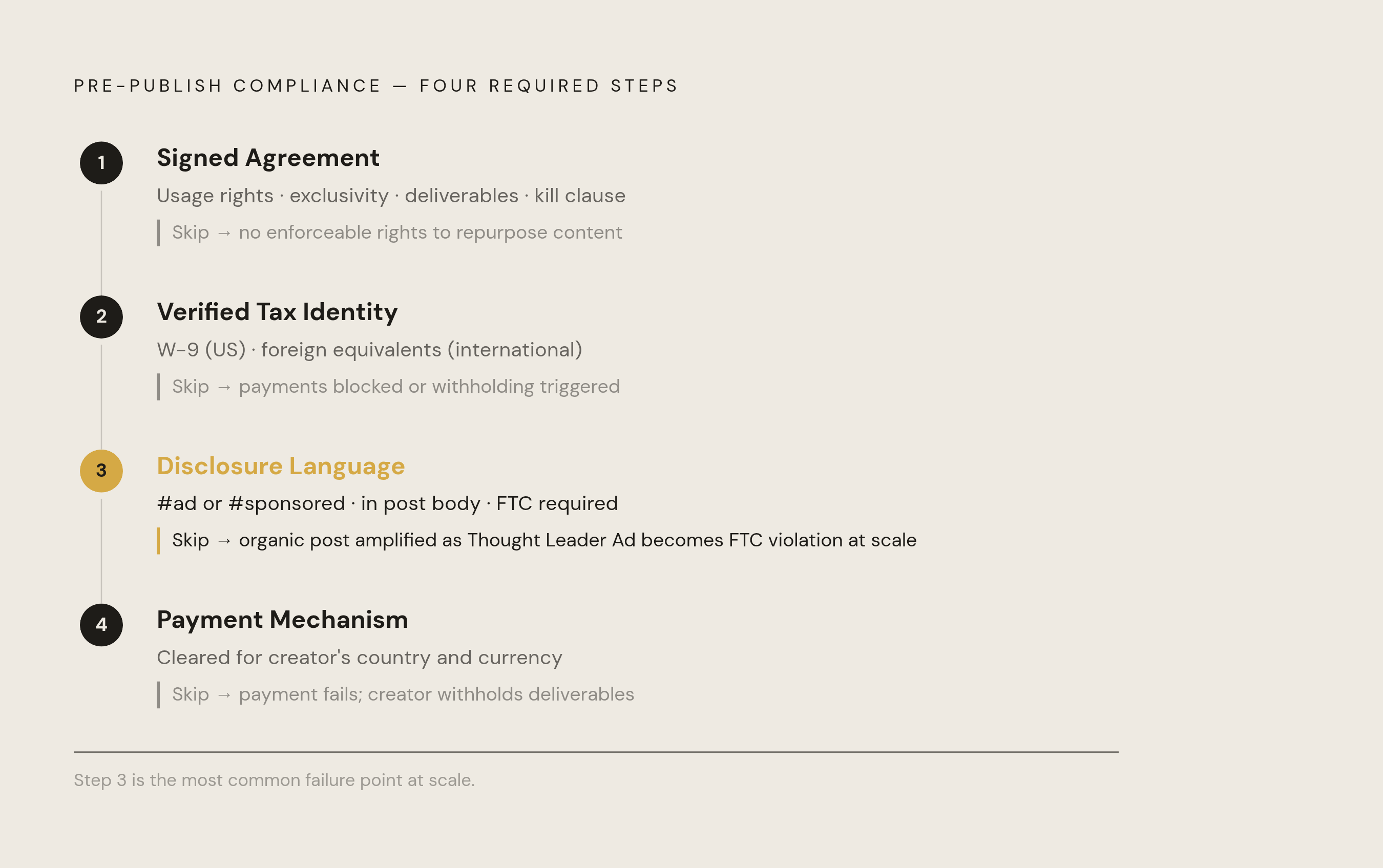
A single creator engagement needs four things, minimum: a signed agreement, verified tax identity, confirmed disclosure language, and a working payment mechanism. Skipping any one of them causes something to break later, usually at the worst possible time.
The agreement has to spell out usage rights. Can the brand run this post as a Thought Leader Ad? Turn it into a BrandLink pre-roll? Those are different permissions, and a creator who signs off on one organic post has not automatically signed off on paid amplification. The contract also needs exclusivity windows, revision cycles, exact deliverable specs, and a kill clause that lets either side walk away without a legal fire drill.
Tax paperwork depends entirely on who the creator is and where they live. A US-based LLC needs a W-9. A UK sole trader needs something else. An EU creator can trigger VAT questions. A creator based in a country without a US tax treaty creates withholding obligations the paying company is on the hook for, whether anyone remembered to plan for it or not.
Then there's disclosure. The FTC's endorsement guidelines require that any material connection, meaning payment, free product, or commission, gets disclosed clearly and conspicuously inside the content itself. On LinkedIn, that means "#ad" or "#sponsored" sitting in the post body, not buried in a comment where nobody scrolls. LinkedIn's own paid-partnership rules stack on top of that: if a brand wants to run a creator's organic post as a Thought Leader Ad or BrandLink placement, the disclosure needs to be present in the post, either included by the creator or applied through LinkedIn's paid-partnership labeling when the ad runs.
Order matters here. Disclosure language belongs in the contract before a single word of content gets drafted, not patched on after the post is live and someone spots the gap.
Cross-border payments add a whole other layer: currency conversion, wire fees, payout rails that vary by platform, and in some countries, local withholding rules that make the paying company legally responsible for money it never directly touches. None of this is exotic. It's just wider than most teams plan for, and that gap is exactly where programs stall out.
Contract tooling: what B2B teams need versus what they usually have
Most teams start with a legal-reviewed template, emailed to each creator, signed, scanned, and dumped into a shared drive. That works fine for two or three deals a quarter. At ten or twenty, it turns into a part-time job for whoever's tracking it.
A workflow built for scale needs a few specific things. A templatized agreement with variables, creator name, deliverable count, usage rights, exclusivity window, payment amount, that auto-fills from a campaign brief instead of getting retyped every time. E-signature routing with an audit trail, which matters both for enforceability and for proving disclosure terms were agreed to if a dispute ever comes up. Usage rights fields that spell out paid amplification explicitly, because assuming a creator agreed to a Thought Leader Ad just because they agreed to an organic post is how legal exposure happens.
Most teams press general-purpose tools into service here, and that's the wrong call past a certain size. DocuSign and Adobe Acrobat Sign handle e-signature. PandaDoc and Proposify generate templatized agreements. None of these were built with creator programs in mind, and while they get the job done at small scale, they run out of road fast once contract volume climbs past a handful a month, because nothing in them understands what a Thought Leader Ad license even is.
Purpose-built creator contract tools tend to live inside broader creator management platforms rather than standing alone, bundled with payment and campaign tracking. The real test for any team is simple: can a new creator get signed without a lawyer touching the document? If the answer is no, the process won't scale past a handful of engagements. The goal is one legal-reviewed master template with variables swapped in.
How do you handle tax documentation and creator classification for B2B influencer programs?
A classification question determines how any form gets collected, since it decides whether the creator counts as an independent contractor or, given how much direction the brand provides and how often payments happen, starts to look like employment in the eyes of the paying entity. Is this creator an independent contractor, or does the relationship, given how much direction the brand provides and how often payments happen, start to look like employment in the eyes of the paying company's jurisdiction? Most B2B creator deals are clean contractor arrangements. Always-on programs with high payment volume and heavy creative direction are the ones that invite scrutiny.
Domestically, the US rules are well established but easy to skip. Any creator paid above the IRS threshold in a calendar year needs a W-9 on file, and a 1099-NEC at year end. Missing the W-9 step creates tax compliance exposure for the paying company that typically surfaces at the worst possible time. Teams that run creator payments through a corporate card or an informal wire almost always find this out the hard way, at tax season, months after the damage is done.
International payments add real complexity, and this is where most teams get it wrong. Non-US creators generally need to provide equivalent foreign tax documentation before payments can go out. Tax treaty status affects withholding obligations, and countries outside any treaty arrangement face less favorable default treatment on gross payments. EU-based creators invoicing a US company usually invoice without VAT under the reverse charge mechanism of the EU VAT Directive, though specific service types can follow different rules depending on jurisdiction. Some jurisdictions impose additional obligations on the paying company; standard influencer contract templates often omit these requirements, and companies typically discover the gap only during the first audit.
Dedicated contractor payment platforms exist specifically to handle this: Deel, Remote, and Trolley collect tax forms digitally, check them against country-specific rules, calculate withholding, and generate year-end tax documents automatically. LinkedIn's own BrandLink payouts route through Stripe as of the March 2026 expansion, which covers payment mechanics for in-platform placements. That doesn't relieve a team of its own tax documentation obligations for direct creator sponsorships negotiated outside that system.
Tax documentation isn't a one-time setup, either. It has to be refreshed every tax year, and a creator whose business structure or status changes may need updated documentation on file. Programs that skip building this refresh into onboarding end up solving the same problem every January, on repeat, forever.
Cross-border payout infrastructure: how payments move and where they fail
The B2B creator pool is global by nature. LinkedIn's Creator Marketplace launched first in the US and Canada, but LinkedIn has over 1.3 billion members worldwide, and the sharpest niche expert for a given target account might be sitting in one city abroad rather than a major hub back home.
Standard bank wires work, technically, but they're the wrong default at any real scale. They mean collecting a banking form from every creator, waiting several business days for international transfers, absorbing wire fees that hurt on smaller payments, and getting zero automated record inside whatever system tracks the campaign. PayPal and similar consumer rails move faster and creators tend to like them, but they create their own compliance complications and aren't built for high-value or recurring payouts in a lot of countries.
Purpose-built contractor payment platforms, Deel, Remote, Trolley, and Tipalti among them, solve most of this in one motion. They pay creators in local currency, handle exchange rates with fee transparency built in, let the creator choose bank transfer versus local rails versus a digital wallet, and gate the payment itself until tax forms are on file. Every payment ties back to a specific campaign or deliverable in an audit trail, which matters the moment finance asks where the money went.
LinkedIn's own answer, as of the March 2026 BrandLink expansion, routes creator payouts through Stripe and adds a self-serve buying option inside Campaign Manager. That covers BrandLink pre-roll placements specifically. It doesn't extend to direct sponsored posts negotiated outside LinkedIn's own ad infrastructure, and that gap is exactly where most B2B teams end up running two separate payment systems with two separate compliance tracks and no shared reporting between them.
This isn't just a finance detail. A team that can pay forty creators across twelve countries in a single billing cycle, without someone escalating to finance for help, has crossed the actual line between a channel and a one-off project.
Disclosure compliance on LinkedIn covers the rules, the risks, and what enforcement looks like.
FTC endorsement guidelines don't care what platform the content runs on. Any material connection, payment, free product, commission, employment, has to be disclosed clearly and conspicuously inside the content itself, not linked from a bio and not buried three replies deep in a comment thread.
LinkedIn's paid-partnership policy requires the disclosure to sit in the post body itself. "#ad" or "#sponsored," placed where it's actually visible, satisfies the requirement. A disclosure added later, as a comment after the post already went live, does not, and this is the single most common failure point teams run into.
Thought Leader Ads raise the stakes. A brand can take a creator's existing organic post and sponsor it, pushing it to a targeted audience far larger than the creator's own following. If that original post never carried a disclosure, running it as a paid ad turns a small oversight into a compliance problem at scale, seen by thousands of people who had no idea money changed hands.
Liability lands on both sides under FTC guidance, and the brand's role in controlling amplification and approving content means disclosure review cannot be delegated entirely. Disclosure review is the brand's job. Handing it off entirely and hoping the creator remembers is how programs end up with an ad running for weeks before anyone notices the hashtag is missing.
The failure patterns repeat, and they repeat for the same two or three reasons. Disclosure gets agreed to over email instead of written into the contract, and the creator ends up using a phrase or format that doesn't actually meet the bar. Or the disclosure sits fine in the original organic post but gets stripped when the content gets repurposed into a different format. International creators add another wrinkle: a UK creator operating under the ASA's standards or an EU creator under local rules may follow different requirements than the FTC, but the paying company's own obligations are set by where it operates, not where the creator lives.
The fix is procedural. Disclosure language belongs in the contract template from the start, gets reviewed again in the brief, gets confirmed once more during content approval, and gets logged before any paid amplification goes live. Four checkpoints, not one, because relying on a single person to remember is how the gap opens.
Integrated creator management platforms that connect these layers into one operational system
A team running a contract tool, a separate contractor payment platform, a spreadsheet for tracking disclosure, and LinkedIn Campaign Manager for amplification is juggling four systems that don't talk to each other. Every campaign means manually copying data between them, and every manual handoff is a place something gets missed.
An integrated creator management platform folds the whole workflow into one system: discovery and ICP-fit scoring (audience composition, engagement rate, topic alignment) so selection is based on whether a creator actually reaches the right buyers, not how many followers they have. Brief generation and content approval in the same place. Contract generation and e-signature without switching tools. Tax documentation gated at onboarding, so a creator can't get activated until the right forms are on file. Payment triggered automatically when a deliverable gets approved, instead of waiting on someone to send an invoice. Campaign tracking that ties the post itself to downstream clicks, leads, and pipeline, so attribution is built into the system rather than bolted on afterward as a separate report.
LinkedIn's own stack covers part of this and leaves real gaps. Creator Marketplace, still in alpha and limited to North America and English-language content,anguage content, handles discovery inside Campaign Manager. BrandLink handles in-platform payouts through Stripe for that one ad format. Direct sponsorship contracts, tax documentation, and cross-border payments outside BrandLink are missing entirely, and that gap isn't closing anytime soon.
What separates B2B creator management from consumer influencer tools is pipeline attribution: the ability to connect a specific post to a named account, a lead record, or a closed deal. That's what makes the channel measurable against the same yardstick as LinkedIn Ads or an email nurture sequence, instead of getting judged on likes and impressions alone.
Influencer Strategists' B2B creator-led growth report, built from more than 200 interviews, found mature always-on programs returning 420% ROI at the 12-month mark, with ROI reaching as high as 20:1 when the creator genuinely fits the target account profile. Those numbers only show up when the operational system underneath is tight enough to run every month without falling apart. A program held together with a shared drive and someone's memory doesn't produce a smaller version of that return. It produces the opposite.
Operational integration is the foundation the strategy runs on. It's the foundation the strategy runs on. A program that compounds toward those returns keeps running, while one that lacks this quietly dies after the third or fourth creator, once the team realizes it can't keep up with its own paperwork.
Choosing between self-serve tooling, managed services, and marketplace models
Three paths exist for building this out, and the right one depends almost entirely on volume, not ambition. Self-serve tooling, stitching together an e-signature tool, a contractor payment platform, and a shared tracker, works fine for programs running a handful of creators a quarter. It's cheap and flexible, but every new creator adds manual work, and that work scales linearly with headcount. That's exactly the trap that turns a promising channel into a burden nobody wants to own.
Managed services hand the operational layer to a team that already runs this workflow across multiple clients. That buys back time and cuts down on the classification and disclosure mistakes that come from doing this for the first time, at the cost of margin and some control over the process.
Marketplace models, LinkedIn's own Creator Marketplace and BrandLink infrastructure among them, bundle discovery and payment together but currently cover a narrower slice of the workflow: North America, English-language content, and in-platform ad formats specifically. They solve part of the problem well and leave the rest, direct sponsorships, cross-border tax documentation, contract customization, for the team to handle elsewhere.
None of these three paths is wrong on its own. The mistake, and it's the one most teams actually make, is picking one without matching it to real volume, then discovering six months in that the operational tax has quietly outpaced the marketing budget it was supposed to serve.