View-Through Attribution for LinkedIn Creator Content
LinkedIn's view-through data needs context to show creator content's real pipeline impact.

Open Campaign Manager on a creator-led campaign. The conversions total sits in one column. LinkedIn combines click-through and view-through conversions by default, so that single number might contain a handful of actual clicks sitting next to a much larger pile of view-throughs, with no visible split between the two. A marketer glancing at that total has no way to tell which kind of conversion did the work.
Three defaults stack on top of each other here. So the conversion total reads higher than the click-driven activity alone would justify. There's no breakdown between view and click built into the standard report. The attribution window itself is tuned for a buying motion much faster than the one creator content actually influences. Leaving all three untouched produces a dashboard that looks healthy while telling almost nothing about what creator content did for pipeline. Fixing that starts with understanding what a view-through conversion is actually measuring, and what it can't.
What a view-through conversion is and what it is not
A view-through conversion gets logged when someone sees a LinkedIn ad, does not click it, and then converts on the company's website within whatever attribution window is set. No click, no direct interaction with the ad itself, just exposure followed later by an action on a separate destination.
The conversion event itself involved a real action: someone visited the site and did something that counted, a form fill, a signup, a demo request. What's inferred is the connection between seeing the post and taking that action. LinkedIn's data shows the sequence, view then conversion, but it can't confirm the viewer remembered the content, acted because of it, or wasn't already heading toward that conversion before the post ever crossed their feed. That gap between sequence and cause is why VTC data calls for interpretation rather than a face-value read: it points to potential influence, not confirmed influence.
Creator posts travel beyond what LinkedIn can measure, so the gap widens once creator content enters the picture. They get screenshotted into Slack channels, forwarded in email threads, pasted into internal docs that a buying committee uses to debate vendors. Anyone who encounters the post through one of those paths never appears as an impression in LinkedIn's data. This means the platform's own view-through numbers are already a partial count before any interpretation question even comes up.
Why B2B creator content creates the VTC measurement problem
A display ad asks for a reaction in the moment: click or don't. Creator content asks something slower. A VP scrolling through a practitioner's point-of-view post is usually in evaluation mode, weighing a category or a vendor, not browsing for entertainment. That post might shape which three vendors make a shortlist weeks or months before anyone clicks anything tied to it.
LinkedIn's distribution mechanics make the gap between exposure and action even larger. Comments from professionals with relevant expertise extend a post's reach through the feed, and that peer amplification compounds engagement well past the original audience, in ways that never register as a tracked impression in any campaign report.
Private sharing compounds the problem again. Professional sharing habits run through closed channels by nature: a Slack message, an internal Notion page, a forwarded email inside the account that's actually evaluating the vendor. A single creator post landing in one of those spaces can influence several members of a buying committee at once, and none of them will ever appear in LinkedIn's view data.
Timing stretches the gap even further. A creator post that plants early awareness in January might not show up as a CRM opportunity until much later in the year. Any attribution window short enough to fit standard ad-reporting conventions is structurally likely to miss that connection altogether, simply because the buyer took months longer to act than the window assumes.
How VTC signals mislead as standalone pipeline proof
The failure that actually costs B2B teams credibility is treating a VTC count as proof of creator-driven pipeline instead of reading it as a partial signal of potential influence. A high view-through number can mean you reached the right accounts. It can also mean a batch of site visits that would have happened anyway, creator post or not, with no way from the number alone to tell which.
Campaign Manager's combined Conversions column makes this worse by construction. Because view and click conversions get added together by default, a campaign can show strong total conversions while generating almost no click-throughs, and a click-through is what actually shows someone acted on the ad directly. In that scenario, the view-throughs are carrying the entire number, and the report gives no visual cue that this is happening.
LinkedIn's "Last Touch, Each Campaign" attribution model adds a second distortion. B2B teams routinely run creator content alongside retargeting campaigns or lead-gen ads at the same time, and under this model, every campaign running concurrently can claim credit for the same conversion. Adding up the conversions reported across campaigns can produce a total that runs well past the number of conversions that actually happened.
None of this makes view-through conversion data useless. The signal itself isn't the problem, the frame around it is. VTC data that's isolated from click data, adjusted to a sensible window, and read next to CRM pipeline tells a meaningful story about where creator content is landing. VTC data pulled straight from the default Campaign Manager column, unadjusted, tells a story that overstates what actually happened.
Calibrating attribution windows to how B2B buyers move
Fixing the window comes before any other correction, because every other layer of the framework depends on it. Different creator content moves buyers at different speeds. A direct, bottom-funnel post that asks for a specific action behaves differently than a thought-leadership piece that plants awareness long before anyone's shortlisting vendors. If you apply one uniform window across both, the awareness content gets undercredited while the direct-response content gets overcredited, or the reverse, depending on where you set the window.
A tiered window model solves this by matching window length to program type. For ABM-aligned programs, a 180-day account-level touchpoint window makes sense: if a target account shows up in creator impression data and later converts through any channel, that's a reasonable basis for partial pipeline credit tied to the creator exposure, even without a click in between.
Putting this into practice means connecting LinkedIn's Insight Tag data to the CRM, either through LinkedIn's native CRM sync or a connector built for Salesforce, HubSpot, Microsoft Dynamics, or Oracle Sales. That connection is what turns individual click data into account-level matching, showing which companies were exposed to creator content rather than only which individuals happened to click. Selling into a committee makes this distinction matter a great deal: no single decision-maker's click tells the whole story, but account-level exposure data starts to.
A second data layer, independent of LinkedIn's own attribution logic, comes from UTM parameters with creator-specific source tags applied to every linked asset. If you match those tags against CRM opportunity creation dates at the 90- and 180-day marks, you get a cross-check that doesn't rely on LinkedIn's reporting assumptions, and it catches connections the platform's own window might miss.
Setting pipeline credit standards before the campaign launches, not after
Bad measurement isn't usually what kills a creator program's credibility at the quarterly business review. The more common failure is launching without any agreement on what the VTC data will mean once it arrives, so marketing and sales end up arguing after the fact over which deals the creator content actually touched, with no shared standard to settle it.
Avoiding that argument means answering a few questions before the first campaign goes live. Multi-touch deals need a model for how credit gets split across touchpoints, and a time-decay fractional model, weighted toward the weeks right before SQL creation, tends to capture creator influence without overcrediting an early awareness post from months earlier. First-touch and last-touch models each distort the picture in opposite directions, because each overcredits whichever end of the journey it's built to favor. Someone also needs to arbitrate disputes when the data is ambiguous, and revenue operations reporting into the CRO tends to produce cleaner results and fewer political standoffs than leaving the model under the control of either marketing or sales, both of which have an obvious stake in how credit gets assigned.
The standard also needs to separate creator-sourced SQLs, where creator content was the first recorded touchpoint, from creator-influenced SQLs, where creator content showed up somewhere inside a longer multi-touch journey. These are different categories carrying different value, and folding them into one number overstates or understates creator impact depending on which deals happen to close in a given quarter. Setting this distinction before launch, rather than negotiating it after the first disputed deal, is what keeps the data usable instead of political.
Building a measurement stack that captures what VTC alone cannot
LinkedIn's own attribution tools matter, but they stop short of a few things: dark social influence, committee members who were exposed to content but never clicked anything, and the link between a creator post from the first quarter and an opportunity that opens in the third. Closing those gaps takes CRM integration and tools built to sit alongside LinkedIn's native reporting rather than replace it.
Account-level attribution platforms built for B2B, among them Factors.ai, HockeyStack, and Dreamdata, take an account-first approach: they group touchpoints by company rather than by individual contact, which lines up with how buying committees actually move through a decision and lets LinkedIn engagement get connected to pipeline stages and eventually to closed revenue. HockeyStack groups touchpoints by account to show how a buying committee engages across channels, using API-based integrations with Salesforce and HubSpot that pull CRM data into its own pipeline reporting environment. Dreamdata visualizes the full revenue journey and enriches company data automatically, surfacing which accounts are engaging with LinkedIn campaigns without ever clicking or converting in a way LinkedIn's own reporting would catch. Cometly uses server-side tracking to pick up conversions that browser-based pixels miss, and that matters when B2B buyers research across multiple devices and sessions over a long buying cycle.
None of these tools replace a survey question sitting in the demo request or trial signup flow. Asking "How did you first hear about us?" at that moment is the only reliable way to capture dark social influence, since no platform-side tool, LinkedIn's or otherwise, can observe a post that got shared inside a private Slack channel or forwarded as a screenshot. LinkedIn's own company-level attribution setting inside its Revenue Attribution Report is worth configuring before reaching for any third-party platform: it gives a more granular view of how marketing activity influences deal progression across a buying committee, and becomes trackable at the account level once CRM data is integrated, making it the native starting point before anything else gets layered on top. Branded search lift rounds out the stack: correlating creator campaign activity with upticks in direct traffic and branded search queries in the following weeks gives a channel-agnostic signal that's harder to game than platform-reported conversions, and it catches influence that never appeared as a LinkedIn impression.
Which combination of these makes sense depends on what CRM infrastructure already exists and how mature the ABM program is, not on any one platform being the default right answer.
Reading VTC data as partial credit within a broader attribution model
The interpretive frame that makes all of this hold together is partial credit. A view-through signal means an account was in the audience for creator content during a window that preceded a conversion. That's meaningful evidence of potential influence. It is not confirmation that the content caused the conversion.
The sourced-versus-influenced distinction changes how much weight that signal deserves in a given case. A creator-sourced SQL, where the view-through conversion is the first touchpoint on record, is a stronger signal than a creator-influenced SQL where the same view-through shows up in the middle of a journey alongside ten other touchpoints. Both deserve some credit. The amount should differ.
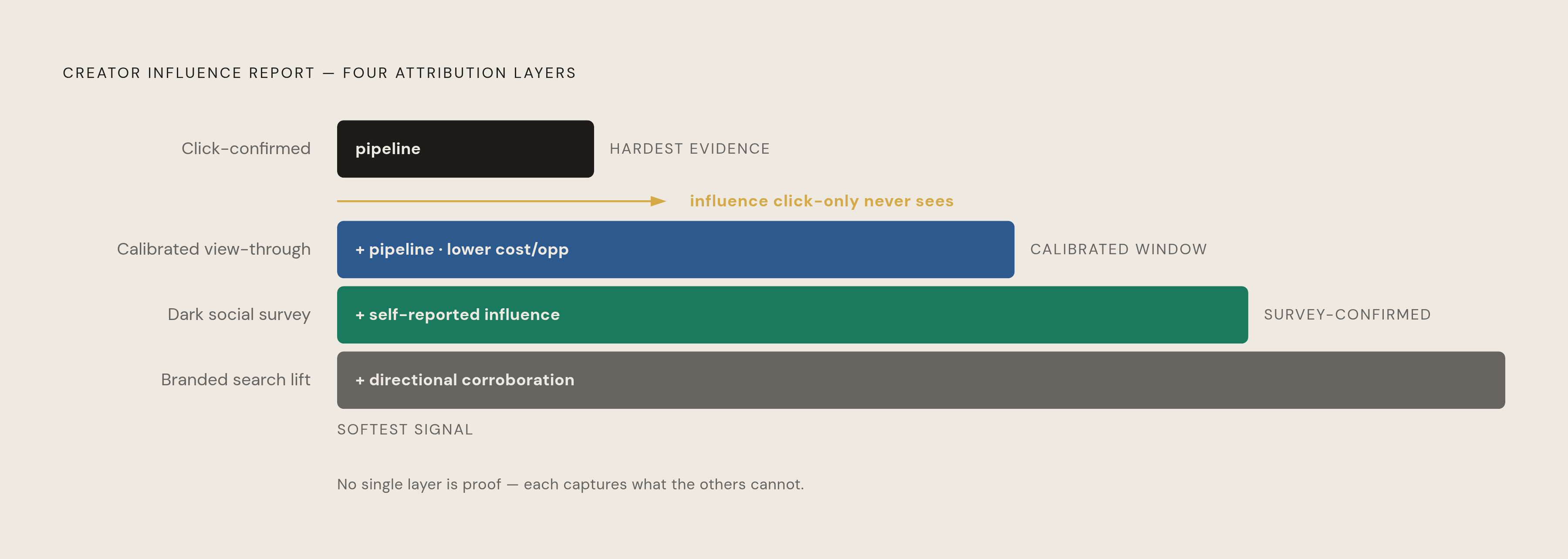
The gap between click-only and view-through measurement becomes visible once a tiered window and CRM integration are in place. Click-through attribution on its own might surface just a single pipeline opportunity, at a high cost per opportunity. Expanding the same campaign's measurement to include calibrated view-through attribution can surface a materially larger number of opportunities at a substantially lower cost per opportunity. That difference is the influence creator content was already generating that click-only measurement was never built to see.
The deliverable that this whole framework is building toward is a creator influence report with four distinct parts: click-confirmed pipeline, view-through-influenced pipeline measured within calibrated windows, survey-confirmed dark social pipeline, and branded search lift as a directional corroborating signal. Each part gets read alongside the others. None of them stands alone as proof. For a mid-market B2B brand running a structured program with consistent creator partners, that stack is what turns creator investment into a demand generation channel with attributable CPL and pipeline, measured on actual outcomes rather than treated as a brand exercise counted in impressions.