GTM Team Distribution on LinkedIn Through Creator Amplification
Personal profiles outreach farther than company pages, so GTM teams need multiple voices.
LinkedIn's feed no longer treats a post from a company page the way it treats a post from a person. Demand Sage's 2026 LinkedIn Statistics report found that nearly all B2B marketers already use LinkedIn for content marketing and lean on it for organic reach, so the buyers are sitting right there. LinkedIn's ranking system also weighs who is doing the engaging: when people with real standing in an industry comment or share, the post gets amplified further than it would otherwise. A company page isn't where that trust gets built anymore. It gets built on the personal profiles of the people who work there, and any GTM team that hasn't accepted this is distributing into the wrong surface.
B2B buyer research on LinkedIn before the sales call
Buyers use LinkedIn to size up vendors long before they ever book a call, and that early research shapes pipeline outcomes in ways most dashboards never pick up. The 2025 Edelman-LinkedIn B2B Thought Leadership Impact Report points to what it calls "hidden buyers": people inside the buying company who never take a cold call but who see a founder's post, read a useful framework, and bring that vendor into an internal conversation sales never sees coming. LinkedIn is one of the only channels where organic content reaches both the visible decision-maker and those invisible internal advocates, well before an account even shows up on a sales team's radar.
What founder-led distribution produces when it works
A GTM leader who posts consistently, with a real point of view, turns a personal LinkedIn profile into a demand-generation engine that beats brand content on reach and on the quality of what it converts. What earns that reach is not a product announcement or a recycled company update. All of that said, one voice, however sharp, only reaches one slice of the audience. That's the limit the next section gets into.
The ceiling on a single founder voice and the case for team distribution
One founder or executive, no matter how good the content, only reaches one segment of the market with one point of view. Scaling past that means putting more named voices into the mix, each covering different ground, so the company's presence on LinkedIn stops depending on a single person's output. The fix is straightforward: bring in one or two more domain specialists, maybe a VP of Engineering, a Head of Product, a Head of GTM, and let each one run their own voice on their own topic lane. Any buyer who doesn't already follow someone on the team simply never sees that content, no matter how good it is. That's the gap creator amplification exists to close. Creators don't replace the GTM team's voices, they carry those voices, and the company's point of view, into buyer communities the team has no organic way of reaching on its own.
Which GTM roles should lead on LinkedIn
Not every role on a GTM team belongs on LinkedIn in the same way, and the ones that should lead are the ones whose day-to-day expertise lines up with the exact questions a buyer is asking before they ever talk to sales. Each role needs its own clear lane so the content doesn't overlap, and together they cover the whole buying committee even though no single post is written for everyone on it. The CEO or founder owns market perspective: framing the category, stating a point of view, showing conviction about where the industry is headed, which is the content that shapes how a buyer thinks about the problem before they even start comparing vendors. The Head of GTM or CMO owns demand generation thinking: frameworks, observations about the buyer journey, lessons from running go-to-market, aimed squarely at the revenue leaders and ops buyers inside the ICP. The VP of Sales or a senior AE owns the deal-stage view: what objections keep coming up, what buyers actually say in calls, which makes this voice the most credible one to the practitioners and economic buyers sitting across the table in a real evaluation. The Head of Product or VP of Engineering owns the technical ground: use cases, product reasoning, where the roadmap is headed, content that reaches the technical evaluators and champions who shape a deal in conversations a CRM record never captures. The CS or implementation lead owns the proof: customer outcomes, onboarding patterns, what drives retention, which speaks to expansion buyers and lowers the risk for anyone late in the buying cycle who's still nervous about the purchase. Running this well takes editorial coordination, a real publishing rhythm, and content built to earn attention rather than just rack up impressions, and some structure behind it is what lets most in-house teams hold that together.
Creator amplification and GTM team reach into buyer communities
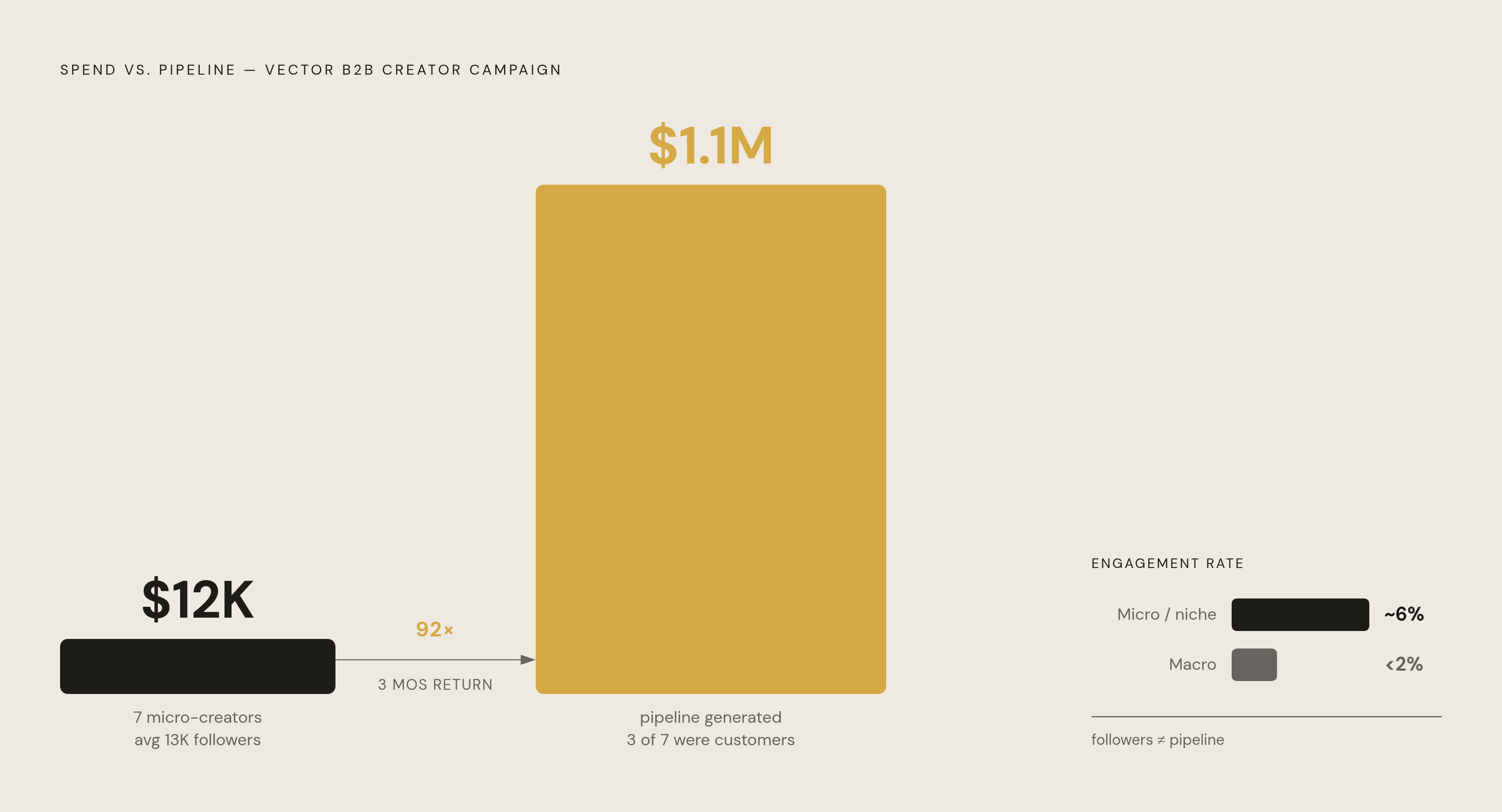
Paying creators whose audience already overlaps with your target buyers gets you there faster, and more credibly, than trying to build brand awareness from zero, because the trust that creator already has transfers to the brand the moment they vouch for it. What's actually being bought in a creator deal isn't reach, it's borrowed credibility: expert endorsements persuade buyers more than the same message coming from the company itself, so the creator's reputation is the real asset on the table. Audience composition determines pipeline outcomes more than audience size does. The B2B SaaS company Vector proved this out directly: it spent $12,000 across seven creators averaging 13,000 followers each and generated $1.1 million in pipeline over three months, and three of those seven were already customers. The logic behind every one of those picks was audience fit. Engagement tells a similar story: micro and niche B2B experts average around 6% engagement, compared to under 2% for macro-creators, because a smaller audience made up of genuine subject-matter followers resonates harder than a mass following ever could. None of this replaces what the GTM team is already posting. It extends the same point of view into audiences the team has no organic path into, and the strongest programs pair a team member's post with a creator's post on the same topic, told from an independent practitioner's angle.
How to select creators whose audiences match your buyers
Picking creators for a B2B campaign should work like vetting a candidate against a list of ICP requirements, not browsing for whoever has the biggest following, because audience makeup, not follower count, is what actually drives the pipeline outcome. Engagement rate works as a sanity check rather than the headline number: micro-tier creators with 10,000 to 50,000 connections tend to post a median engagement rate above the platform's overall median, so any creator charging a premium rate should at least clear that bar. LinkedIn itself is building infrastructure for exactly this kind of vetting. The LinkedIn Creator Marketplace launched in alpha on June 10, 2026, letting brands search vetted creators by topic and expertise, check audience composition, find organic posts that already mention the brand, and move straight into amplifying with Thought Leader Ads. Creators get in through a new Monetization tab, though access for now is limited to select countries and to content in a limited set of languages.
What creator campaigns cost
Creator sponsorships on LinkedIn are priced mostly on audience quality rather than raw follower count, so a well-targeted B2B program can get started on a modest budget concentrated in the micro-creator tier without giving up anything on audience fit. Favikon's review of 136 LinkedIn influencers found that most sponsored B2B posts cost between $200 and $2,000, and the actual transacted median across real client deals in 2026 is $798. For a GTM team with no creator program running yet, three to five micro-creators, the same range Vector operated in, is a realistic and measurable place to start, giving a team enough spread to test audience fit without overcommitting budget before there's any pipeline data to point to.
Amplifying creator content with LinkedIn's paid formats
The best amplification approach takes an organic creator post that has already proven it resonates and puts paid spend behind it, rather than launching a cold ad that has none of the creator's built-in credibility. The full stack runs three layers deep: the organic creator post itself, that same post boosted as a Thought Leader Ad (which lets a company sponsor and promote a person's post instead of a brand-page post), and BrandLink in-stream pre-roll, which places video next to creator and publisher content inside members' feeds. The order matters. The Creator Marketplace folds Thought Leader Ads directly into its discovery flow, so a brand can go from finding a creator to amplifying their post without leaving Campaign Manager, which is the end-to-end loop LinkedIn has said it's building toward. Notion's approach is the clearest picture of what this looks like at its most mature: rather than treating each sponsored post as a one-off placement, the company coordinates creator content as a fleet, timing and pairing posts the way a media buyer would plan a channel, not a single campaign.
Measuring creator campaigns in pipeline terms
A creator campaign judged only on impressions and engagement will almost always undercount its real value, because B2B sales cycles run long and the influence of a single post can appear in a deal months after it was published. If a campaign has a fixed start and end date, it only catches the buyers who happen to already be close to a purchase decision while it runs, but always-on programs build value across the entire buying cycle and deliver meaningfully stronger returns over time. A 30-day dashboard misses most of what a creator post actually generates, because the pipeline signal can take months to appear after the post went live. A pipeline-first GTM team needs a measurement stack built around that lag. That means tracking clicks and UTM-attributed traffic from each creator's post to gated or high-intent pages, tracking lead volume and lead quality from that traffic by source inside the CRM, tracking the sales-accepted rate on creator-sourced leads against every other channel, tracking pipeline dollars tied to creator-influenced contacts using a multi-touch model rather than last-click credit, and tracking cost per sales-qualified lead against equivalent paid LinkedIn campaigns. Those are the figures that actually get a CFO's attention. Mature always-on creator programs post substantially stronger ROI at the 12-month mark than programs run in short bursts, which is the argument for treating creator-led distribution as a standing channel. What you put in front of leadership should be influenced pipeline by creator, cost per SQL by creator cohort, and sales cycle length for creator-sourced deals against everything else, not impression counts and not engagement rate treated as the main metric.
Running a GTM creator program operationally
The sheer workload of running a creator program, writing briefs, negotiating contracts, managing approvals, processing payouts, pulling attribution, is the biggest reason most B2B GTM teams launch one or two creator relationships and never grow past them. Building briefs with AI assistance that bakes in ICP criteria, messaging guardrails, and the creator's own tone can fix that failure point without adding headcount. Payouts matter because a creator who waits weeks to get paid after posting isn't likely to work with that brand again, so fast, automated payout is how a program keeps its best creators around. Reporting is the other load-bearing piece: without UTM-level attribution tied back to CRM pipeline, nobody can defend the program at a budget review, so that reporting infrastructure is what turns creator spend into a repeatable line item instead of a one-off experiment nobody wants to repeat. Some GTM teams want to run all of this themselves with the right platform behind them, others want a managed layer handling sourcing, briefing, and reporting on their behalf, and both are workable models as long as the infrastructure underneath supports either one.
Structuring the first 90 days of a GTM creator distribution program
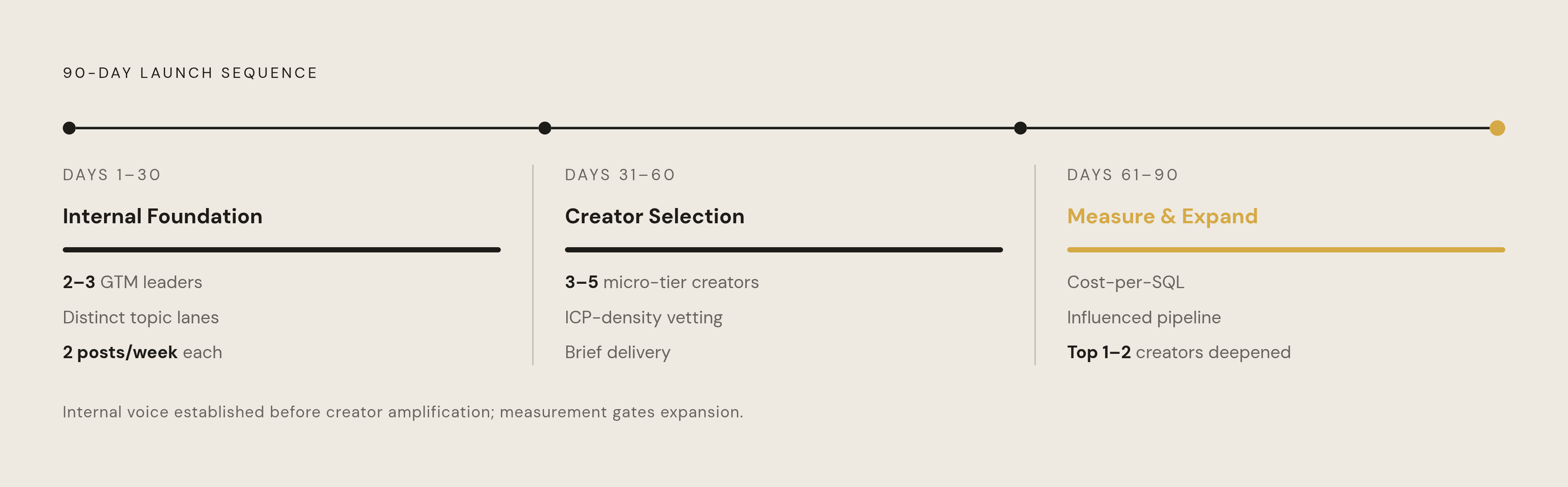
You don't need a huge budget or a fully built-out creator network to get a GTM creator distribution program off the ground. It takes a sequence: build the internal voice foundation first, layer in vetted creator amplification next, then measure everything in pipeline terms. The first 30 days are about the internal foundation. Pick two to three GTM leaders whose roles map directly onto what buyers are actually asking, typically the founder or CEO, one sales or GTM lead, and one domain specialist, and give each one a distinct topic lane and a steady publishing rhythm, even two posts a week per person is enough to start building algorithmic authority. Days 31 through 60 move into creator selection and the first campaign: pick three to five micro-tier creators using the ICP-density checks already covered, favoring existing customers or practitioners in the target segment, and brief each one on the specific message, the ICP being targeted, and a content format that fits how they already post, so the result sounds like them. The final stretch, days 61 through 90, is where the program gets measured, reported, and expanded: report sales-accepted lead rate, cost per SQL, and influenced pipeline by creator rather than leading with impressions or engagement, find the one or two creators whose audience and content performance line up most closely with real pipeline, and deepen those relationships going into the next quarter. Stack the program's cost-per-SQL against equivalent paid LinkedIn spend, since that's the number that actually earns more budget. Present the 90-day results as a channel performance report, not a social media recap, because that framing is what decides whether the program keeps growing or quietly stalls out. That sequence, internal voices first, creator amplification next, pipeline measurement throughout, is the whole thesis of this piece in practice: a GTM team's LinkedIn presence turns into a real distribution channel once it's deliberately paired with creators whose audiences already hold the buyers that team is trying to reach.