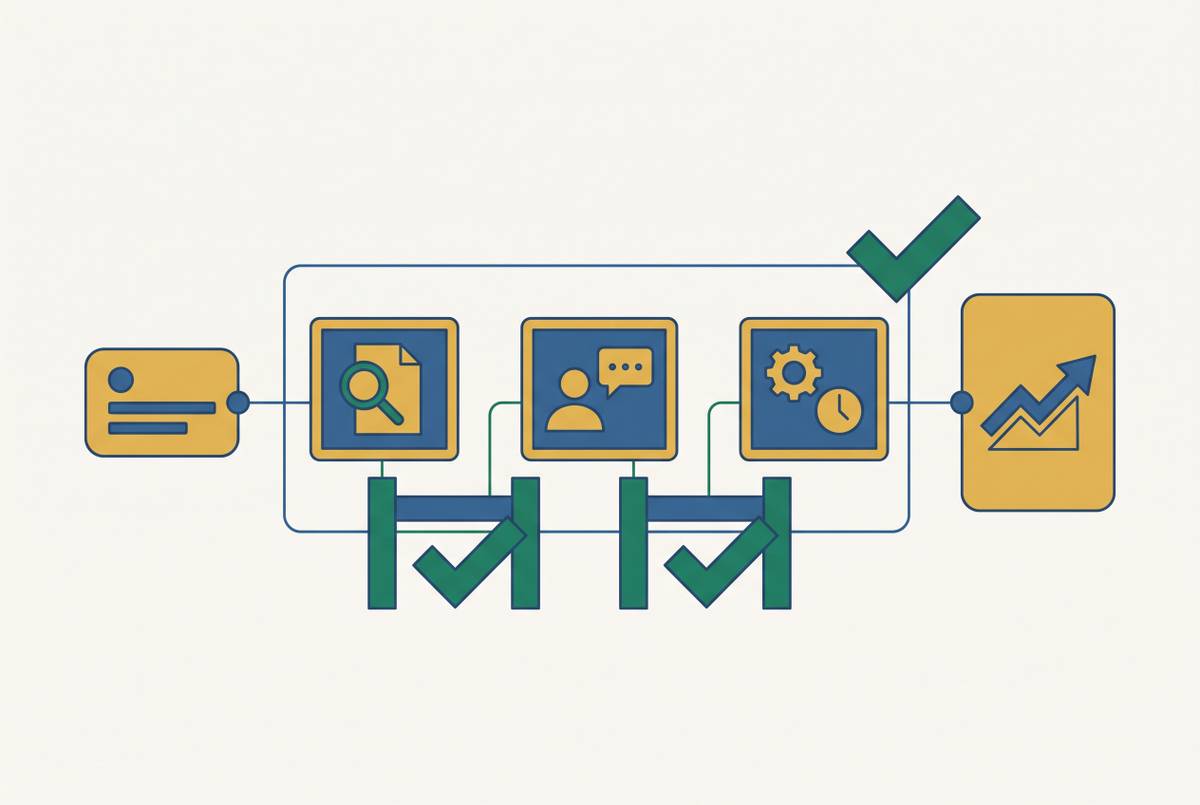
Automating Creator Payouts for Multi-Creator LinkedIn Programs
Automating payments unlocks B2B creator programs stuck in spreadsheet limbo.
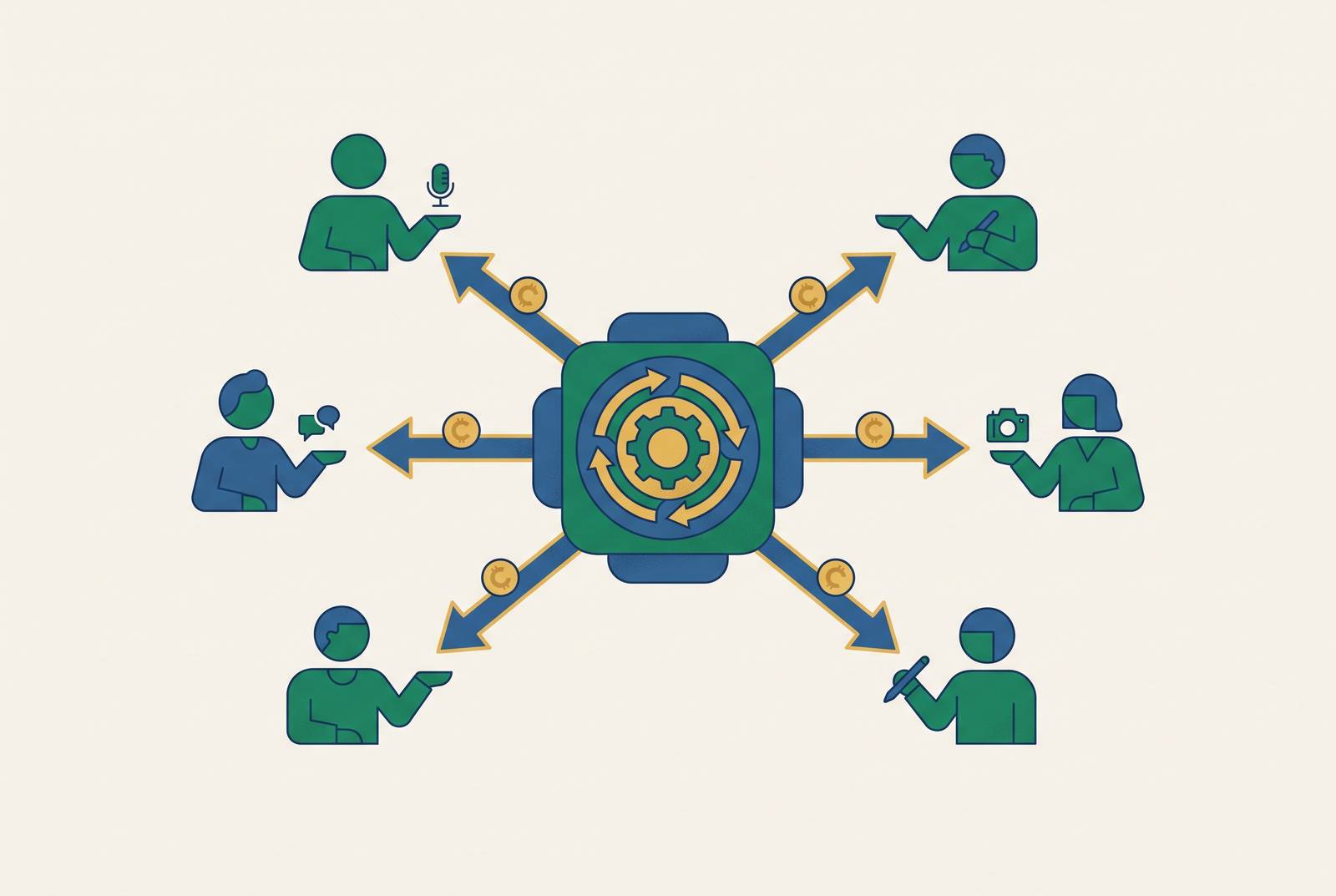
B2B teams running LinkedIn creator programs hit the same wall: payroll. Once a program grows past a handful of creators, the work of paying them, contracting them, and keeping their tax paperwork straight becomes a job on its own, and that job stalls programs before anyone can prove they work. Automate the payout layer, and a scrappy creator initiative turns into something finance funds quarter after quarter. Skipping that step kills the strongest content strategy in a spreadsheet, next to a stack of unsigned W-9s.
The LinkedIn-Ipsos B2B Marketing Benchmark found that 55% of B2B marketers already run creator or influencer marketing on LinkedIn, and another 29% plan to start within the year. The LinkedIn-Ipsos B2B Marketing Benchmark found that 55% of B2B marketers already run creator or influencer marketing on LinkedIn, and another 29% plan to start within the year. Investment in creator marketing on LinkedIn grew 171% year over year, and 61% of B2B marketing leaders plan to spend more on creator content this year. Teams are building rosters of dozens, all running at once, and that's where the operational math stops being simple: contracts per creator, payment timing, tax forms per country, currency conversion, compliance tracking. None of that scales in a straight line. What worked at two creators, a spreadsheet, a wire transfer, a W-9 in a folder somewhere, turns into a full-time coordination job at twenty.
What "multi-creator program" means in a B2B LinkedIn context
A multi-creator program is an ongoing set of relationships with a roster running at the same time, each creator on different terms, different formats, different pay structures.
That roster splits into a few distinct groups, and each group gets paid differently. Industry analysts and category experts sit at the top: highest trust, most expensive, slowest to bring on board, usually locked into flat-fee deals negotiated one at a time. Operator-creators, founders, VPs, senior practitioners with 5,000 to 50,000 followers concentrated in the exact buyer roles a company targets, make up the largest and most cost-efficient tier. Customer influencers are existing buyers with a LinkedIn following, often paid through advisory arrangements or community perks rather than a standard per-post fee. Internal executives running founder-led distribution get paid on a structure that looks nothing like any outside creator deal.
Favikon's analysis of 132 companies running LinkedIn creator campaigns found 83% were SaaS companies, which tells you a lot about the shape of the programs this piece is describing.
Each tier drags in its own payout variables. Fee structures vary by post, retainer, or milestone. Format changes the price too: Format also affects price, with carousel and video posts typically commanding a premium over plain text, though the exact spread varies by creator and niche. Geography matters just as much. That same survey put median pay per post at $500 to $550 in the US, UK, Canada, and Mexico, versus $300 in France and $155 in India. A single 20-creator program can span all of that at once: 20 different payment amounts, 20 currencies or tax situations, 20 sets of contract terms, each needing its own tracking.
The four payout variables that multiply with every creator added to a program
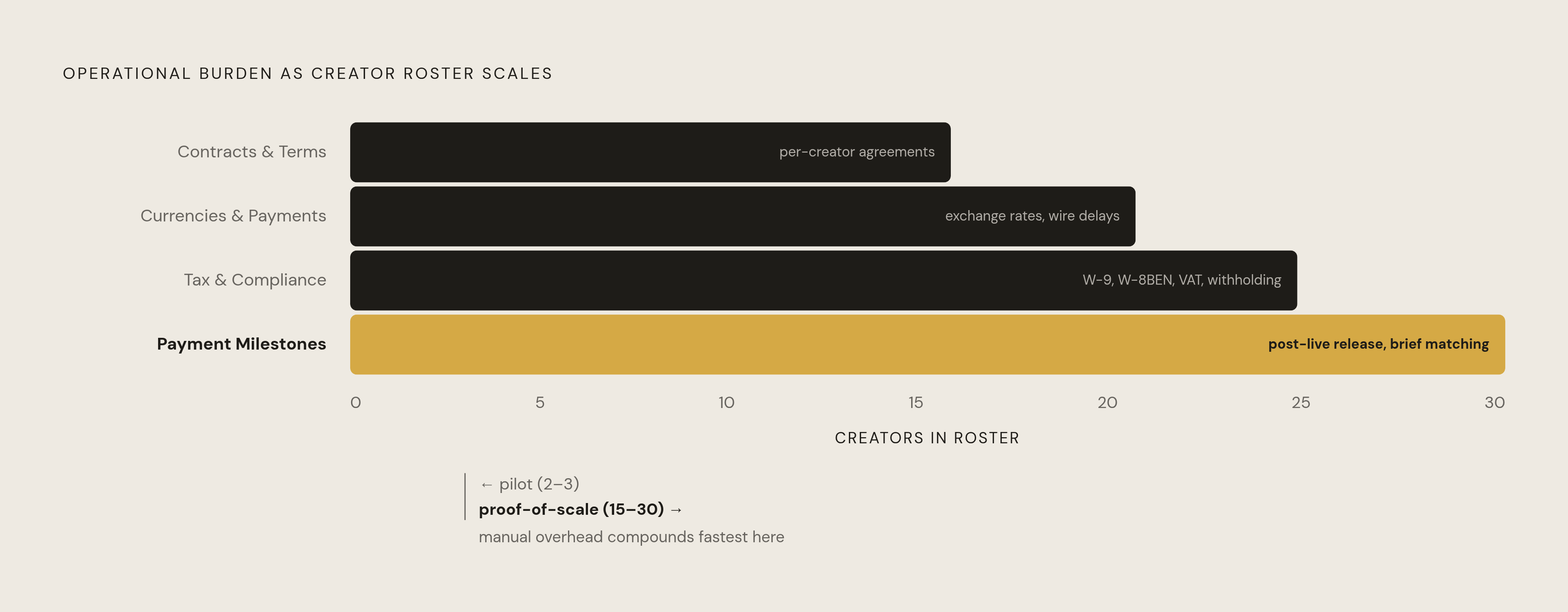
Four things get harder with every name added to the roster, and none of them scale in a straight line.
Contracts and terms come first. Every creator relationship needs its own agreement covering deliverables, format, exclusivity windows, revision rights, usage rights, and FTC disclosure language. Because format premiums differ, one creator might carry two different rates within the same campaign: one for a carousel post, one for video. Tracking signature status and compliance by hand, across a growing roster, causes version-control mistakes and audit gaps that nobody notices until a legal review turns them up.
Currencies and cross-border payments come next. A program running across four or five countries has to handle multiple currencies, and LinkedIn's creator base stretches well past the US. Exchange rate timing changes what a campaign actually costs. Manual wire transfers add delays and fees, and those delays cost more than money: they wear down the goodwill of creators watching how reliably they get paid.
Tax documentation and compliance follow close behind. US-based payors need a W-9 on file for domestic creators and a W-8BEN for international ones, collected before the first payment goes out, with no minimum dollar threshold that lets a company skip it. Misclassification risk, treating a contractor like an employee or vice versa, grows right alongside roster size. Cross-border programs add VAT rules, withholding requirements, and local contractor law that differ by country, so every new market added to the roster is a new compliance problem.
Payment timing and milestone tracking round it out. Creator pay is usually tied to a deliverable, such as a post going live, a performance number hitting, or a campaign wrapping. Tracking which posts published, whether they matched the brief, and releasing payment on that basis is a workflow, not a checklist, and spreadsheets stop holding up once the roster gets big. Late or inconsistent payment is the fastest way to lose a creator to a competitor willing to pay on time, and that's a roster risk as much as an accounting one.
Why the manual approach breaks at the program-proving stage
The break point sits at the jump from pilot (two or three creators) to proof-of-scale (fifteen to thirty). That's exactly where manual overhead compounds fastest, and it's the stage most programs never survive.
At pilot size, one ops person tracks payout status in a shared sheet without much strain. At program size, that same person is now doing accounts-payable work full time, no matter what their job title says.
The TopRank Marketing 2025 B2B Influencer Marketing Report, based on 404 US B2B marketing professionals, found 99% of teams using an always-on influencer approach rate their program as effective. Always-on is the goal everyone's chasing, and for good reason, but it only works if creators get paid reliably, month after month, without someone chasing down a new vendor form every time. Manual processes buckle under that rhythm.
A creator's payment slips two weeks because finance needs a corrected invoice or updated compliance documentation on file. The creator goes quiet, skips a planned post, and the campaign loses momentum right when someone's trying to pull attribution numbers together. A quieter failure runs alongside it. The team spends more hours on payout admin than on writing good briefs or managing the creator relationship, the two things that actually move performance.
Programs like this rarely stall because the strategy was wrong. They stall because the back-office layer wasn't built for the volume, and because they stalled before producing clean data, the whole channel loses its shot at a bigger budget next cycle. Payout friction doesn't just create busywork. It kills the evidence the program needs to survive.
What automated payout infrastructure handles end to end
Payout automation isn't just "pay people faster." It covers four layers of work that, done by hand, eat a program alive.
Contracts and briefs get standardized: templates that auto-fill creator-specific terms (deliverables, format, fee, exclusivity, disclosure language), paired with e-signature workflows that leave an audit trail instead of a thread of emailed PDFs. Some platforms add AI-assisted brief generation, turning a campaign goal into creator-ready guidance without needing a copywriter for every single activation.
Tax and compliance collection happens automatically. W-9 and W-8BEN forms get collected at onboarding, before a single dollar moves. Contractor classification records get stored and stay audit-ready. Cross-border payments route through the correct withholding and currency handling for whatever jurisdiction the creator sits in.
Payment execution triggers off milestones, a post goes live and clears brief review, rather than waiting for someone to remember to process it. Multi-currency disbursement happens without the marketing team wiring money by hand, and payout records sync automatically with finance for reconciliation.
Reporting and attribution tie it together. Payout data links to campaign performance: cost per post, cost per click, cost per lead, and eventually pipeline. That link is what turns ROI into a number you calculate instead of one you assemble from six spreadsheets after the fact. When every payment ties back to a specific creator and a specific post, attribution stops being guesswork.
How payout automation changes the unit economics of creator campaigns
Manual payout management carries a hidden cost: staff time. Contract drafting, chasing tax forms, initiating wires, reconciling currency conversion, none of that appears in the creator fee line item, but all of it belongs in the real cost of running the channel.
At twenty-plus creators, that overhead eats a real chunk of the total budget. The effective cost per lead runs worse, sometimes a lot worse, than the sticker price on creator fees suggests. Automation strips that overhead out. The same headcount runs a bigger roster, or a smaller team runs a program that used to need a dedicated ops hire just to keep the lights on.
The upside is worth chasing, but only if the program gets far enough to bank it. Industry data puts the average return at $5.20 for every $1 spent on influencer marketing, and Research has found 83% of marketers say sponsored influencer content beats brand content on conversions. Those numbers appear only if the program runs long enough, and cleanly enough, to generate the data behind them. A program that stalls halfway through on payment friction never gets there, and never gets to walk into a budget meeting with proof.
Payment reliability doubles as a recruiting edge. Creators with real B2B audiences have options, and who pays on time factors into who they choose to work with again. TopRank's data found teams without an always-on approach were 17 times more likely to call their program ineffective, and always-on only survives operationally if the payout logistics behind it run on autopilot. Otherwise "always-on" just means "always behind."
Criteria for evaluating payout automation options for a B2B creator program
Some capabilities aren't optional once a program passes a handful of creators. Multi-currency payment support with automatic conversion built in is one. Tax form collection, W-9 and W-8BEN, needs to sit inside onboarding rather than get bolted on after the fact. Payments should trigger off content events, a post going live, a brief getting approved, rather than someone manually releasing funds. An audit trail needs to export cleanly for finance to reconcile. Contracts, briefs, and payments should live in the same system, because splitting those across three separate tools just rebuilds the coordination overhead automation was supposed to remove.
A few questions cut through the vendor pitch fast. Does the platform connect payment records to campaign performance, or does someone still have to stitch attribution together by hand afterward? How does it route cross-border payments, and can a creator in India or France actually receive the money without fees eating a chunk of their pay? Does it support both self-serve and managed setups, or does it force a team into one operational mode regardless of fit?
Payout tools that don't talk to the campaign management layer, briefs, content approval, performance tracking, aren't really creator program platforms. They're accounting software wearing a marketing skin. LinkedIn's own Creator Marketplace, which launched in alpha for the US and Canada on June 10, 2026, handles discovery well but doesn't currently offer end-to-end payout infrastructure. Third-party platforms covering discovery through payment in one workflow are filling that gap.
Payout automation is only half the job. A platform also needs audience-fit filtering, ICP alignment and the seniority of a creator's followers, so the roster getting paid is actually the right roster. Automating payments to the wrong creators faster is just faster waste. It's just faster waste.
Building a creator program that finance will fund again next quarter
Payout automation is a marketing decision, full stop. Without it, a program can't produce the attribution data it needs to defend its own budget next quarter.
A well-instrumented, automated program produces clean cost-per-post records broken out by creator and format, a traceable line from creator post to click to lead to pipeline, and creator performance benchmarks that shape next quarter's roster decisions based on who actually drove pipeline, not who racked up impressions.
That's the real difference between running a few creator campaigns and building a creator channel. A channel has repeatable unit economics. It has a feedback loop that sharpens each cycle. Its budget grows because the returns are visible. The LinkedIn-Ipsos B2B Marketing Benchmark found brands running creator programs outperform non-users by up to 39% on engagement and 30% on revenue growth and lead generation, and that's the ceiling worth chasing, but only if the program runs long enough and cleanly enough to prove it happened.
Before signing the next creator, audit the current payout process. Find exactly where the manual steps live and what breaks once the roster hits twenty, because something will break there. Payout infrastructure has to go in as a prerequisite for scaling the roster. Pick a platform that covers discovery, briefs, contracts, payouts, and attribution in a single workflow, because the overhead that never gets automated is the overhead sitting in the gaps between disconnected tools.
Creator-led acquisition on LinkedIn has become a measurable, repeatable demand-gen channel. It earns that title only when the infrastructure that supports it can run at real volume without falling apart.