Approval Workflow Design for B2B LinkedIn Sponsored Content
Speed matters when creators' posts lose momentum days after publishing.
Approval workflows are the reason good LinkedIn creator campaigns die quietly. A draft sat in someone's inbox for six days while three people argued about a word choice, not because the content was weak. The teams getting this right have settled on a specific, role-clear process that keeps compliance intact without grinding creator relationships to dust, and that process is what this piece maps out.
Approval workflows as a campaign-speed problem
Creator marketing on LinkedIn crossed from experiment to standard practice fast. 55% of B2B marketers already run creator programs on the platform, and another 29% plan to start within the year. Adoption is heading toward roughly 84%. The teams still treating this as a side project are about to be the minority.
Spend is moving even faster than headcount. Creator marketing on LinkedIn grew 171% year over year, and 61% of B2B marketing leaders say they're putting more budget behind it this year, not less. That growth curve changes what "approval workflow" even means. A team running one or two creator campaigns a quarter can survive a clunky, ad hoc review process. Nobody notices the friction. But scale that to a dozen creators and three campaigns running simultaneously, and the same sloppy process becomes the thing that kills velocity.
Delay has a real cost here, not an abstract one. A creator who submits a draft and hears nothing for a week cools off. The posting window tied to a trending topic closes. LinkedIn's algorithm rewards early engagement, so a post that goes live five days late has already lost the momentum it needed. Sponsored content is time-sensitive in a way that a lot of B2B marketers still underestimate.
Structural differences between LinkedIn sponsored content approval and other content review
Most brand content review assumes the brand controls the asset from draft to publish. LinkedIn sponsored content doesn't work that way, at least not for Thought Leader Ads, which are the dominant format right now. TLAs amplify an organic post that already exists on someone's personal profile. The brand is paying to boost something the creator already wrote and posted. The brand is paying to boost something the creator already wrote and posted, so the entire review has to happen before that post goes live organically, not after.
There's a platform mechanic layered on top of this. Once a brand sponsors a creator's post, LinkedIn sends that creator (or employee) a notification, and they have to actively approve the sponsorship before the campaign goes live. The creator's response time depends entirely on whether they're expecting it. But only if the creator already knows it's coming. A creator blindsided by a random notification sits on it, or worse, ignores it.
As of June 2026, LinkedIn widened who's eligible for this. TLAs now extend beyond employees to non-employees: advisors, contractors, outside thought leaders. That's a much bigger pool of content flowing into brand review, and a much bigger pool of people who need to understand the approval mechanic before their first post ever gets sponsored.
Format restrictions matter for workflow design too, because they shape what reviewers are even looking at. Documents, polls, multi-image posts, reshared content, and "celebrate an occasion" posts can't be promoted. What can be promoted: short opinion posts, data-backed observations, counter-intuitive takes, practitioner frameworks. These are formats built on real creative judgment, not templates you can rubber-stamp. That has direct consequences for how reviewers should spend their time, which the next few sections get into.
The four roles that must be defined before any review starts
Most approval bottlenecks are role ambiguity failures. They're role ambiguity failures. Too many people have veto power, nobody has actual final say, and reviewers don't know what they're supposed to be checking for.
Four roles need to be nailed down before a single campaign launches:
The brief owner writes the creative brief and is accountable for translating brand goals into direction a creator can actually use. This person owns the standard the content gets measured against, which matters because it means feedback later has to trace back to the brief, not to personal taste.
The brand or legal reviewer checks for compliance: regulatory risk, trademark use, claims accuracy. This role runs through a fixed checklist once. It does not make creative calls, and it shouldn't be rewriting sentences.
The final approver is the one person with authority to say yes. In most B2B marketing teams, that's the campaign manager or the head of content. Their job is to decide, not to polish the copy.
The creator liaison is the single point of contact for the creator all the way through review. This person manages how feedback gets delivered, protects the relationship, and stops creators from getting three contradictory sets of notes from three different people.
If these roles aren't defined, reviewers default to whatever they personally like instead of checking against the brief. Creators get conflicting feedback and start losing confidence in the partnership. Revision rounds multiply because there's no one person who can actually close the loop and say "done."
Creators control the final LinkedIn-level approval step, and their acceptance is required before the campaign goes live. They're the last checkpoint.
Building the brief so that approval becomes a checklist, not a negotiation
A brief that's actually built well cuts down approval rounds, because it hands reviewers something objective to check against instead of a blank canvas for their own preferences.
A LinkedIn creator brief needs a specific set of elements to make review fast instead of endless. Start with the ICP definition: who, specifically, in the creator's audience is this post supposed to reach. That single anchor keeps feedback tied to audience fit instead of brand vanity metrics. Next comes one core claim. Single-point posts perform better on LinkedIn anyway, and they're dramatically easier to review against.
The brief also needs a clear list of what the creator must not say: specific claims, competitor names, regulatory language to avoid, laid out as a short exclusion list rather than a vague "stay on brand" instruction that means nothing to anyone. Format guidance matters too. Spell out the structural constraints for the intended format, keeping in mind that only certain post types are eligible for TLA promotion.
Voice latitude might be the most overlooked piece. State explicitly how much the creator can deviate from the brief in tone, structure, framing. The more room granted upfront, the less time gets burned negotiating it during review. Round it out with an approval deadline and go-live date built directly into the brief, so the creator and the internal team are working off the same calendar from day one.
AI-assisted brief creation appears more often in B2B creator platforms now, not as a replacement for strategy but as a way to shrink the gap between "campaign concept" and "creator-ready document."
A reviewer should be able to finish their check quickly, using only the brief's stated criteria, without asking the brief owner a single clarifying question.
The staged review structure that prevents pile-on feedback
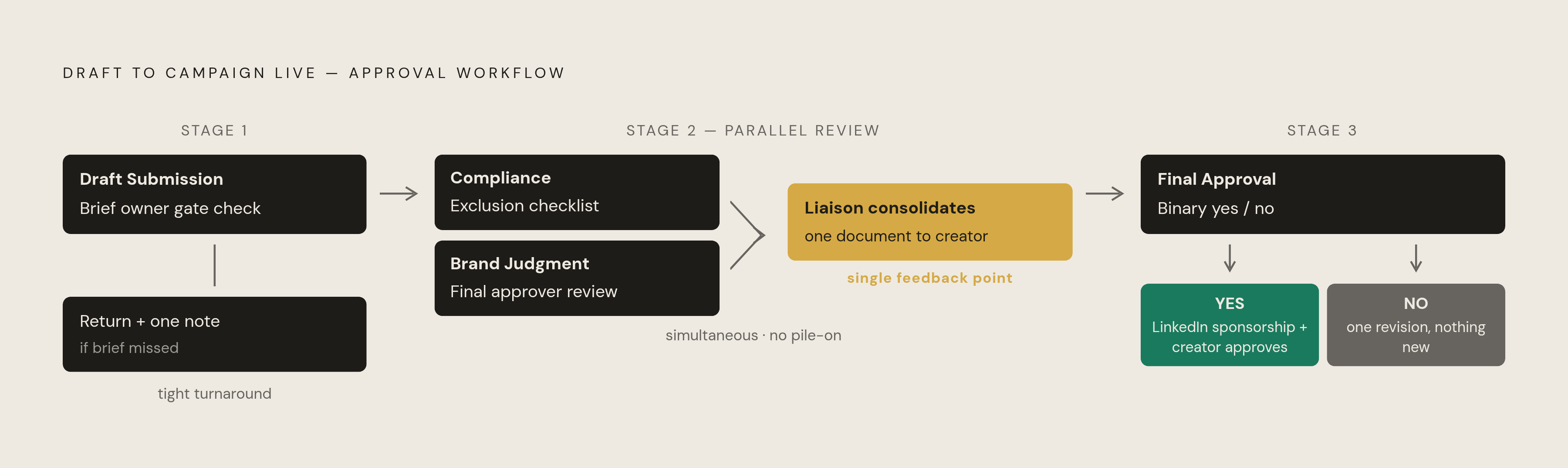
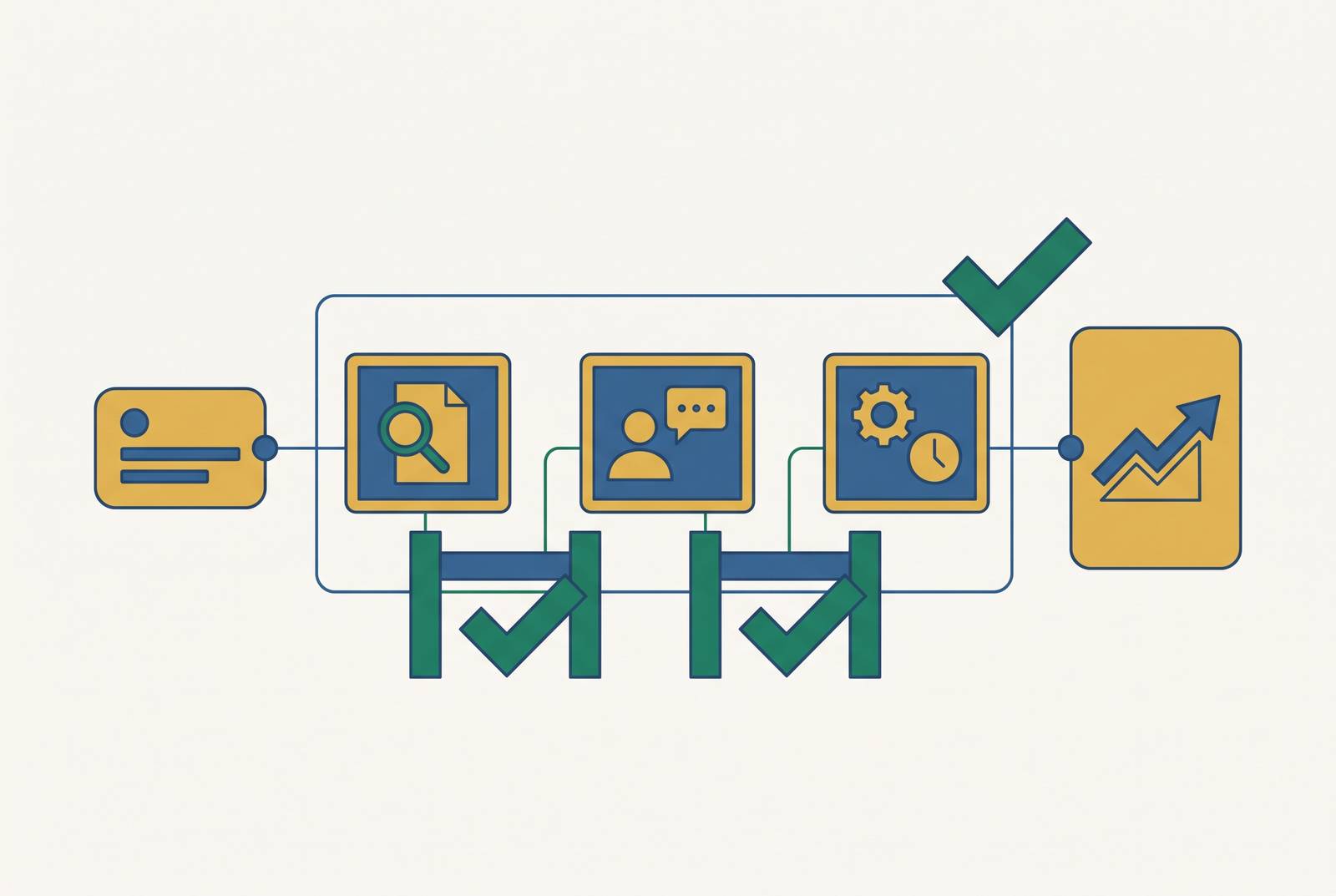
Sequential review, where person A reviews, then hands to person B, who hands to person C, multiplies elapsed time every step of the way. Staged parallel review, where every role checks within their own defined scope at the same time, compresses it.
Stage 1, draft submission, with a tight turnaround target. The creator submits a draft against the brief. The brief owner does a gate check, not a full review, confirming the draft actually addresses the core claim and the ICP framing. If it misses the brief entirely, it goes back with one specific note. No other stakeholders get looped in yet.
Stage 2, parallel compliance and brand review, with a defined short window. The brand or legal reviewer runs the exclusion checklist, flagging only what's actually on the brief's compliance list. The final approver reads separately for overall judgment: does this represent the brand appropriately, does it sound like the creator. Both submit their feedback at the same time to the creator liaison, who consolidates everything into one document before it ever reaches the creator. This consolidation step isn't optional. Creators should never see raw, unmediated notes from four different people layered on top of each other.
Stage 3, final approval, with a short window after revision. The creator submits a revision, and the final approver gives a binary yes or no against the consolidated notes. A yes means the brief owner coordinates the LinkedIn-level sponsorship request, the creator approves in-platform, and the campaign goes live. A no means only the final approver can request a second revision, and only on the specific unresolved item from Stage 2, nothing new.
Revision rounds should be strictly limited. Each additional round is a sign the brief was incomplete, not that the content is bad.
Total elapsed time, draft submission to campaign live, should be kept as short as the process allows for a standard TLA campaign. Unnecessary delay is a workflow failure. It is not, whatever anyone tells you, a compliance requirement.
What reviewers should and should not be checking
The single most common thing that kills approval speed: a reviewer assigned to check compliance who instead performs a full creative rewrite, swapping the creator's actual voice for brand copy-speak.
The brand or legal reviewer's job is narrow. Check specific claims against the compliance exclusion list from the brief. Flag competitor mentions, regulatory language, unsubstantiated superlatives. Confirm required disclosures are present, FTC language or platform labeling where it applies. That's the whole job. Sentence structure, word choice, framing, none of that is in scope.
The final approver's job is narrow too, just in a different direction. Does the post match the brief's core claim. Does it read as authentically the creator's voice, not the brand's. Would someone in the ICP actually find it useful or credible. And critically: nothing that compliance already cleared gets re-litigated here.
There's a simple test for whether the whole process worked: if the approved draft could have been written by the brand's own content team, the review failed. The creator's distinctive framing drives the performance difference between sponsored creator content and standard brand advertising. A $12,000 creator program produced $1.1 million in pipeline for one B2B team, and the mechanism behind that number is straightforward: creators spoke in their own voice, to audiences that already trusted them, and the brand didn't sand that voice down into something generic.
Setting creator expectations upfront to protect the relationship
Creator relationships on LinkedIn work best when they're treated as ongoing, not transactional. The strongest B2B creator programs think of creators as partners building familiarity with an audience over time, not vendors executing a single brief and disappearing.
The same trust mechanic that makes creator content effective is what heavy-handed review puts at risk. 87% of B2B buyers say they consult thought leaders when making purchase decisions, and that influence only holds up if those thought leaders read as independent voices, not brand mouthpieces. Squeeze too hard in review and you erase the very thing that made the partnership worth paying for.
Set the following at kickoff, before a single draft gets written. Share the full review process, every stage, so there are no surprises later. Hand over the compliance exclusion list upfront so the creator can self-check before they ever submit, which cuts down flags at Stage 2 dramatically. Confirm who the creator liaison is and how feedback will reach them. Agree on the two-round revision limit now, with the shared understanding that a third round means the brief needs fixing, not the creator's work. And confirm the LinkedIn in-platform approval step explicitly, because plenty of creators working with a new brand partner get caught off guard by that notification, and a heads-up now prevents it from stalling the go-live date later.
There's a reputational layer to all this too. How cleanly a brand's approval process runs is itself a signal of how that brand operates. Creators talk to each other constantly, and a brand known for slow, chaotic review is a brand that struggles to recruit the best voices in its category next time around.
Adapting the workflow for always-on programs versus one-off campaign bursts
One-off campaigns and always-on programs need structurally different approval treatment. Conflating them is a common mistake, one that over-engineers relationships that don't need it and under-engineers the ones that do.
For a one-off or launch campaign, run the full three-stage review described above. Build the compliance list fresh. Let the creator liaison manage the relationship from a standing start, since there's no history to lean on yet.
Always-on programs can shed some of that weight once trust is established. After two or three approved posts from the same creator, build a pre-cleared voice profile: a short document capturing their established framing, tone, and the specific claims they've already been cleared to make. With that in place, the Stage 1 gate check can shrink from a 48-hour window down to a same-day read by the brief owner. Compliance review shifts from a full checklist every time to a delta check, flagging only new claims or new topics that haven't already been cleared. Final approver involvement can even move to a weekly batch review across multiple posts instead of signing off on each one individually, once a creator has proven out.
Overhead is the real reason most B2B teams don't scale creator programs in the first place: too many briefs, too many contracts, too many payout cycles, too many redundant review passes. Running the same full-weight review for a creator who's published a dozen approved posts as for one who's never worked with the brand before is a scaling failure. It's a scaling failure, and it's the exact kind of friction that makes teams quietly abandon programs that were actually working.