Sponsored Creator Posts vs. Organic Employee Advocacy on LinkedIn
Employee advocacy compounds over time while creator posts deliver immediate, targeted reach.
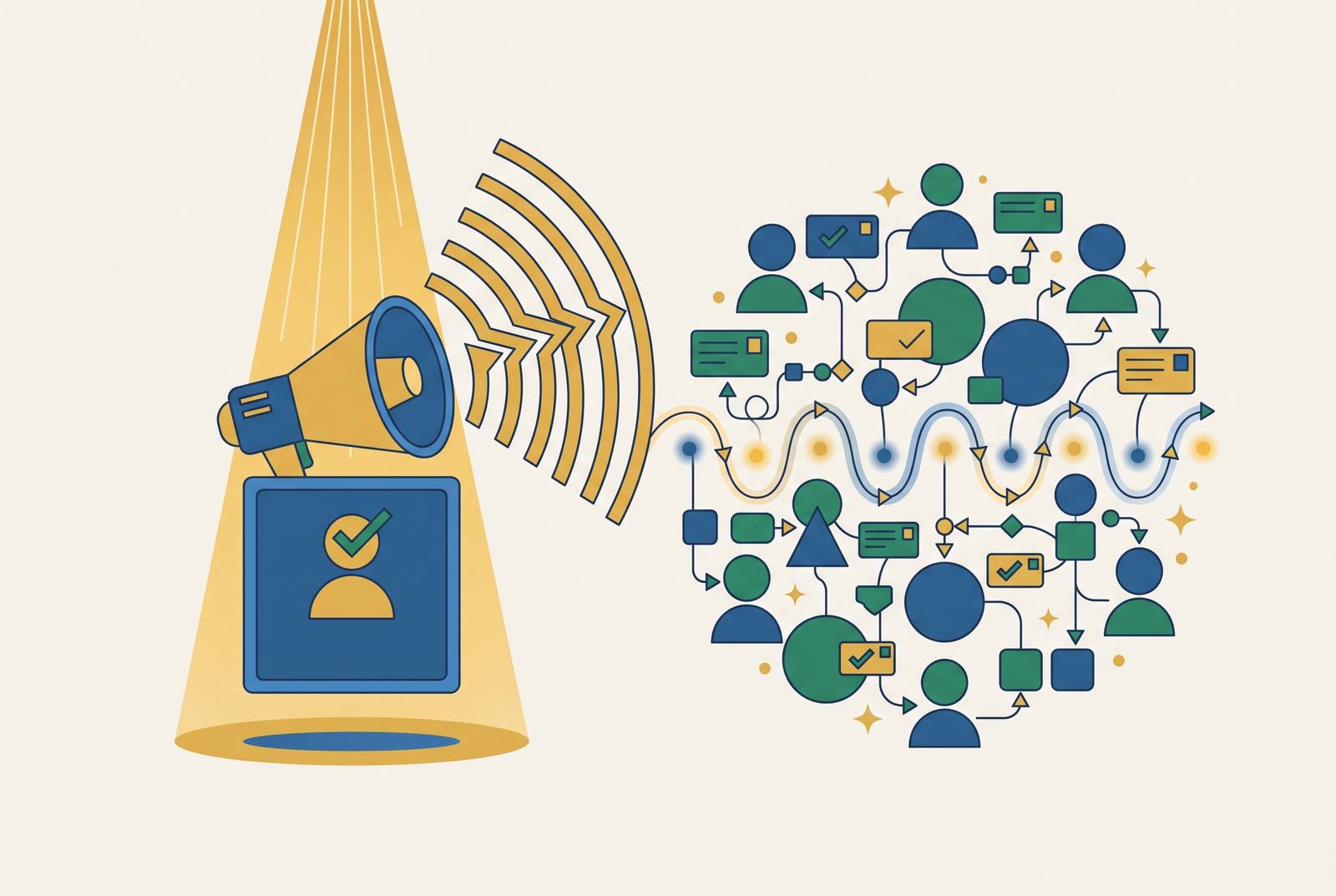
LinkedIn's feed now favors people over brands. A company page post reaches a small share of the audience that a personal post from an individual reaches, and that single design choice reshaped B2B marketing on the platform. Brand-page-only strategies no longer work well enough on their own, which left companies with two paths: pay creators who already have the right audience, or build that audience from inside the company through employees and founders. Favikon's research on companies running LinkedIn creator campaigns found that most of them are SaaS companies running creators as an ongoing growth channel. Both sponsored creator posts and employee advocacy come from the same algorithm shift, but from there they split: they build trust differently, cost money differently, and get measured differently.
How sponsored creator posts work in B2B
A sponsored creator post works by borrowing trust that already exists between a practitioner and an audience that looks like the brand's buyers. That trust only transfers if the post sounds like the creator, not like the brand. LinkedIn's algorithm picks up on language that reads like an ad and cuts its distribution, so the creator's own voice and professional standing have to stay intact. The kind of trust at play here differs from consumer influencer marketing too: a B2B creator earns authority through real work and a career people recognize, not through fame. Favikon's B2B Creator Loop frames the whole selection process around one question: is this person credible enough to put budget behind, regardless of how many followers they have.
Enterprise brands have already built full programs around this idea. SAP ran its "AI in Action" series through LinkedIn's BrandLink program with creators including Allie K. Miller and Bernard Marr. ServiceNow built "The CEO Playbook" with Steven Bartlett and Dorie Clark. Both were ongoing series, showing these companies treating creator partnerships as programs. Notion took a different approach: more than 50 creators changed their profile pictures to cryptic "loading" images at the same time, building curiosity before a coordinated wave of posts landed together. That wasn't a sponsorship of individual voices so much as a brand orchestrating an entire creator network, and it generated unincentivized posts from people outside the paid group as a side effect.
Access to this kind of campaign got easier in March 2026, when LinkedIn opened BrandLink as a self-serve option in Campaign Manager for select customers, a step that previously required a managed relationship with LinkedIn. And within this ecosystem, Thought Leader Ads, which take an existing creator or employee post and push paid distribution behind it, consistently beat brand-page ads on engagement, because they pair a real person's face and credibility with precise targeting. Platforms built for this kind of matching, including Naano, handle the selection work by lining creators up against buyer profiles before any money moves, so teams go from finding the right person to writing the brief to launching the campaign without the manual vetting that stalls most programs before they start.
How employee and founder advocacy builds trust differently
Employee and founder advocacy draws trust from a different well than paid creator content. The audience already knows the person, whether as a colleague, a founder they've followed, or someone they've worked with, and that familiarity carries a different kind of weight than a post from a stranger a brand paid to write it.
Dave Gerhardt's time at Drift is a clear example of what that kind of trust produces. He and CEO David Cancel built their personal LinkedIn audiences and ran the Seeking Wisdom podcast, and inbound demo requests started coming from prospects who opened the conversation by referencing specific things they'd heard from Gerhardt or Cancel directly. Those deals closed at a higher rate and a larger deal size than deals from other channels. Founder-led growth scales this effect further. Unify's founder grew a LinkedIn following substantially through 2024, and the pipeline that followed made LinkedIn one of the company's best channels when you measure by return. Another company's co-founder and CEO reported meaningful pipeline from LinkedIn posts within a single year, and CPOs at major brands were sold on the approach before a demo ever happened.
The quality of the post matters as much as who writes it. When employees write original posts, they outperform shared, unedited company content by a wide margin, and a light editorial pass on shared content still noticeably improves reach. The limit on advocacy is structural: it reaches the networks employees already have, and those networks might line up with the company's ideal customer profile, or they might not. That gap between who an employee's network actually contains and who the company needs to reach is the format's main weakness, and it's the trade-off the next section turns into a real decision.
The cost and speed trade-offs that determine which tool fits which situation
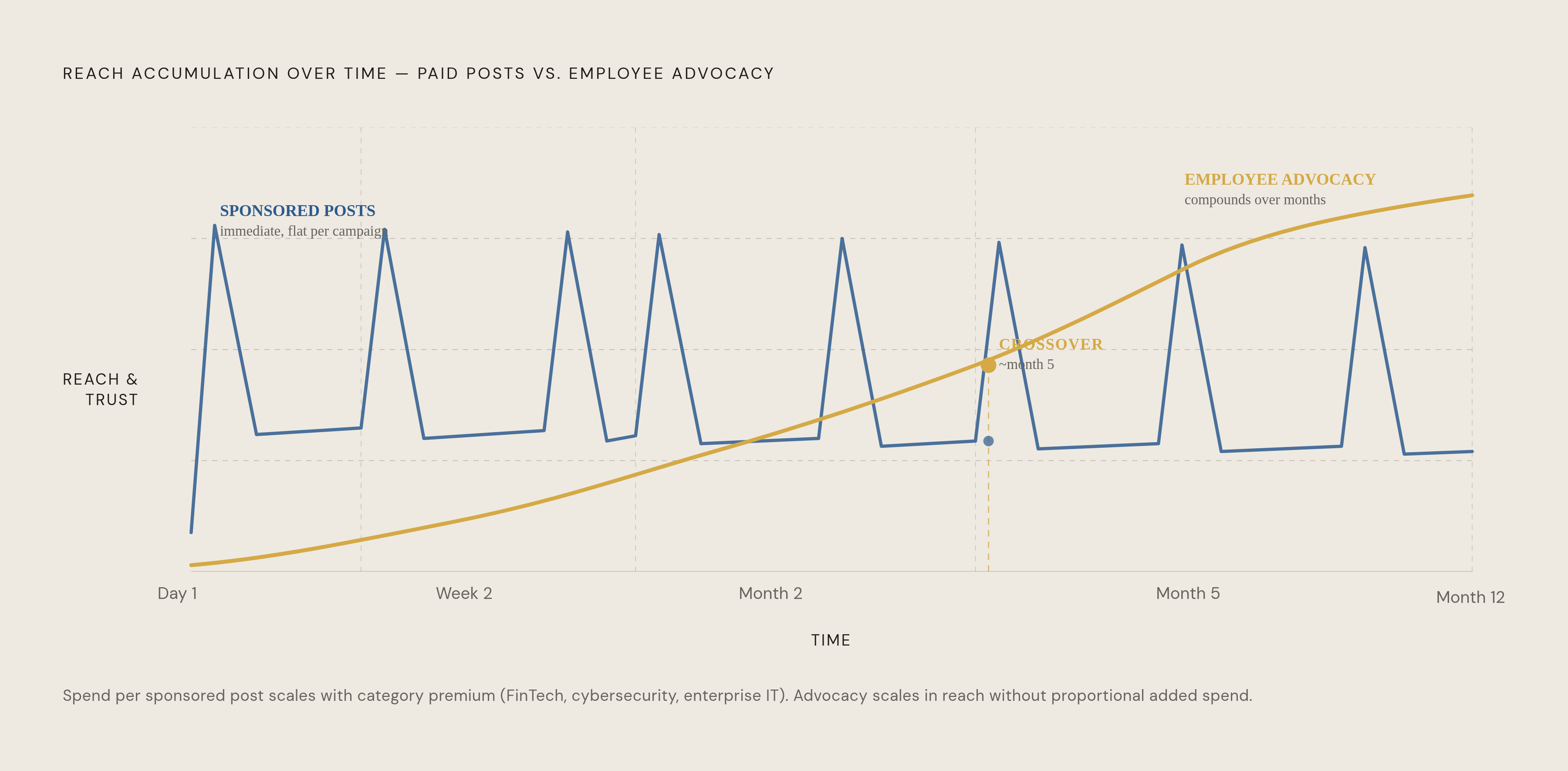
You can't measure sponsored creator posts and employee advocacy on the same cost-and-speed curve. Creator posts buy speed and precise targeting. Advocacy buys reach that builds on itself over time, at a lower cost per result, but only after a longer runway.
A paid creator campaign starts generating impressions on launch day. Advocacy takes weeks to build momentum, since it depends on employees growing their own audiences over time, but once that growth starts, it compounds in a way paid campaigns simply can't replicate. Targeting also splits cleanly down the middle: LinkedIn's Campaign Manager lets brands amplify a creator post by job title, company size, industry, and location, while advocacy only reaches whatever network an employee happens to have built, a network the brand has no control over.
The money works differently too. Creator sponsorships appear on the budget as a direct, predictable line item with a set rate per post. An advocacy program costs mostly time and tooling, and once it's running, it scales without needing proportionally more spend. Rates for creator sponsorships also vary by category: FinTech, cybersecurity, and enterprise IT carry real premiums, because the pool of credible creators with executive-level audiences in those fields is small.
The common mistake is treating advocacy as free simply because no invoice shows up for it. You pay for employee time, the tools used to produce and manage content, the people running the program, and the work those employees aren't doing while they write posts instead. Teams that skip this accounting tend to underestimate what advocacy actually costs and overestimate what it delivers, which sets up the next problem directly: neither strategy gets measured the same way, and measuring them the same way is how teams misjudge both.
Why measuring the two strategies requires fundamentally different approaches
LinkedIn's Revenue Attribution Report is built entirely around paid activity. Organic advocacy posts don't generate ad spend, so the tool has almost nothing to report about the pipeline those posts actually produce. A team running a founder-led advocacy program and relying on this report to judge results will consistently see a smaller number than the program actually delivered.
The tracking methods built for sponsored posts, click tracking, UTM parameters, Thought Leader Ad reporting, catch almost nothing from organic advocacy. A team using one measurement approach across both strategies will undervalue whichever one it evaluates second. Dark social makes this worse. Creator content on LinkedIn gets shared constantly into private Slack channels, email threads, and internal Notion pages, and there it reaches buying committee members who never clicked the original post and never will. Last-click attribution can't see any of that activity.
This is why a simple question in a demo request or trial signup form, "How did you first hear about us?", is the main way to catch the dark-social signal that click tracking misses by design. Favikon's B2B Creator Loop builds this reality into its structure: the re-strategy stage feeds results back into the first stage rather than acting as a final report, because creator programs produce results on a lag and a one-time measurement snapshot misses that pattern. Naano attributes clicks, leads, and pipeline back to the specific post that generated them, so sponsored creator campaigns get the same attribution standard other B2B acquisition channels already have. The space between what a platform like that can measure and what an unstructured advocacy program can measure makes its own case for why infrastructure matters here.
Creator selection mechanics that make sponsored posts work for B2B buyers specifically
What decides whether a sponsored post works is how closely that creator's audience overlaps with the people who actually sit on the brand's buying committee, not the creator's follower count. A small, well-matched audience beats a large generalist one on every metric that matters commercially.
Engagement rate makes the case against chasing big numbers better than anything else. A creator with a smaller but highly engaged following in the right category outperforms a creator with a much bigger audience that isn't paying close attention. Favikon's framework reflects this by starting with customer research, not creator research: figure out who sits on the buying committee first, then build a shortlist of creators against that profile, rather than starting from a list of big names and working backward.
Vetting has to go past the follower count and into engagement rate, professional credibility within the category, and the makeup of the audience by job title and seniority. A creator whose followers hold the right job titles but the wrong seniority level is still a miss, even if every other number looks good. Naano's discovery tools are built around this exact problem: its creator network across AI, SaaS, sales, and founder communities is organized by audience fit rather than raw follower volume, turning the ICP-first selection logic described above into something searchable instead of something a team has to piece together by hand.
The operational complexity that stops most B2B teams from scaling either strategy
Most B2B teams run one creator campaign, see decent results, and stop there. The operational weight of briefs, contracts, compliance, and payouts piles up faster than most marketing teams can handle.
Brief design is harder than it looks. LinkedIn's algorithm rewards posts that spark real comments, so a brief needs to build in room for an actual point of view, a claim someone might push back on, a data point worth arguing with, instead of safe, promotional language that reads like a press release. Disclosure adds another layer of complexity. If you put #ad or #sponsored before the hook of a post, engagement tends to drop, because professional audiences skip past anything they immediately recognize as an ad. The brief has to specify that the disclosure goes after the hook, within the first three lines, to stay both compliant and effective.
Payouts become a bottleneck sooner than most teams expect. You can manage invoices, tax paperwork, and payment timing across a handful of creators. Across a dozen or more, the administrative load grows in a straight line with the size of the program, and most marketing teams aren't staffed for that kind of operations work. The friction here is operational: vetting creators by audience fit, managing briefs, handling contracts, and tracking which posts actually generate pipeline typically means manual coordination across a pile of separate tools. Platforms built specifically for B2B creator campaigns, Naano among them, match creators to buyer profiles before launch and automate everything from brief creation to payout, which is what lets a team go from finding a creator to a live post in days instead of weeks, and it's the difference between a program that stalls after two or three campaigns and one that runs as a repeatable channel.
When to run sponsored creator posts versus advocacy
The strongest B2B LinkedIn programs don't pick one strategy over the other. They give each one the job it's actually suited for, run both at once, and let each one make the other work harder.
Sponsored creator posts make sense when speed matters, say a product launch, an event, or a narrow competitive window where timing is the whole game. They also make sense when you need precise targeting, since Thought Leader Ads let you reach specific job titles and company sizes directly. And they make sense when a brand needs to borrow trust it hasn't earned yet, reaching people who don't know the company through a voice those people already follow and believe.
Employee and founder advocacy makes sense when the goal is reach that builds over months instead of days, when a company has real expertise worth putting in front of people, or when the real objective is raising the baseline credibility of an entire category, since that baseline is what makes sponsored content land harder later on. Run together, the two reinforce each other directly: creator posts bring new audiences into contact with the brand for the first time, employee content deepens the relationship with people already somewhere in the funnel, and together they build trust across the whole buyer journey.
The data backs this pattern up. Favikon's research found that most companies running LinkedIn creator campaigns treat them as a systematic growth channel rather than a one-off experiment, and Dentsu's Superpowers Index found that influencer marketing is now the fastest-growing driver of B2B purchase decisions, with nearly two-thirds of buyers citing influencers somewhere in their most recent purchase. Most teams still don't have the infrastructure to run creator campaigns at that scale. Sponsored posts and employee advocacy have grown up side by side as two answers to the same algorithm shift. If a platform handles creator discovery by ICP fit, campaign launch, full program management, and pipeline attribution, it gives a marketing team the infrastructure to run sponsored creator work as a repeatable channel next to whatever advocacy program is being built internally. Naano fits that role as the operational layer that makes the sponsored side scale, not a replacement for either strategy.
The decision comes down to timeline and what's already being measured. If you need results in four to eight weeks, go with sponsored creator posts through a vetted marketplace. If you're building toward growth that compounds over a year, invest in founder and employee advocacy now, and let sponsored posts carry near-term pipeline in the meantime. And if neither strategy is being measured against pipeline today, you need to fix attribution before another dollar goes toward either one.